The Hill of Tara is a site of immense historical and mythological significance in Ireland.
Here's a breakdown of its history:
Ancient Origins:
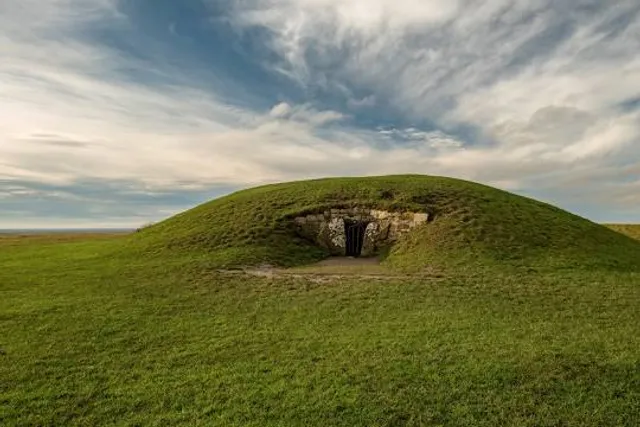
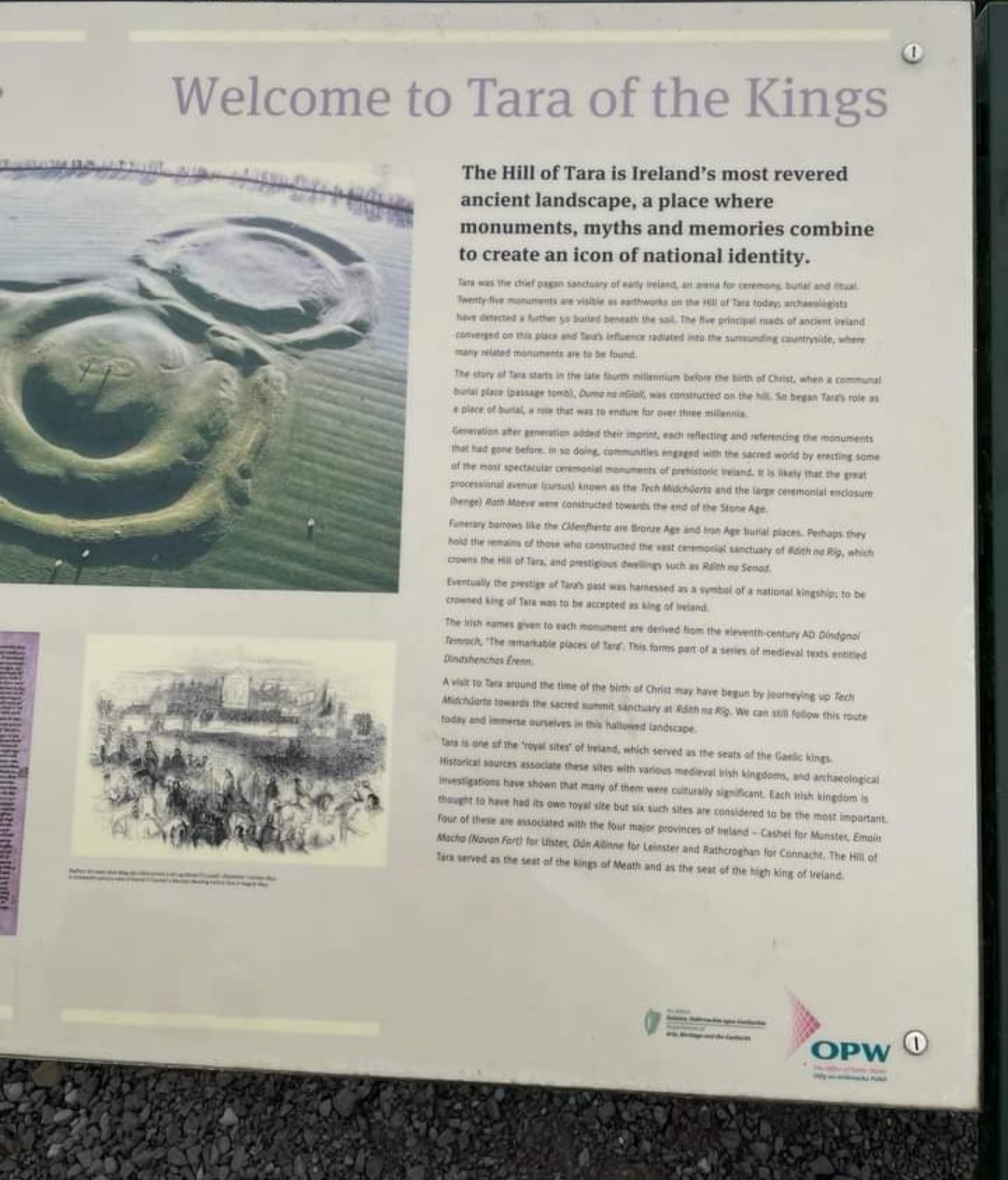
Prehistoric Significance : The Hill of Tara has been a place of importance since the Neolithic period, with evidence of activity dating back to the late Stone Age. This is shown by the presence of passage tombs, such as the Mound of the Hostages.
It gained prominence during the Iron Age and into the Early Christian period.
Mythological Importance:
In Irish mythology, Tara was considered a sacred place, believed to be the dwelling of gods and an entrance to the Otherworld.
It's strongly associated with the Tuatha Dé Danann, a supernatural race in Irish mythology.
Seat of the High Kings:
Tara is traditionally known as the seat of the High Kings of Ireland. It's said that many kings reigned there.
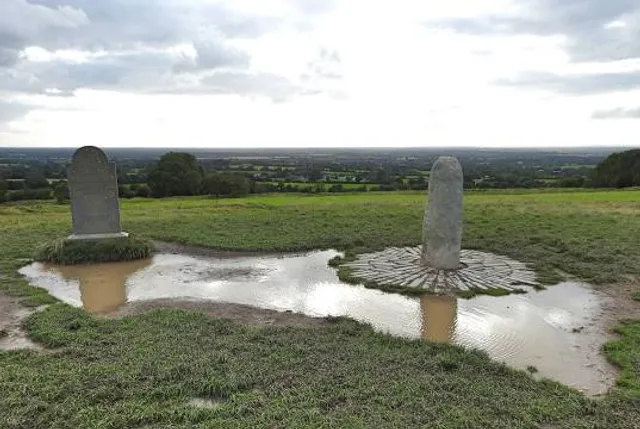
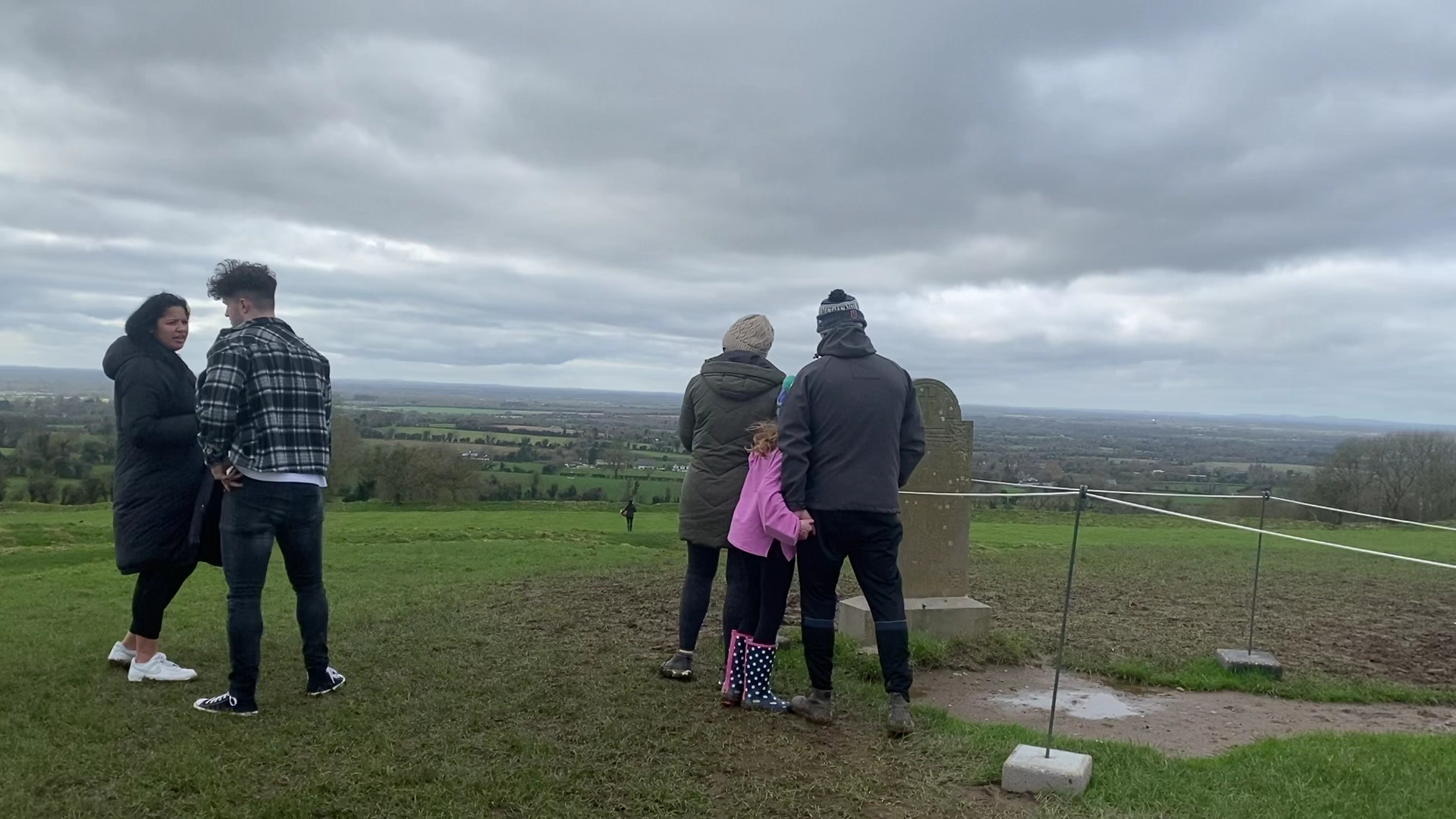
The Lia Fáil, or "Stone of Destiny," is a significant feature, believed to have been used in the coronation of these kings.
Historical Developments:
Early Christian Period:
St. Patrick is said to have visited Tara to confront the pagan King Lóegaire, marking a significant moment in the Christianization of Ireland.
Later History:
Despite the decline of its political importance, Tara remained a symbol of Irish identity.
In 1798, during the Irish Rebellion, the Hill of Tara was the site of a battle between Irish rebels and British forces.
Modern Day:
Today, the Hill of Tara is a popular tourist destination and a national monument, attracting visitors interested in its rich history and mythology.
Key Features:
Mound of the Hostages: A Neolithic passage tomb.
Ráith na Rí (Royal Enclosure): A large earthwork enclosure.
Lia Fáil (Stone of Destiny): A standing stone believed to have been used in coronations.
Banqueting Hall: The remains of a large ceremonial avenue.
In essence, the Hill of Tara is a layered site, with evidence of continuous human activity spanning thousands of years. It holds a unique place in Irish history and mythology, representing both ancient spiritual beliefs and the historical seat of power.
🔥
The Hill of Tara, with its deep historical and mythological roots, is a place where many people report feeling a strong sense of connection to the past, and some even describe having mystical experiences. Here's what contributes to this:
Ancient Spiritual Significance:
The Hill of Tara was a sacred site for pre-Christian Ireland, believed to be a dwelling place of gods and a gateway to the Otherworld. This long history of spiritual use can create a sense of lingering energy.
The presence of ancient monuments like the Mound of the Hostages, a Neolithic passage tomb, adds to the feeling of being connected to a distant and mystical past.
Mythological Associations:
The strong association with Irish mythology, including the Tuatha Dé Danann and the High Kings of Ireland, imbues the site with a sense of magic and wonder.
For those familiar with these myths, visiting Tara can feel like stepping into a living story.
Sense of Place:
The panoramic views from the Hill of Tara, overlooking the Irish countryside, can create a feeling of awe and connection to the land.
The quiet atmosphere and the sense of history can be conducive to contemplation and introspection.
Personal Interpretation : Whether or not someone has a "mystical" experience is often a matter of personal interpretation.
For some, simply being in a place with such a rich history and spiritual significance can be a powerful and moving experience. Therefore, while not everyone will have a clearly defined "mystical" experience, it's certainly a place where many people feel a strong sense of connection to the past and a...
Read moreBeautiful ancient greenfield megalithic sacred site, which boasts astounding views of the Irish landscape. It has been a symbol of Irish sovereignty & indigenous culture for millennia. The Hill of Tara and it's surrounding landscape are one of the 5 main sacred 'Royal' sites of ancient Ireland (Tara, Rathcroghan in the West, co Roscommon, Uisneach, centre in Co. Westmeath, Navan Fort or Eamhain Macha in Ulster, and Caravel in the south in Co. Cork). These sites were associated with kingship inaugurations in the medieval period, and all have mythological and folkloric associations that stretch back millennia. They all also sport astounding 'trick of the landscape' views over extensive swathes of the Irish landscape.
The legendary medieval high king Brian Boru (Briain Boruimhe) used the ancient reputation and symbolic power of Tara to try to unite the patchwork of tribal clan based kingdoms in Ireland into one nation, to strengthen & preserve the ancient Irish culture & ways of life in a Europe that was tending towards centralisation. He almost succeeded, but was killed in his tent by a Viking slave boy while he was praying, at the Battle of Clontarf in 1014.
Daniel O'Connell (dubbed the 'Father of Modern Ireland') held one of his famous "Monster Rallys" here on the Hill of Tara, and the United Irishmen hid out on the hill for a few months.
In 2007-2009, there was a Vigil Camp on the hill of Tara, where many people tended a sacred fire, to support a grassroots resistance movement and many different campaign groups who were trying to have a section of the M3 motorway re-routed out of the Gabhra valley and away from the sensitive landscape around the Hill of Tara. This movement was supported by the Discovery program & archaeologists in the department of Archaeology in NUIGalway. This was a contentious issue, which encountered & raised political corruption and the shadowy property development & speculation practices which haunted the 'Celtic Tiger' economy, which led to the fall of the government, and banking crash of 2008 & much declaimed nationalisation of bank debt. National Monuments of international significance were bulldozed overnight (Baronstown), and Lismullen Henge, a very rare and unique form of henge structure (being situated in a hollow rather than on a prominence, and appearing to function as an ampitheatre), was discovered & destroyed without proper EIS procedures.
No-one has ever lived on the of the hill; the site of the early modern village of Tara is now occupied by Slevins bookshop (full of old rare books), Courtney Davis art & crystal shop, & Macguires coffee & gift shop.
This site has been in continuous use & ceremonial activities continue today... you will find gatherings, sacred circles & many wise people here, especially on full moons or ancient pagan festivals. The phenomenons of intervisibility & astronomical alignment are very apparent in the Irish megalithic landscape & the Hill of Tara is a wonderful example & entry point to study of this.
The Hill of Tara attracts c.200,000 visitors a year... any fine evening or weekend you will find many people here, running, bringing children, taking tours, walking dogs, meeting friends etc & enjoying the site. Sometimes you might come across a Harper or other musicians amongst the mounds or woods, playing music or seeking inspiration. There are many knowledgeable people to be found here, in the shops, giving tours, or Just...
Read moreFull disclosure: Tara is one of my favourite places in the world. I've been coming here since I was a child, and if you're visiting with kuds one of the great joys in life as a youngster is to run up and down the ramparts and earthworks. Tara is both a place of natural beauty, with unparalleled views on a clear day, huge natural energy and plenty to explore AND one of the most important historical and cultural sites in Ireland. Unlike many sites, it's free and open - no need to go through a gatekeeper or visitors centre (although a tour guide can definitely enhance your visit if new to Tara) There are several key points, the Lia Fail (stone of destiny) The old church (COI originally) now visitor exhibition and its graveyard, the various mounds each with important history and archaeology and the Witch Trees. These latter are identifiable by the many "ribbons" tied to their branches. One is currently lying after a storm. PLEASE note : tying cloth to a tree is one thing. Modern plastic ribbons are another. Chains and metal items, face masks, and the very worst - embedding coins in the trees themselves - is NOT LUCKY. In fact it's hard to imagine a more offensive and unpleasant way to treat a beloved pary of Tara. Fair warning: people will often remove your rubbish and curse you roundly while doing so :) There's a fab cafe/shop at the carpark, very friendly helpful staff. Lots of variety in books from academic to absolutely bonkers! Lots of choice too in little souvenirs. Tara is a great day out, be prepared for the weather but get out on the...
Read more