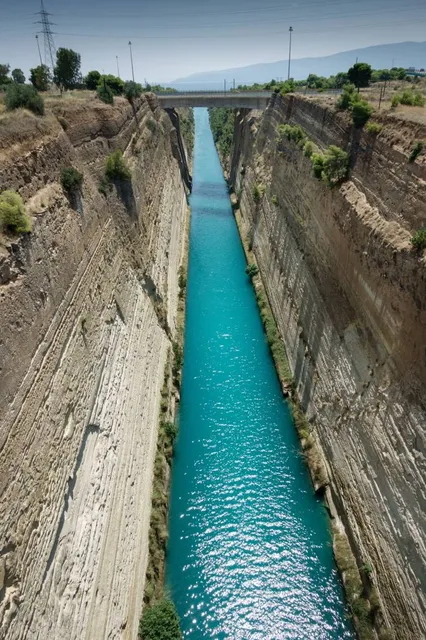
Corinth Canal | The World's Most Useless Man-Made Wonder 🚢
🚗 When driving from Athens to the Peloponnese Peninsula, you'll inevitably pass by a special attraction—the Corinth Canal. It was excavated between 1881 and 1893, spans 6.3 kilometers, connects the Ionian Sea with the Aegean Sea, and separates the Peloponnese Peninsula from the Greek mainland. 🅿️ After crossing the canal via the highway bridge, turn left at the intersection a hundred meters west of the bridge and you'll find a free parking lot. Next to it, there's a burger joint and a snack bar, and a large supermarket a few dozen meters away, making it a perfect stop for a break and supplies. 👀 Standing on the bridge and looking down, you'll see the sheer rock walls on both sides, dropping eighty to ninety meters to the water's surface, with the steep stone cliffs being very spectacular. The Corinth Canal is geologically part of a plateau, with an average altitude of over 90 meters. The difficulty of excavating a canal through the rock massif is imaginable. Thus, it is the world's deepest canal and one of the few canals excavated in hard rock. 🤷🏻♂️ However, this canal, which cost a fortune to excavate, is now known as the world's most useless canal 🤣 1️⃣ After the 20th century, with the rapid development of maritime trade, the tonnage of ships increased rapidly. Today's oil tankers and container ships are often over 200,000 tons, and the Corinth Canal has a water depth of only 8 meters and a surface width of just 24 meters, which can no longer support such sizes. 2️⃣ The stone walls on both sides of the Corinth Canal become fragile after weathering, leading to frequent collapses and landslides that threaten passing ships. 3️⃣ Looking at Greece itself, including the capital Athens, the second-largest city, and the largest port, are all located to the east of the canal. Their materials do not need to pass through the Corinth Canal to reach the less developed west, which further reduces the utilization rate of the canal. ⛴️ Today, the canal has become a popular travel destination, with about 30 ships passing through daily, mainly cruise ships. Traveling between the steep cliffs is a unique experience. 🏺 Additionally, the ancient Corinth, located 6 kilometers southwest of the Corinth suburbs, is well worth a visit for history enthusiasts. 🛕 The ancient Corinthian city-state flourished for over 600 years after the Mycenaean civilization and holds an important place in Greek history and culture. The ancient Corinthian city-state no longer exists, but the ruins from that time remain. 🧿 The most famous site in the ruins is the Temple of Apollo, a grand Doric-style building dating back to the 5th century BC, which predates other Roman-era structures. Other noteworthy places to visit include the marble platform, the Caesar's Basilica, the Peirene Fountain, the ancient theater outside the west side of the site's main gate, and more. Additionally, the ancient Corinth archaeological museum within the ruins houses a vast collection of historical artifacts, so be sure to go inside. 🎫 Admission is 6 Euros. #OffTheBeatenPath #BeautifulSceneryOnTheWay #GreeceTravel #GreeceTourism #Corinth #CorinthCanal #Peloponnese #GreekTemple #AcropolisOfCorinth #IonianSea #GreeceRoadTrip