

HTML SitemapExplore

Visiting the Ancient Ruins of Teotihuacan

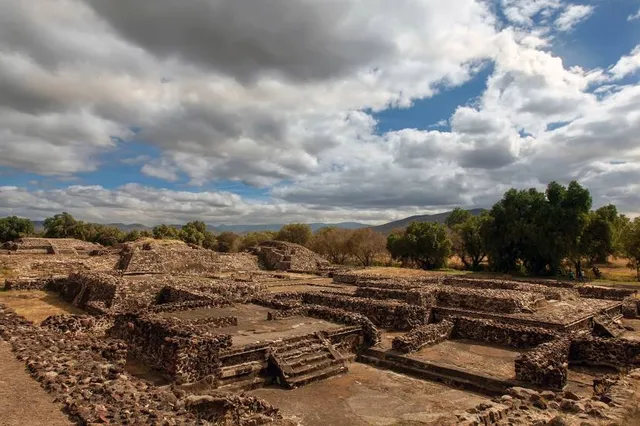
Just as one cannot claim to have visited China without seeing the Great Wall, a trip to Mexico would be incomplete without exploring the ancient ruins of Teotihuacan. Inscribed on the UNESCO World Heritage List in 1987, Teotihuacan's iconic Pyramid of the Sun (Pirámide del Sol) and Pyramid of the Moon (Pirámide de la Luna) stand as magnificent testaments to this ancient civilization.🎨 Located on the eastern side of the Avenue of the Dead, the Pyramid of the Sun was constructed around the 2nd century AD. As the world's third largest pyramid and Teotihuacan's most massive structure, it features a square base measuring 225 by 222 meters, with five tiers rising 63 meters high. This colossal edifice, with a volume exceeding 1 million cubic meters, was built using 2.5 million tons of earth and gravel beneath its vibrantly carved volcanic stone exterior. Unfortunately, during 20th century restoration work, architect Leopoldo Batres added an extra tier between the original fourth and fifth levels and reconstructed three exterior walls, somewhat altering the pyramid's original appearance.✨ 🌊The Pyramid of the Sun holds many unsolved mysteries. In 1971, explorers discovered that a tunnel accessed through a western cave leads to a massive chamber at the pyramid's exact center, comprising four interconnected rooms. Besides ritual artifacts and mirrors found within, the complex stone drainage system revealed inside demonstrates astonishing engineering sophistication. Remarkably, during the spring and autumn equinoxes at noon, a straight shadow appears on the pyramid's western first tier, lasting exactly 66.6 seconds - earning it the nickname "the eternal clock."🌊 The Pyramid of the Moon, situated at the northern end of the Avenue of the Dead, was built about 200 years after its solar counterpart. With base dimensions of 150 by 120 meters and four tiers standing 46 meters tall, this 380,000-cubic-meter structure used approximately 1 million tons of earth and gravel beneath its ornate exterior. Though smaller in scale, its construction displays greater precision, with over 200 steps each featuring unique angles of inclination. The expansive Plaza de la Luna before the pyramid houses the beautiful Palace of the Quetzalpapálotl (Butterfly Bird), another significant Teotihuacan relic.💙✨ #Teotihuacan #PyramidOfTheSun #PyramidOfTheMoon #AncientMexico
Related posts
Mexico City Must-Visit: Jumex Museum of Contemporary Art 🎨🔥Frida Kahlo MuseumPerfect Encounter of Desert and Sea🇲🇽 Hidden Gem Alert – Mexico City is Full of Surprises! ✨Solo Walk at Mexico City’s Zócalo 📸 🌮☀️ HUSET - The Most Instagrammable Open-Air Restaurant in Roma Norte
Brittanie jack
Brittanie jack
6 months ago
Brittanie jack
Brittanie jack
6 months ago
no-comment

No one has commented yet...

Visiting the Ancient Ruins of Teotihuacan

Just as one cannot claim to have visited China without seeing the Great Wall, a trip to Mexico would be incomplete without exploring the ancient ruins of Teotihuacan. Inscribed on the UNESCO World Heritage List in 1987, Teotihuacan's iconic Pyramid of the Sun (Pirámide del Sol) and Pyramid of the Moon (Pirámide de la Luna) stand as magnificent testaments to this ancient civilization.🎨 Located on the eastern side of the Avenue of the Dead, the Pyramid of the Sun was constructed around the 2nd century AD. As the world's third largest pyramid and Teotihuacan's most massive structure, it features a square base measuring 225 by 222 meters, with five tiers rising 63 meters high. This colossal edifice, with a volume exceeding 1 million cubic meters, was built using 2.5 million tons of earth and gravel beneath its vibrantly carved volcanic stone exterior. Unfortunately, during 20th century restoration work, architect Leopoldo Batres added an extra tier between the original fourth and fifth levels and reconstructed three exterior walls, somewhat altering the pyramid's original appearance.✨ 🌊The Pyramid of the Sun holds many unsolved mysteries. In 1971, explorers discovered that a tunnel accessed through a western cave leads to a massive chamber at the pyramid's exact center, comprising four interconnected rooms. Besides ritual artifacts and mirrors found within, the complex stone drainage system revealed inside demonstrates astonishing engineering sophistication. Remarkably, during the spring and autumn equinoxes at noon, a straight shadow appears on the pyramid's western first tier, lasting exactly 66.6 seconds - earning it the nickname "the eternal clock."🌊 The Pyramid of the Moon, situated at the northern end of the Avenue of the Dead, was built about 200 years after its solar counterpart. With base dimensions of 150 by 120 meters and four tiers standing 46 meters tall, this 380,000-cubic-meter structure used approximately 1 million tons of earth and gravel beneath its ornate exterior. Though smaller in scale, its construction displays greater precision, with over 200 steps each featuring unique angles of inclination. The expansive Plaza de la Luna before the pyramid houses the beautiful Palace of the Quetzalpapálotl (Butterfly Bird), another significant Teotihuacan relic.💙✨ #Teotihuacan #PyramidOfTheSun #PyramidOfTheMoon #AncientMexico

Mexico City
Teotihuacan Mexico
Teotihuacan MexicoTeotihuacan Mexico