It is said that this sthala Emperumaan is kept in the Agraharam (Where all Vaishnavas live in a some place all together) in Vithukodu and after sometime, he is changed to this place. This sthalam also explains about the unity of Vaishnavam and Saivam.
As soon we enter this sthalam, we can see a separate sannadhi for Lord Shiva and behind this is the Sannadhi for Uyyavantha perumal.
This sthala perumal is also called with the name "Abhaya pirathan" giving his seva and protecting (Abhayam) his bhaktas. It is said that this sthala perumal is said to be same as the amsam of Lord Shiva with the name "Aabhathsagaayar". (Abhath means danger and Sagaayar means person who helps at the time of danger).
This sthala perumal gave his prathyaksham for Ambhareeshan. Ambhareesh is the son of Nabhakanan and who is a great king. He was a great Vishnu bhakta and once he did a tapas against Vishnu and at that time, Emperumaan Sriman Narayanan came there as "Devendran Indiran". Seeing Devendran, Ambhareeshan told that he didnt do the tapas to see Indra, he did that to get the dharshan of Sriman Narayanan. On hearing this, the Emperumaan seeing his bhakti towards him, showed his original roopan and gave him lots of Varams.
Once, Ambhareeshan did fasting (Viradham) towards Emperumaan on all EkAdasi. He gave 60 cows and after Ekaadasi, he finishes the Viradham by doing Paarayanam (devoting the perumal and then eating) on Dvadasi. Same way, once he did this Viradham and was waiting for some Narayana Bhaktas, so that he may give them the food and then he can eat. At that time, he saw Duruvaasa, Duruvaasa said that he will accept the food from Ambhareeshan after bath. So, he went to Kalathi river and asked Ambhareeshan that he should finish the fasting only after he comes. Duruvaasa muni went to the river for bathing but didn't come up till the end of Dvadasi. But, Ambhareeshan had to finish the Viradham by taking some food (or) water. At the end time of Dvadesi, Ambhareeshan could not wait for Duruvaasa Muni and took some water and finished the Viradham.
On seeing this, Duruvaasa muni got angry on him and sent an arakkan (demon) to kill. But, Ambharees with the help of Vishnu chakkaram killed the Arakkan. Duruvaasa muni felt bad for his act and blessed Ambhareesh.
Ambhareesh asked this sthala perumal that he should get the dharshan of the perumal in Viyugha Avathaar (perumal should be seen in all the directions) and as requested by Ambhareesh, this sthala perumal, Uyyavantha perumal gives his seva in all the 4 directions. The perumal in the center is worshipped by Dharma, the west directional perumal is worshipped by Arjuna, the left side perumal is worshipped by Bheema and the perumal in the right side is worshipped by Nakula and Sahadeva. So, this perumal is worshipped by all the Panja Pandavas and it is one of the historical issue that is explained.
And this sthalam is said to be the Mukthisthalam of Ambhareesh.
There is some similar issues that is found to be common with this divyadesam and Thiruchitrakooda divyadesam. In both these divya desam, the perumal is found in Vyuha avatar by giving their seva in Nindra Thirukkolam in this sthalam and pallikonda thirukkolam in Thiruchitra koodam. In both of this sthalam, the perumal is said to be the amsam of Lord Shiva and Thiruchitrakoodam is said to have the relation with Ramayan and this sthalam is said to have the relation with Mahabarath.
In Thiruchitrakoodam, Thirumangai alwar does the Mangalasasanam of the perumal using Sankara barana Ragam and likewise this sthala perumal is done the Mangalasasanam by Kulasekara Alwar with the same sankara...
Read moreAnother temple Destroying bye Govts, Useless Hindus, communist Hindus and Abrahamic arab religious believers.
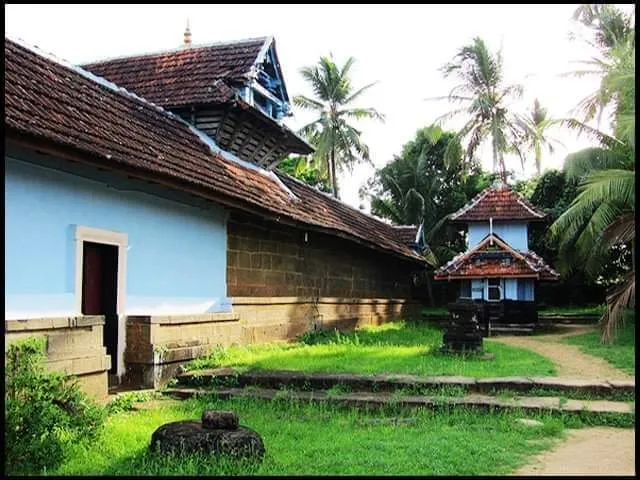
Uyyavandha Perumal Temple at Thirumittacode is one of the oldest temples in Kerala. It is about 4 kilometers from Pattambi, a small town in the Palakkad district of Kerala.
Thirumittacode Anju Moorthy Temple
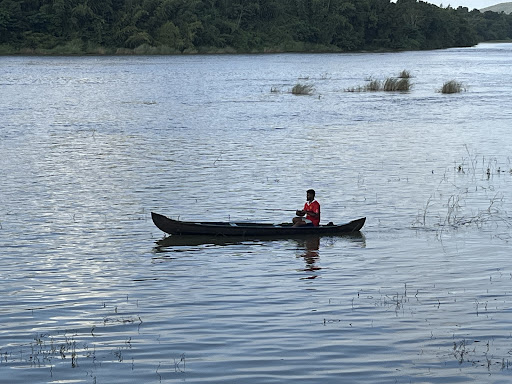
The temple situated on the banks of River Nila (aka Bharatapuzha) is famous for its brilliant mural paintings that adorn the walls of its sanctum. The murals depict scenes from the epics. Sadly, many of these paintings are now in a state of ruin. The colors have faded and the drawings have become unclear. Still, they don’t fail to captivate the attention of devotees.
Thirumittakode temple is only about 2 kilometers from Nhangattiri Bhagavathy Temple. There is a short cut along the river to reach Thirumittakode Temple from Nhangattiri Bhagavathy Temple.
Architecture and Temple layout
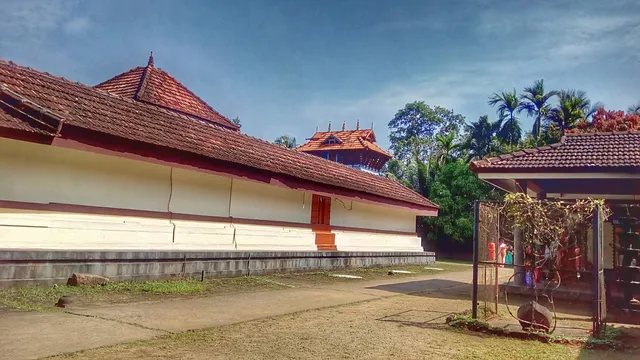
The inner sanctum houses two shrines. The first shrine that one sees after entering the sanctum is dedicated to Lord Shiva. Behind this shrine is another shrine dedicated to Uyyavandha Perumal (The lord who gives salvation – Vishnu). The Vishnu shrine stands on an elevated platform and devotees have to climb the steps behind the Shiva Shrine to reach the Vishnu shrine. Both shrines have walls adorned with beautiful mural paintings and carvings.
The huge banyan trees standing in front of the Thirumittacode Anju Moorthy Temple
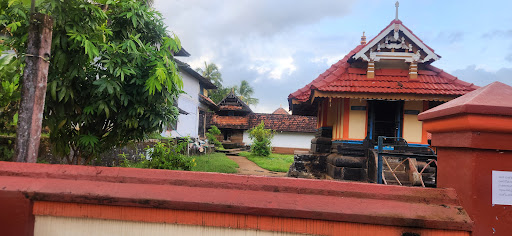
Outside the Sanctum there are shrines dedicated to Lord Ganapathy (Ganesh), Dakshinamurthy (The Lord of the South) and Goddess Durga. These small shrines are what you see when you enter the temple premises. It is believed that the five idols of this temple were installed by the 5 Pandavas. According to another popular legend, it was here that Lord Vishnu gave his darshan to his ardent devotee King Ambarisha.
Popular legends associated with this temple are related to Pandavas of the epic Mahabharatha. They are said to have visited this place during their life in exile and found the area quite beautiful and secluded. So, they decided to stay here and perform penance. Each one of them installed five idols of Vishnu. The idol seen inside the sanctum is believed to have been installed by Arjuna. The other four installations are outside the sanctum.
The Thirumittakode Temple is also blessed with the presence of Lord Shiva. According to a popular legend, a sage who lived here had gone to Kashi (Banaras) to offer prayers to Lord Shiva or Kashi Viswanathan. Shiva was pleased with his ardent devotion and followed the sage hiding in his umbrella on his return journey from Kashi. When he reached Thirumittakode, the sage decided to take a bath in the Bharatapuzha. He left the umbrella on the river banks and took a dip in the river. When he returned to the place where he had put the umbrella, he found a Shiva Lingam instead. Thereafter a shrine was constructed here in honor...
Read moreThirumittakode Anchumoorthi Temple: திருவித்துக்கோடு
Also called Thiruvithuvakoodu In this temple the deities Vishnu and Shiva are equally associated. Temple is situated on the banks of the Bharathappuzha at Thirumittacode. The five statues – one for Shiva and four Vishnu – are known here as Thirumattikodu five (Anchu) Moorthy Temple.
As a Shiva temple, it is regarded as 108 Shivalayam of Shaivas and is installed by sage Parasurama dedicated to Shiva. Constructed in the Kerala style of architecture, It is one of the 108 Divyadesam (by Kulasekara Alvar.) dedicated to Vishnu, who is worshipped as Uyyavandha Perumal and his consort Lakshmi as Vithuvakootuvalli.
The Thiruvonam festival and the Vaikunta Ekadasi during the month of Thai are the major festivals celebrated in the temple.
The temple is open from 4 am to 11 am and 5 pm to 8 pm and is administered by Travancore Devaswom Board.
There is another myth in the place, Kasi Viswanathan, a Brahmin who came back after visiting the Kasi darshan, in this temple.
As per Hindu legend, both an elephant and Lakshmi, the consort of Vishnu were worshiping Vishnu with lotus flowers. Once all the lotus flowers were taken away by Lakshmi making Gajendra, the elephant to pray to Vishnu. Vishnu gave a boon to Lakshmi to be along with him and let the whole lotus garden be taken up by Gajendra. The place is a Mumurthi Kshetra as the Trinity of Hinduism, Shiva, Vishnu and Brahma are worshiped here.
Hindus perform last rites on the banks of the river in the temple similar to that of Varanasi.
There are five shrines in the temple, one each of Shiva, Vishnu as Abhayapradhan, Vithuvakootuvalli, Vinayaga and Ayyappan.
During Mahabharata period, the Pandavas built the temple here. Arjuna established the temple and this is standing as Moolavar, main deity here.
It is also said that the Ayodya king Ambareeksha got moksha at...
Read more