Alchi Monastery or Alchi Gompa is a Buddhist monastery, known more as a monastic complex (chos-'khor) of temples in Alchi village in the Leh District, of the Indian state under the Ladakh Autonomous Hill Development Council of Jammu and Kashmir. The complex comprises four separate settlements in the Alchi village in the lower Ladakh region with monuments dated to different periods. Of these four hamlets, Alchi monastery is said to be the oldest and most famous. It is administered by the Likir Monastery.13]
Alchi is also part of the three villages (all in lower Ladakh region) which constitute the ‘Alchi group of monuments’; the other two villages adjoining Alchi are the Mangyu and Sumda Chun. The monuments in these three villages are stated to be of "unique style and workmanship’, but the Alchi monastic complex is the best known.[1
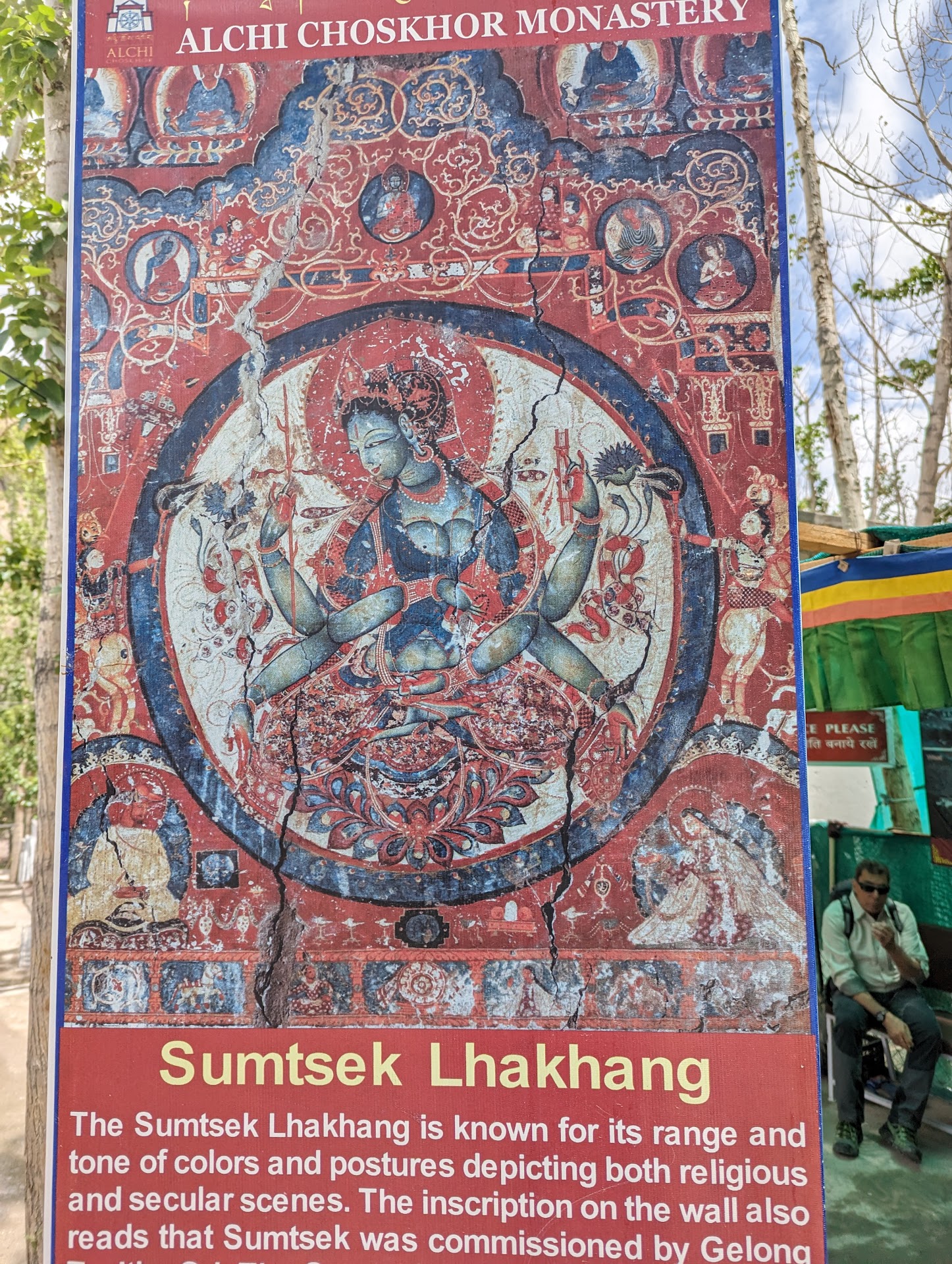
The monastery complex was built, according to local tradition, by the great translator Guru Rinchen Zangpo between 958 and 1055. However, inscriptions in the preserved monuments ascribe it to a Tibetan noble called Kal-dan Shes-rab later in the 11th century.2 Dukhang or Assembly Hall and the Main Temple (gTsug-lag-khang), which is a three-storied temple called the Sumtseg (gSum-brtsegs), are built in Kashmiri style as seen in many monasteries; the third temple is called the Manjushri Temple ('Jam-dpal lHa-khang). Chortens are also an important part of the complex.1
The artistic and spiritual details of both Buddhism and the Hindu kings of that time in Kashmir and Himachal Pradesh are reflected in the wall paintings in the monastery. These are some of the oldest surviving paintings in Ladakh. The complex also has huge statues of the Buddha and elaborate wood carvings and art-work comparable to the baroque style.2 Shakti Maira has vividly explained the beauty of this small monastery.6]
The history of the monuments in the Alchi complex and in the other two villages in the Alchi group is not precise, in spite of many inscriptions and texts displayed on the walls.[27]
Traditionally, the creation of the Alchi complex is attributed to the famous scholar-translator Rinchen Zangpo (958–1055) in the 10th century, along with the Lamayuru Monastery, the Wanla, the Mang-gyu and the Sumda. During the tenth century, the Tibetan King Yeshe Od of Guge, in order to spread Buddhism in the Trans Himalayan region, took the initiative by allocating 21 scholars to the region. However, due to harsh climatic and topographic conditions, only two survived, one of them the esteemed scholar and translator Rinchen Zangpo who established Buddhist activity in the Ladakh region and other areas of India including Himachal Pradesh and Sikkim. During his sojourn there, he also went to the neighbouring countries of Nepal, Bhutan and Tibet. Zangpo became known by the epithet "Lohtsawa" or the "Great Translator"; he is credited with building 108 monasteries in the trans-Himalayan region in his quest to disseminate Buddhism. He institutionalized Buddhism in the region; these monasteries are considered the mainstay of Vajrayana of Tibetan Buddhism (also known as Lamaism). Zangpo engaged Kashmiri artists to create wall paintings and sculptures in the legendary 108 monasteries; only a few of these have survived, with the Alchi Monastery complex in Ladakh having pride of place among all monasteries that he built.[2[9]
Since the monasteries of this period did not belong to any of the established Tibetan schools, they were initially brought under the control of the Kadampa order. When the condition of the monasteries deteriorated, they were mostly taken over by the Gelukpa order, with the exception of Lamayuru which was placed under the Drigunkpa sect. After worship at Alchi monastery ceased for some reason in the fifteenth century, it also became under the Gelugpa sect controlled...
Read moreThe monastery complex was built, according to local tradition, by the great translator Guru Rinchen Zangpo between 958 and 1055. However, inscriptions in the preserved monuments ascribe it to a Tibetan noble called Kal-dan Shes-rab later in the 11th century.Dukhang or Assembly Hall and the Main Temple (gTsug-lag-khang), which is a three-storied temple called the Sumtseg (gSum-brtsegs), are built in the Kashmiri style as seen in many monasteries; the third temple is called the Manjushri Temple ('Jam-dpal lHa-khang). Chortens are also an important part of the complex.
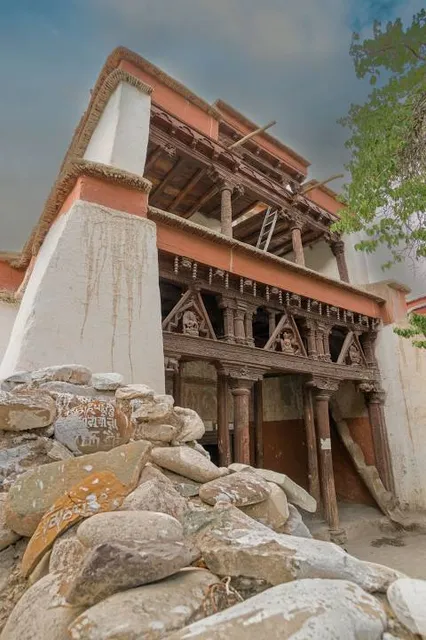
The artistic and spiritual details of both Buddhist and the Hindu kings of the time in Kashmir and Himachal Pradesh are reflected in the wall paintings in the monastery. These are some of the oldest surviving paintings in Ladakh. The complex also has huge statues of the Buddha and elaborate wood carvings and art-work comparable to the baroque style.Shakti Maira has vividly explained the beauty of this small monastery.
The history of the monuments in the Alchi complex and in the other two villages in the Alchi group is not precise, in spite of many inscriptions and texts displayed on the walls.One inscription refers to the foundation of the monastery by a king and a queen, who may appear in the royal drinking scene from the murals at the entrance of the Dukhang, and dated to circa 1200 CE.
Traditionally, the creation of the Alchi complex is attributed to the famous scholar-translator Rinchen Zangpo (958–1055) in the 10th century, along with the Lamayuru Monastery, the Wanla, the Mang-gyu and the Sumda. During the tenth century, the Tibetan lama-king Yeshe-Ö of Guge, in order to spread Buddhism in the Trans Himalayan region, took the initiative by allocating 21 scholars to the region. However, due to harsh climatic and topographic conditions, only two survived, one of them the esteemed scholar and translator Rinchen Zangpo who established Buddhist activity in the Ladakh region and other areas of India including Himachal Pradesh and Sikkim. During his sojourn there, he also went to the neighbouring countries of Nepal, Bhutan and Tibet. Zangpo became known by the epithet "Lohtsawa" or the "Great Translator"; he is credited with building 108 monasteries in the trans-Himalayan region in his quest to disseminate Buddhism. He institutionalized Buddhism in the region; these monasteries are considered the mainstay of Vajrayana of Tibetan Buddhism. Zangpo engaged Kashmiri artists to create wall paintings and sculptures in the legendary 108 monasteries; only a few of these have survived, with the Alchi Monastery complex in Ladakh having pride of place among all monasteries that he built.
Since the monasteries of this period did not belong to any of the established Tibetan schools, they were initially brought under the control of the Kadampa order. When the condition of the monasteries deteriorated, they were mostly taken over by the Gelukpa order, with the exception of Lamayuru which was placed under the Drigunkpa sect. After worship at Alchi monastery ceased for some reason in the fifteenth century, it also became under the Gelugpa sect...
Read moreAlthough there are a great many temples, caves and stupas built in Ladakh by Rinchen zangpo, Translator, Alchi Choskor is the largest and most famous of all of them. Alchi is situated at a distanc of 69 kilometres west of Leh, south of the village of Saspola on the opposite side of the Tsangspo (Indus). Alchi Choskar was constructed by RinchenZangpo, the Translator, approximately 990 ycars ago. The sacred temples to be seen there include the principal one of Rinchen the Losta Lhakhang (Translators Temple), the Jamyang Lhakhang i Temple) and the so-called Sumtsag Lhakhang OThree-tiered Temple). The main image is that of Vairocana but there can also been seen the Five Buddha Families together with their attendant deities, the beautiful and various forms of the buddhas and bodhisattvas moulded in clay, carved in wood and painted on the walls. The paintings are not like the Tibetan but rather they are executed according to the Indian order to build these temples tradition. Rinchen zangpo, the Translator is said in the various biographics to have brought with him from Kashmir thirty-two sculptors and woodcarvers. There are, furthermore, many temples and stupas there which have gone to ruin. The translators own staff which he himself planted there is now a huge willow tree. It is reckoned be the to oldest willow in Ladakh. other temples built by Rinchen zangpo, the Translator, are to be found at Mangyu, Sumda, each containing a sacred image of Vairocana, various most beautiful images of the Buddhas and Bodhisatvas and many kinds of lovely paintings. They are also included among the 108 temples built by Rinchen zangpo, the Translator, within the province of...
Read more