Review of Peninsula Valdes
These are important notes on the current situation in Pen. Valdes in Patagonia. These are particularly for non-Spanish speaking visitors, where you won’t understand fully the guidance you are being given.
We visited on 24th and 25th October 2024.
The coast road from Puerto Madryn to Playa Doradillo is closed on a 17km section. You cannot access Playa Doradillo from the south.
You can take Route 2 and turn off towards the coast and work your way back to Playa Canteras. You can’t go any further south.
Whales were viewable from the various beaches that were accessible.
High tide is the time to go.
Continuing into Pen. Valdes, you next meet the park gate where you pay for your ticket. A$30,000 per person and A$1,700 for a private car. You can get your tickets stamped at this location on the way out and you can access the park again within the next 7 days for free the 2nd time. You still need to pay the A$1,700 for the car each day.
After the main entry, there is an information centre about 20kms further along where there are toilets, exhibitions and an information desk.
The one main road is paved all the way to Puerto Piramides. All other roads are unpaved gravel roads, of different levels of condition. The car can travel as slowly as 30kms per hour for some parts and as high as 70kms per hour on others. There are many iron grids at very regular intervals that you need to slow down to 40kms per hour to go over. Drive carefully throughout.
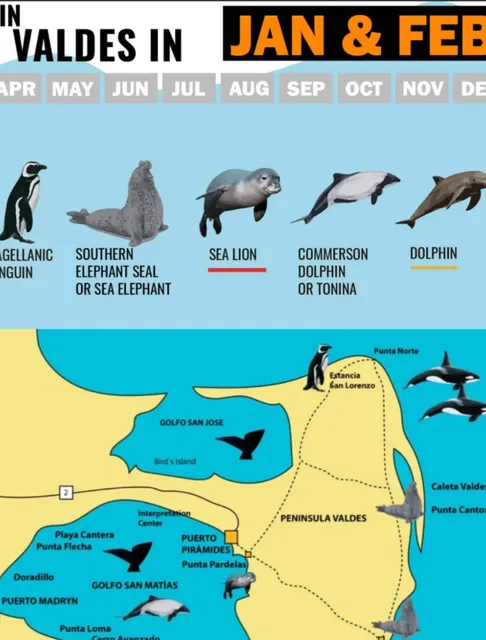
The lighthouse at Punta Delgado is currently closed “temporarily”. It is not clear when it will reopen. Based on this there is no reason to drive this road. There are NO access points to the beaches or cliffs anywhere on this road, all the way around to Caleta Valdes. You would be better off driving directly to Caleta Valdes and save time. There is a penguin viewing point at Caleta which gets you very close to the penguins and further south 5kms is a good centre with toilets and aa cafe to see elephant seals, although they are about 50-100 metres away.
The road from Caleta to Punta Norte is also fully closed, so you need to track back inland to get the road to the North.
We went the 2nd day to the Punta Norte and had good views of elephant seals and seals. Didn’t see any orcas, although they are in the area. It’s pure chance if you see some.
It takes over an hour to get from one place to another - the distances are very long. There’s a lot of time spent focusing on the road and seeing nothing but sheep (10 times more sheep than guanacos!).
Puerto Piramides is a nice small village. All whale watching boats leave from here. The trips are weather dependent and I got to go out in the afternoon due to high winds in the morning. The rangers at the ticket gate warned us up front that the morning sailings weren’t happening, which was helpful.
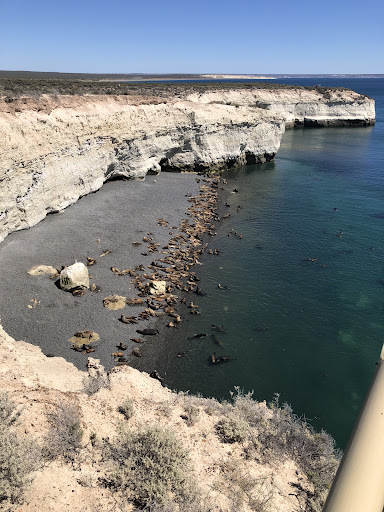
There is a good viewing spot for seal lions just outside of P. Piramides, with a sign saying “Mirador Balaena”. We did not see any whales from this location.
Separately, if you’re staying in Puerto Madryn, there is a good spot to see sea lions about 15kms south of P. Madryn, with an information centre. The last 5kms is a gravel road.
The amount of road closures and weather dependent activities means you should plan your trip carefully. If Delgado is still closed, you are far better off skipping that whole...
Read more
 Learn more insights from Wanderboat AI.