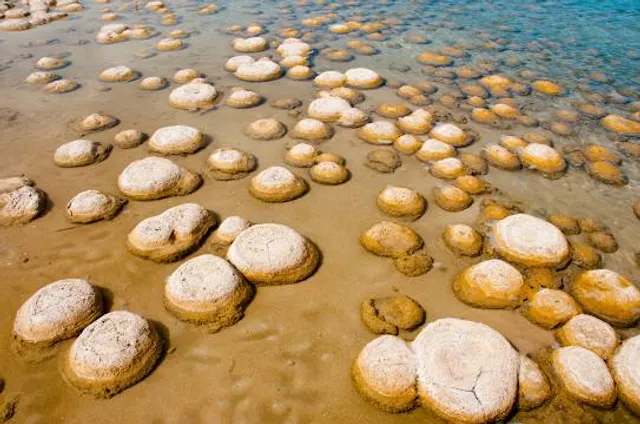
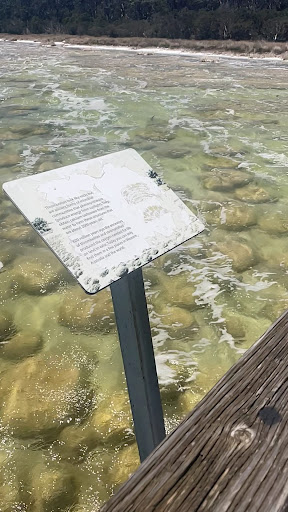
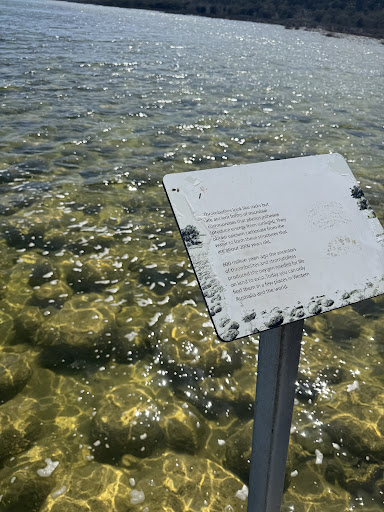
Lake Clifton, located in Western Australia’s Yalgorup National Park, is home to one of the world’s most remarkable natural wonders: thrombolites. These rock-like structures, formed by microorganisms such as cyanobacteria, are living relics of Earth’s prehistoric past, resembling the earliest life forms that existed over 3.5 billion years ago. Thrombolites are built through a process of photosynthesis, where cyanobacteria trap and bind calcium carbonate particles, creating the dome-shaped formations visible today. These microbial structures played a crucial role in Earth’s history by contributing to the oxygenation of the atmosphere, making them a vital component of life’s evolution. At Lake Clifton, they form a colony stretching 15 kilometers along the shoreline, making it one of the largest living thrombolite sites in the southern hemisphere.
The thrombolites at Lake Clifton thrive in a unique hypersaline environment, supported by groundwater seepage rich in minerals. Their survival depends on the delicate balance of the lake’s ecosystem, where low nutrient levels and specific salinity conditions create an ideal habitat. A purpose-built boardwalk allows visitors to observe the thrombolites without damaging the fragile structures, providing a rare opportunity to witness these ancient life forms up close. The lake’s tranquil beauty, combined with the scientific significance of its thrombolites, makes it a destination of ecological and historical importance.
However, Lake Clifton’s thrombolites are under threat from rising salinity, groundwater extraction, and pollution. As climate change and human activities alter the lake’s conditions, conservation efforts have become critical. The site is protected under the Ramsar Convention, highlighting its international importance as a wetland ecosystem. Through research, education, and sustainable tourism, efforts are being made to preserve these extraordinary structures. Protecting Lake Clifton’s thrombolites ensures the survival of a living link to Earth’s ancient history and a deeper understanding of our...
Read moreIncredible scenery, awesome wildlife! Saw Black cockatoos and colourful Orb spiders captured some great landscape photographs. Such a serenely peaceful place I've put a mini guide below.
Follow the wooden walkway through the swamp and scattered scrub you will see the salt marsh is overun by a green carpet of sea asparagus (West Australian Samphire) a part of the succulent family, which acted as an important food and water source for the local idigenous Nyoongar peoples. The Aboriginal name for Samphire is Milyu (however the Nyoongar name for this plant is unknown).
As you approach the jetty it is obvious Noorook Yalgorap's (lake clifton) shore line is domimated by the 2000 year old Thrombolites. Micro-organisms which as they photosynthasize draw calcium carbonate from the water to form these incredible dome like structures. Around 600 million years ago their ancient ancestors along with the Stromatalites (similar to the ones found in Hamelin Pool near Shark bay) produced the atmospheric oxygen vital for the evolution of life on land.
Noorook Yalgorap (Lake Clifton) is 20km long and is the 2nd largest of the Yalgorup lake system which comprises of 10 lakes over an area of 55km within the Yalgorup National Park. The largest of which is Lake Preston to the south at 30km. Yalgorup is a Nyoogar word, 'Yalgor' meaning 'lake' and 'up' meaning 'place of'.
The area is flush with a variety of wildlife with from iconic Black Cockatoos, Monitor and Blue Tongue lizards, Orb spiders and the incredibly unique Jewel Spider to name a few.
Well worth a visit if you are in the...
Read moreRock-like structures lying just off the beach under the water's surface, the Thrombolites are extremely rare...and alive!
Fun facts:
Thrombolites, living rock formations built by ancient microorganisms, are among the oldest life forms on Earth, dating back 570 million years, and are rare, with only a few locations on the planet hosting them, including Lake Clifton in Western Australia.
The thrombolites and why they form at Lake Clifton, but one theory is that they form because the lake is associated with upwellings of fresh groundwater that is high in calcium carbonate. The micro-organisms living in this environment are able to precipitate calcium carbonate from the waters as they photosynthesise, forming the mineralised structure that is the thrombolite.
Lake Clifton’s thrombolites are very fragile, so an observation walkway has been built for visitors to enjoy these incredible formations while protecting them from damage.
Do not leave cash or...
Read more