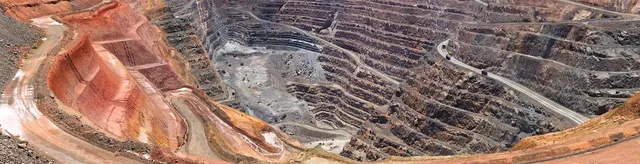
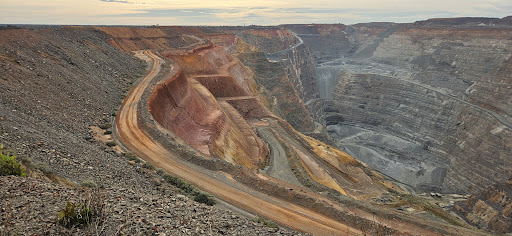
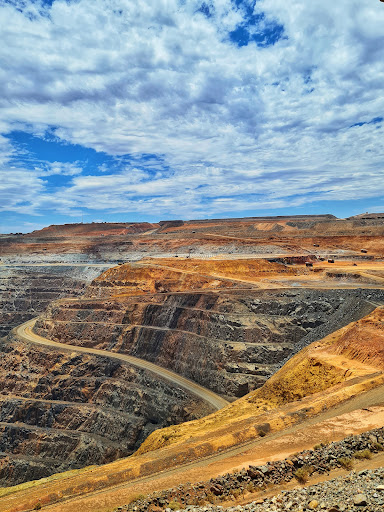
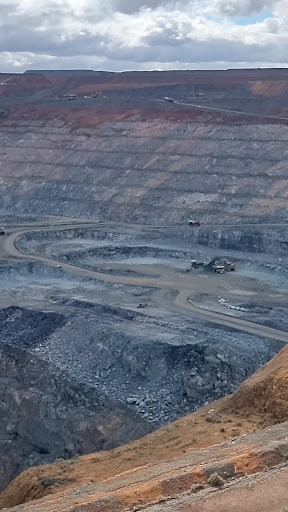
Look, again, I'm biased as I'm just fascinated by the scale of these marvels of the industrial achievements. Port Hedland was amazing, as is the super pit. The lookout is scheduled for relocation in approximately 10 weeks (end August ish 2025???), so just be aware, as I also assume it may be out of action while being set up in its new location??? The pit itself is huge…3.5ks long x 1.6ks wide x 700m deep and getting bigger. The tiny little Tonka trucks you see driving up and down are carrying around 250 tonnes each. WOWWWY. There are 45 of them and will be 75 in the next couple of years, costing millions each. The lookout is free access, closing at 7pm nightly, and although crushed rock etc, wheelchair access isn't an issue, probably just a bit of work. We had torches with us as it was quite dark by 6pm, but surprisingly, there was no lighting. I suppose it's a long way to run power, although a couple of strategically placed solar lights would make sense, anyway, good fun for the kids with torches. We came back again the following day, and unfortunately missed the detonation, scheduled for 1pm each day, but this was at 1.40pm... Missed by that much... Hence the smoke shown in one of the frames. The main issue you have is knowing where the detonation will take place, but just a little tip, look for the area where the big trucks aren't.
Do yourselves a favour, book a bus tour. ($70ea and about 2hrs ish). We booked 3 days in advance, so check on availability. I didn't notice if wheelchair access was available. Sorry, so please check. You get down into the pit workings and see the scale of things,...
Read moreThe museum and tours were closed as we visited during Boxing Day. However, the SuperPit lookout was very informative and the view of the SuperPit was really impressive.
The town of Kalgoorlie got its name from a local Aboriginal word, 'Karlkurla', which translates to 'place of the silky pears'.
Gold was discovered here in June 1893. Today, the Golden Mile in the Kalgoorlie Goldfield is one of the richest gold deposits in the world. The mine produces about 500,000 ounces of gold (14,000 kilograms) per year. For every one million tonnes of ore extracted, there are between 250 and 300 kilograms of gold. In 2019 the mine poured its 50,000th bar of gold, bringing the total produced from the Golden Mile to over 60 million ounces since the first lease was pegged 120 years ago.
In order to extract the ore, the mine is subject to blasting three to four times a week. Up to 1,000 tonnes of explosives are used monthly in 10,000 production holes. In modern times, the site uses 12,000 megalitres of water annually (mostly recycled). Before the Goldfields Water Supply pipeline project was completed (1896-1903), camel trains brought water in from Perth. One amazing camel that undertook this task was recorded to journey 960km without drinking any water.
The deepest part of the pit is 650 metres below...
Read moreThe Fimiston Open Pit, colloquially known as the Super Pit, was Australia's largest open cut gold mine until 2016 when it was surpassed by the Newmont Boddington gold mine also in Western Australia. The Super Pit is located off the Goldfields Highway on the south-east edge of Kalgoorlie, Western Australia. The pit is oblong in plan view and is approximately 3.5 kilometres long, 1.5 kilometres wide and over 600 metres deep.
The Fimiston Open Pit is owned by Kalgoorlie Consolidated Gold Mines Pty Ltd, a company owned 50:50 by Saracen Mineral Holdings Limited and Northern Star Resources Limited. The mine produced 456,000 troy ounces (14.2 t) of gold in 2019, and employs around 1,100 employees and contractors...
Read more