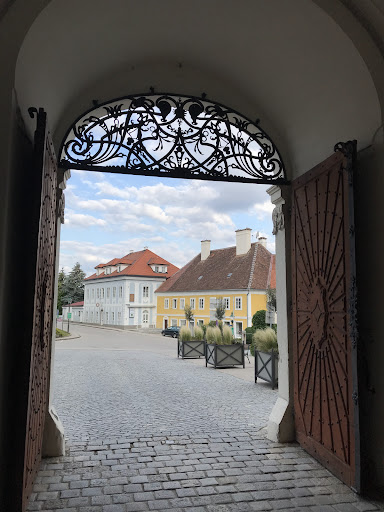
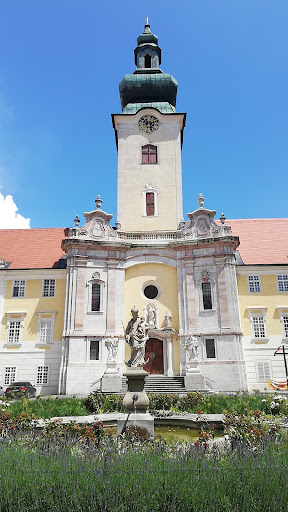
Seitenstetten is located on the Voralpenbundesstraße (122) approximately in the middle between Amstetten and Steyr. The own station "St. Peter-Seitenstetten "(Westbahnstrecke) is about 2.5 km from the village.
1112 founded Udalschalk - or Udiskalk - at the present place a monastery, to which he dedicated his entire inheritance in Seitenstetten, in Grünbach, Heft and in silence (in today's Upper Austria). 1114 Benedictine from Göttweig moved into the new foundation. In 1116, Bishop Ulrich von Passau, a relative of Udalschalk, inaugurated the new collegiate church and gave the monastery the extended parish of Aschbach. 1142 received the pin also the large parish Wolfsbach. From these two large parishes went out all fourteen parishes, which still cares for the pen today.
Around 1180, Archbishop Wichmann of Magdeburg gave the pens the extended forests on the Ybbs, with the order to build a cell there and to celebrate church services. The first reference to a monastery school in Seitenstetten dates back to the founding century.
Despite some setbacks by two monastic fires and property disputes, the monastery took a gradual upswing. In 1347 the convent had 22 members. After a long period of decline, Benedict I, who had formerly been Schottenprior in Vienna, also supported the milking reform in Seitenstettten and brought about an upswing in religious and cultural life. This abbot had a chapel built on the Sonntagberg in 1440 and consecrated, thus establishing the Sonntagberg pilgrimage under the care of the abbey. The Hungary storm of Matthias Corvinus, the Turks taxes, but especially the Reformation, put the sift hard. The number of brothers decreased rapidly.
Only abbot Christoph Held (1572/1602), strongly supported by the imperial monastery council, initiated the spiritual rebirth. The following abbots introduced Baroque art. Bavaria and Swabia increased the membership of the convent. But it was only after the Thirty Years' War that Abbot Gabriel Sauer (1648/74) managed to consolidate the monastery economically and to religiously bring the convent to a climax. Even a big building activity could start now:
Abbot Benedict II Abelzhauser (1687/1717) had Jakob Prandtauer the magnificent pilgrimage church to the Hlst. Building Trinity on the Sonntagberg.
1718 to 1747, the current Baroque monastery was built. The funds for this were provided above all by the copper mine in Radmer (Styria) and the brass mill Reichraming (Upper Austria).
After the difficult times of Josephinism and the French wars, the monastery reached its peak at the turn of the century. Abbot Theodor Springer (1920/58) led the pen out of the economic crisis after the First World War and rescued the pen without lifting by the Second World War.
Under Abbot Albert Kurzwernhart (1962/84) extensive renovations were carried out on Sonntagberg, in the other parish churches, but above all in the collegiate church!
From 1985-1991, under Abbot Berthold Heigl (1984-2013), the entire monastery building was restored from the cellar to the roof, and from 1987 to the present day the entire Meierhof was built in...
Read more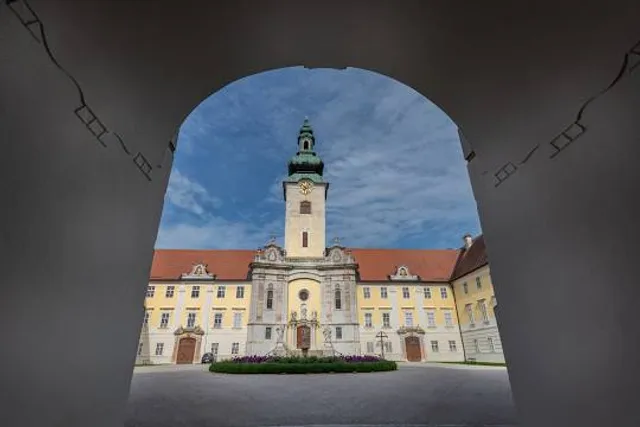
 Learn more insights from Wanderboat AI.