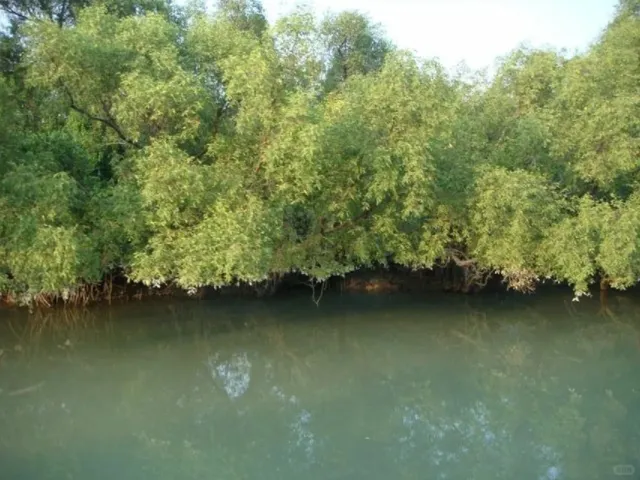
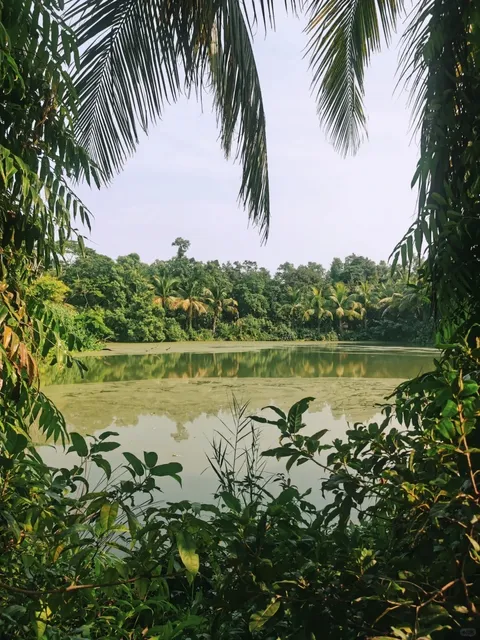
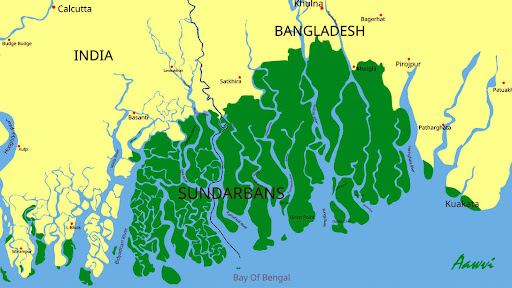
The Sundarbans is a vast forest area on the coast of the Bay of Bengal which is one of the natural wonders of the world. Located in the delta delta of the Ganges, Meghna and Brahmaputra rivers, Khulna, Satkhira and Bagerhat districts of Bangladesh and the two districts of West Bengal state of India are spread over North 24 Parganas and South 24 Parganas. As the largest mangrove forest in the saline environment of the coast, the Sundarbans is the largest intact forest in the world. Built on an area of 1.5 sq km, the sundarban has an area of 5.7 sq km in Bangladesh and the rest is in India. The Sundarbans was recognized as a UNESCO World Heritage Site in 7 CE. Its Bangladesh and Indian parts are in fact adjacent to the same uninhabited land, but are listed on UNESCO's World Heritage list under different names; Named "Sundarbans" and "Sundarbans National Parks" respectively. The Sundarbans are enclosed by a network of marine streams, mud chars and mangrove forests, along with salinity of mangrove forests. About 1.5 percent of the total forest area, that is, 1,5 square kilometers, covers rivers, creeks, wetlands with bills. Two types of biosphere can be seen in the Sundarbans: freshwater wetlands and mangrove forests. In addition to the famous Royal Bengal Tiger in the forest, the forest is also known as home to numerous species of birds, chitra, deer, crocodiles and snakes. According to the survey, there are 5 tigers and 3 to 5 chitra deer now in the Sundarbans area. The major forest varieties of the Sundarbans include the abundance of heritiera fomes, gaiva (Excoecaria agallocha), goran (Ceriops decandra) and kera (Sonneratia apetala). According to Prine's estimates published in 3, there are a total of 20 species and 4 species of plants. Also scattered throughout the region are Dhundal (Xylocarpus granatum), Poresia coaractata, Myriostachya wightiana, Shawn (Imperata cylindrical)], Nal Khagra (Phyphagites karka), Golpata (Nypa fruticans) in grass and bush. On May 27, 2012, Sundarbans was recognized as the place of Ramsay. Thousands of tourists visit Sundarbans every year. Numerous tourists from all over the country are fascinated by the beauty of the Sundarbans. Visiting Sundarbans acquires various knowledge...
Read moreSundorbon largest single block of tidal halophytic mangrove forest in the world, located in the southwestern part of Bangladesh. It lies on the Ganges-Brahmaputra Delta at the point where it merges with the bongoposhagor. The forest lies a little south to the Tropic of Cancer between the latitudes 21°30'N and 22°30'N, and longitudes 89°00'E and 89°55'E. With its array of trees and wind life the forest is a showpiece of natural history. It is also a centre of economic activities, such as extraction of timber, fishing and collection of honey. The forest consists of about 200 islands, separated by about 400 interconnected tidal rivers, creeks and canals. The Sundarbans was originally measured (about 200 years ago) to be of about 16,700 sq km. Now it has dwindled to about 1/3 of the original size. Because of the partition of India, Bangladesh received about 2/3 of the forest; the rest is on the Indian side. It is now estimated to be about 6,000 sq km, of which about 1,700 sq km is occupied by waterbodies. The forest lies under two forest divisions, and four administrative ranges viz Chandpai, Sarankhola, Khulna and Burigoalini and has 16 forest stations. It is further divided into 55 compartments and 9 blocks. The Sundarbans was declared as a Reserve Forest in 1875. About 32,400 hectares of the Sundarbans have been declared as three wildlife sanctuaries, and came under the UNESCO World Heritage Site in 1997. The ecological diversity of the Sundarbans supports a large variety of birds. Among the total number of species recorded, most are resident. Over 50 species are known to be migratory and are mostly represented by the waterfowls. The egrets, storks, herons, bitterns, sandpipers, curlew, and numerous other waders are seen along the muddy banks. There are many species of gulls and terns, especially along the seacoast and the larger waterways. Accipitridae (kites, eagles, vulture, harrier etc) is represented by about 22 species. Nine species of kingfishers are available in the forest. The rich avifaunas of the forest include species of woodpeckers, barbets, owls, bee-eaters, bulbul, shrikes, drongos, starlings, mynas, babblers, thrush, oriole, flycatchers, and...
Read moreSundarbans: The Sundarbans is one of the largest mangrove forest in the world (133,010 ha). It lies on the delta of the Ganges, Brahmaputra and Meghna rivers on the Bay of Bengal. It spans the area from the Hooghly River in India's state of West Bengal to the Baleswar River in Bangladesh's Khulna Division.
Covering 133,010 ha, the area is estimated to comprise about 55% forest land and 45% wetlands in the form of tidal rivers, creeks, canals and vast estuarine mouths of the river. About 66% of the entire mangrove forest area is estimated to occur in Bangladesh, with the remaining 34% in India.
The most abundant tree species are Sundari (Heritiera fomes) and Gewa (Excoecaria agallocha). The forests provide habitat to 453 fauna wildlife, including 290 bird, 120 fish, 42 mammal, 35 reptile and eight amphibian species. It is total ban on all killing or capture of wildlife other than fish and some invertebrates.
The Sundarbans are an important habitat for the Bengal tiger (Panthera tigris). The forest also provides habitat for small wild cats such as the jungle cat (Felis chaus), fishing cat (Prionailurus viverrinus), and leopard cat (P. bengalensis).
Places to visit:
• Kotka Beach and Jamtala Beach: Famous for its beauty, where you can often spot spotted deer and sometimes Royal Bengal Tigers.
• Karamjal: A forest station and popular tourist spot, it is home to a crocodile breeding centre where baby crocodiles are kept before being released into the forest.
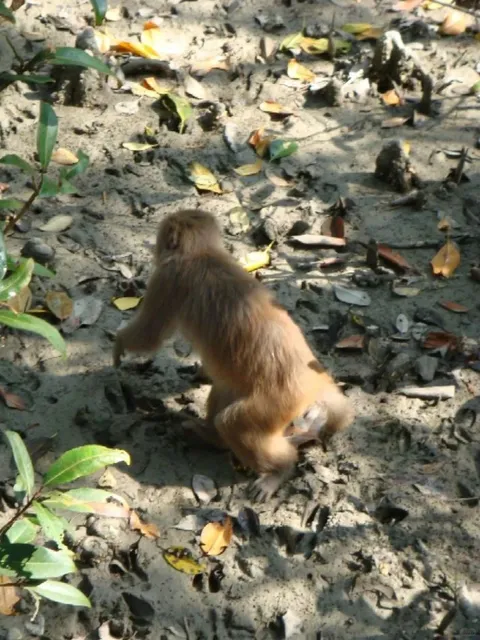
• Hiran Point: A protected wildlife sanctuary with a long wooden walkway to view various animals including deer and monkeys.
• Kochikhali: A beautiful tourist spot and an important area for wildlife watching, especially deer.
• Dublar Char Island: A unique island destination within the Sundarbans, known for its fishing activities and picturesque views.
• Harbaria: Considered an attractive ecotourism park with trekking trails and watchtowers for observing the forest and its wildlife.
• Tin Kona Island: Another popular place in the forest for wildlife and bird watching.
• Katka Beach Watch Tower: Another popular place in the forest for wildlife and...
Read more