HTML SitemapExplore
logo
Find Things to DoFind The Best Restaurants

Kantajew Temple — Attraction in Rangpur Division

Name
Kantajew Temple
Description
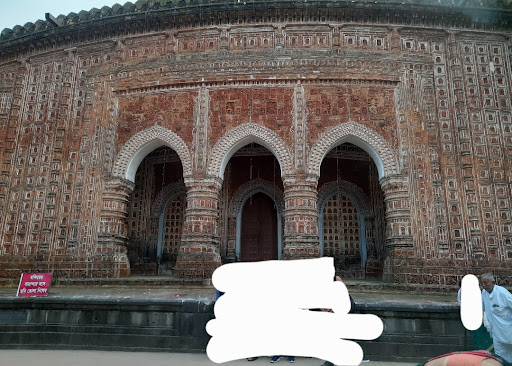
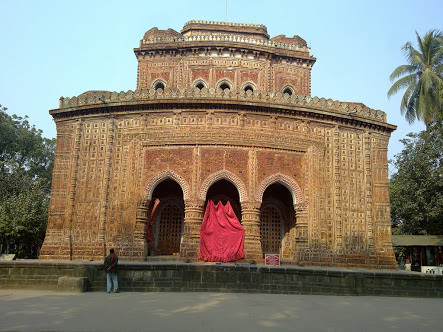
Kantanagar Temple, commonly known as Kantaji Temple or Kantajew Temple at Kantanagar, is a Hindu temple in Dinajpur, Bangladesh. The Kantajew Temple is a religious edifice belonging to the 18th century. The temple belongs to the Hindu Kanta or Krishna and this is most popular with the Radha-Krishna cult in Bengal.
Nearby attractions
Nearby restaurants
Nearby hotels
Related posts
Keywords
Kantajew Temple tourism.Kantajew Temple hotels.Kantajew Temple bed and breakfast. flights to Kantajew Temple.Kantajew Temple attractions.Kantajew Temple restaurants.Kantajew Temple travel.Kantajew Temple travel guide.Kantajew Temple travel blog.Kantajew Temple pictures.Kantajew Temple photos.Kantajew Temple travel tips.Kantajew Temple maps.Kantajew Temple things to do.
Kantajew Temple things to do, attractions, restaurants, events info and trip planning
Kantajew Temple
BangladeshRangpur DivisionKantajew Temple

Basic Info

Kantajew Temple

QMR8+4R7, 5200, Bangladesh
4.5(2K)
Closed
Save
spot

Ratings & Description

Info

Kantanagar Temple, commonly known as Kantaji Temple or Kantajew Temple at Kantanagar, is a Hindu temple in Dinajpur, Bangladesh. The Kantajew Temple is a religious edifice belonging to the 18th century. The temple belongs to the Hindu Kanta or Krishna and this is most popular with the Radha-Krishna cult in Bengal.

Cultural
Scenic
Family friendly
Accessibility
attractions: , restaurants:
logoLearn more insights from Wanderboat AI.
Website
archaeology.gov.bd
Open hoursSee all hours
Tue8 AM - 5 PMClosed

Plan your stay

hotel
Pet-friendly Hotels in Rangpur Division
Find a cozy hotel nearby and make it a full experience.
hotel
Affordable Hotels in Rangpur Division
Find a cozy hotel nearby and make it a full experience.
hotel
The Coolest Hotels You Haven't Heard Of (Yet)
Find a cozy hotel nearby and make it a full experience.
hotel
Trending Stays Worth the Hype in Rangpur Division
Find a cozy hotel nearby and make it a full experience.

Reviews

Get the Appoverlay
Get the AppOne tap to find yournext favorite spots!
Wanderboat LogoWanderboat

Your everyday Al companion for getaway ideas

CompanyAbout Us
InformationAI Trip PlannerSitemap
SocialXInstagramTiktokLinkedin
LegalTerms of ServicePrivacy Policy

Get the app

© 2025 Wanderboat. All rights reserved.
logo

Reviews of Kantajew Temple

4.5
(1,983)
avatar
5.0
1y

Kantanagar Temple an eighteenth century brick temple, situated in the peaceful island hamlet of Kantanagar (Kantanagar), about 12 miles north of Dinajpur town, and about a mile west of Dinajpur-Tetulia highway across the Dhepa river. It has gained eminence as an outstanding monument in Bengal for its fabulous terracotta embellishment. This nava-ratna or 'nine spired' Hindu temple, now stripped off its original nine spires atop its corners during the devastating earthquake of 1897, exhibits the exuberance of terracotta art at its best in Bangladesh. The confusion about the date of its construction can be settled from the record of a chronogram in the Sanskrit stone inscription, fixed on the northeast corner plinth of the temple. It records that Maharaja Prannath of Dinajpur began its construction about 1722.

His adopted son Maharaja Ramnath completed it, in Shaka era 1674 (1752 AD) in order to propitiate the consort of Rukmini in fulfillment of his father’s wish. However, in the early 20th century Maharaja Girijanath Bahadur restored it substantially, except for the missing nine spires.

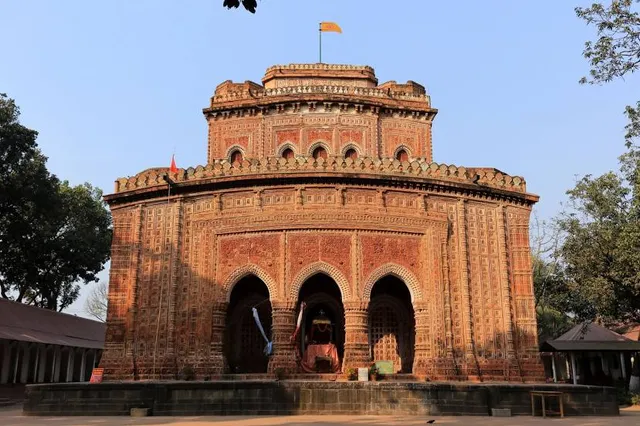
This magnificent pyramidal temple rose in three receding terraces and was crowned with nine ornamental spires or ratnas (jewels) on the corner of the three terraces which imparted to it an appearance of a huge ratha or an ornate chariot resting on a high plinth. It was provided with arched openings on all four sides in order to enable devotees to see the deity enshrined inside from all directions.

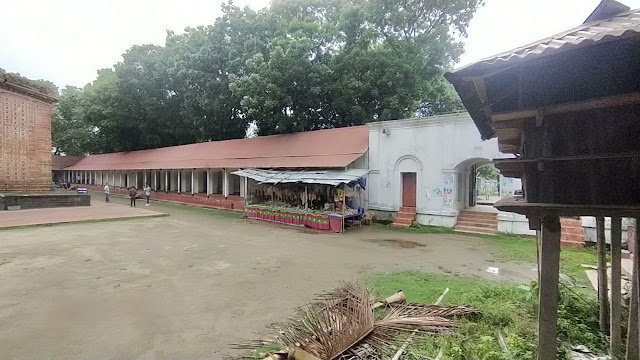
The 15.84 sq km temple stands in the centre of an oblong court (73.15m ' 36.57m) enclosed by a pilgrim shed with a corrugated tin roof. Its main fabric pivots around a nuclear square cell (3.04m), shooting up to a height of about 15.24m above its 1.005 m high plinth of stone, believed to have been quarried from the ancient ruins of Bannagar near Gangarampur in Dinajpur. Three other square outer shells in graded heights have been added to it, as much to variegate the plan as to strengthen the central cella which carry atop a massive tower. The other eight ornamental towers, now missing, occupied the eight roof corners of the lower two stories. The curved cornice of the ground floor, sharply drooping at the corners, rise in the middle to a height of 7.62 m from the plinth, while that of the first floor rises to 4.56m and that of the second floor to 1.83 m. There are small square cells at each of the four corners of the ground and first floors for supporting the heavy load of the ornate octagonal corner towers above.

The temple accommodates four rectangular corridors on the ground floor around the prayer chamber measuring 9.17 m × 1.53 m and 4.57 m×1.22 m. On the ground floor, there are three multi- cusped arched entrances on each side, each separated by two richly decorated brick pillars. The number of arched doorways in the ground floor disposed in its four shells is 21; that of the first floor is 27. The reduced second floor has only three entrance doors and three windows. A narrow strip of staircase, merely 0.70m wide, built into the western second corridor, winds up through its dark passage to the first, second, and third stories.

A small derelict single spired temple, now overgrown with rank vegetation, stands about one hundred yards north of the main temple beyond the pilgrim shed, which is believed to have been erected by Maharaja Prannath in 1704 where he initially installed the Krisna icon, brought from Brindaban. The icon was later transferred to the 'nava ratna' temple when completed. It is now an abandoned shrine. It is a 16-sided temple rising to a height of about 12.19 m and provided with a multi-cusped arched entrance...

   Read more

avatar
5.0
8y

Kantojiu Temple – Terracotta Treasure The ancient Hindu temple of Kantojiu is located in the Dinajpur District of Bangladesh. Constructed over a period of fifty years (1702-1752) the building of the temple was initiated by Maharaja Pran Nath and concluded during the reign of his son, Maharaja Ramnath. Kantojiu Temple originally featured nine spires typical of the nava-ratna architectural style, but the earthquake of 1897 destroyed the spires and they were never reconstructed. Nevertheless, the temple remains an architecture marvel featuring some of the best examples of terracotta adornment to be found in Bangladesh.

Also known as Kantanagar, the Hindu temple is built around a square inner courtyard, reaching a height of around fifteen meters. The stone of the courtyard is believed to have been transported from the ancient ruins of Bannagar, located near Gangarampur. Small square cells are located at the four corners of both the ground and first floors, supporting the octagonal towers above. Four ground floor rectangular alleys surround the prayer hall, with three arched entrances on each side separated by intricately decorated pillars.

The most outstanding feature of the temple, which is both a Hindu pilgrimage site and a tourist attraction, is its terracotta murals which cover every available space both inside and out. A range of themes can be seen in the terracotta artwork. The lowest panels on the outer walls of the temple feature floral motifs with fully opened blooms alternating with foliage, along with scenes depicting life at the time and focusing on the landed nobility. The panels further up depict hunting scenes and royal processions of camels, horses and elephants, as well as nobility and their soldiers dressed in Mughal garb carrying weapons. Zamindars puffing on elaborate hookahs, chariots, stallions, boats with revelers, and squads of weapon-laden soldiers.

Panels higher up include mythological scenes featuring the nativity of Krishna; the attempts by King Kangsa to kill Krishna; Krishna's slaying of the Putana ogress and the crane-demon Bakasura; the lifting of Govardhana mountain and subsequent killing of Keshi. On the south and east face of Kantojiu Temple are scenes from the Ramayana, with the north face portraying scenes of Krishna and Balarama – the elder brother of Krishna. The western face of the temple focuses on scenes from the legend of Krishna, including scenes which can still be seen in rural Bangladesh today – the carrying of milk and butter in string bags hanging from poles resting on...

   Read more
avatar
5.0
1y

Kantajew Temple, located in Dinajpur, Bangladesh, is a magnificent example of terracotta architecture and a testament to the region's rich cultural heritage. Built in the mid-18th century by Maharaja Pran Nath, this Hindu temple is dedicated to Lord Krishna and is also known as Kantaji Temple.

The temple's most striking feature is its intricate terracotta ornamentation. The entire surface of the temple is covered with detailed carvings depicting scenes from Hindu mythology, everyday life, and floral motifs. These terracotta panels are not only artistically impressive but also provide a window into the socio-cultural fabric of the time. The craftsmanship displayed in these carvings is unparalleled, making the temple a significant architectural and cultural landmark.

Kantajew Temple is built in the navaratna (nine-tower) style, although only the base structure remains today due to an earthquake in the 19th century that damaged the towers. Despite this, the temple's grandeur remains intact, attracting visitors from far and wide. The three-story structure stands on a high plinth and features arched doorways that lead to the inner sanctum, where the deity is housed.

The temple grounds are well-maintained, providing a serene and contemplative environment for visitors. The lush greenery and the peaceful ambiance enhance the overall experience, making it a perfect spot for both worshippers and tourists.

Visiting Kantajew Temple offers a unique opportunity to appreciate the artistic and architectural achievements of the past. It is a must-visit for anyone interested in history, art, or religion. The temple not only stands as a religious monument but also as a symbol of the rich heritage of Bangladesh, preserving the legacy of its artisans...

   Read more
Page 1 of 7
Previous
Next

Posts

Mosfiqur RahamanMosfiqur Rahaman
Kantanagar Temple an eighteenth century brick temple, situated in the peaceful island hamlet of Kantanagar (Kantanagar), about 12 miles north of Dinajpur town, and about a mile west of Dinajpur-Tetulia highway across the Dhepa river. It has gained eminence as an outstanding monument in Bengal for its fabulous terracotta embellishment. This nava-ratna or 'nine spired' Hindu temple, now stripped off its original nine spires atop its corners during the devastating earthquake of 1897, exhibits the exuberance of terracotta art at its best in Bangladesh. The confusion about the date of its construction can be settled from the record of a chronogram in the Sanskrit stone inscription, fixed on the northeast corner plinth of the temple. It records that Maharaja Prannath of Dinajpur began its construction about 1722. His adopted son Maharaja Ramnath completed it, in Shaka era 1674 (1752 AD) in order to propitiate the consort of Rukmini in fulfillment of his father’s wish. However, in the early 20th century Maharaja Girijanath Bahadur restored it substantially, except for the missing nine spires. This magnificent pyramidal temple rose in three receding terraces and was crowned with nine ornamental spires or ratnas (jewels) on the corner of the three terraces which imparted to it an appearance of a huge ratha or an ornate chariot resting on a high plinth. It was provided with arched openings on all four sides in order to enable devotees to see the deity enshrined inside from all directions. The 15.84 sq km temple stands in the centre of an oblong court (73.15m ' 36.57m) enclosed by a pilgrim shed with a corrugated tin roof. Its main fabric pivots around a nuclear square cell (3.04m), shooting up to a height of about 15.24m above its 1.005 m high plinth of stone, believed to have been quarried from the ancient ruins of Bannagar near Gangarampur in Dinajpur. Three other square outer shells in graded heights have been added to it, as much to variegate the plan as to strengthen the central cella which carry atop a massive tower. The other eight ornamental towers, now missing, occupied the eight roof corners of the lower two stories. The curved cornice of the ground floor, sharply drooping at the corners, rise in the middle to a height of 7.62 m from the plinth, while that of the first floor rises to 4.56m and that of the second floor to 1.83 m. There are small square cells at each of the four corners of the ground and first floors for supporting the heavy load of the ornate octagonal corner towers above. The temple accommodates four rectangular corridors on the ground floor around the prayer chamber measuring 9.17 m × 1.53 m and 4.57 m×1.22 m. On the ground floor, there are three multi- cusped arched entrances on each side, each separated by two richly decorated brick pillars. The number of arched doorways in the ground floor disposed in its four shells is 21; that of the first floor is 27. The reduced second floor has only three entrance doors and three windows. A narrow strip of staircase, merely 0.70m wide, built into the western second corridor, winds up through its dark passage to the first, second, and third stories. A small derelict single spired temple, now overgrown with rank vegetation, stands about one hundred yards north of the main temple beyond the pilgrim shed, which is believed to have been erected by Maharaja Prannath in 1704 where he initially installed the Krisna icon, brought from Brindaban. The icon was later transferred to the 'nava ratna' temple when completed. It is now an abandoned shrine. It is a 16-sided temple rising to a height of about 12.19 m and provided with a multi-cusped arched entrance on the south.
Tanim RahmanTanim Rahman
Kantojiu Temple – Terracotta Treasure The ancient Hindu temple of Kantojiu is located in the Dinajpur District of Bangladesh. Constructed over a period of fifty years (1702-1752) the building of the temple was initiated by Maharaja Pran Nath and concluded during the reign of his son, Maharaja Ramnath. Kantojiu Temple originally featured nine spires typical of the nava-ratna architectural style, but the earthquake of 1897 destroyed the spires and they were never reconstructed. Nevertheless, the temple remains an architecture marvel featuring some of the best examples of terracotta adornment to be found in Bangladesh. Also known as Kantanagar, the Hindu temple is built around a square inner courtyard, reaching a height of around fifteen meters. The stone of the courtyard is believed to have been transported from the ancient ruins of Bannagar, located near Gangarampur. Small square cells are located at the four corners of both the ground and first floors, supporting the octagonal towers above. Four ground floor rectangular alleys surround the prayer hall, with three arched entrances on each side separated by intricately decorated pillars. The most outstanding feature of the temple, which is both a Hindu pilgrimage site and a tourist attraction, is its terracotta murals which cover every available space both inside and out. A range of themes can be seen in the terracotta artwork. The lowest panels on the outer walls of the temple feature floral motifs with fully opened blooms alternating with foliage, along with scenes depicting life at the time and focusing on the landed nobility. The panels further up depict hunting scenes and royal processions of camels, horses and elephants, as well as nobility and their soldiers dressed in Mughal garb carrying weapons. Zamindars puffing on elaborate hookahs, chariots, stallions, boats with revelers, and squads of weapon-laden soldiers. Panels higher up include mythological scenes featuring the nativity of Krishna; the attempts by King Kangsa to kill Krishna; Krishna's slaying of the Putana ogress and the crane-demon Bakasura; the lifting of Govardhana mountain and subsequent killing of Keshi. On the south and east face of Kantojiu Temple are scenes from the Ramayana, with the north face portraying scenes of Krishna and Balarama – the elder brother of Krishna. The western face of the temple focuses on scenes from the legend of Krishna, including scenes which can still be seen in rural Bangladesh today – the carrying of milk and butter in string bags hanging from poles resting on the shoulder.
Plabon BhadraPlabon Bhadra
The Kantaji Temple, situated in Dinajpur, Bangladesh, is a mesmerizing architectural marvel that captivates visitors with its intricate terracotta artwork and rich historical significance. Dating back to the 18th century during the reign of the Maharaja Pran Nath, this Hindu temple stands as a testament to the region's cultural heritage and artistic prowess. The temple's façade is adorned with meticulously crafted terracotta panels depicting mythological scenes, religious motifs, and intricate floral designs, showcasing the unparalleled skill of the artisans of that era. Visitors are entranced by the vivid colors and intricate details that adorn every inch of the temple's surface, making it a photographer's paradise and a treasure trove for art enthusiasts. Stepping inside the temple, one is greeted by the sanctum sanctorum dedicated to Lord Krishna, where devotees offer prayers and seek blessings. The serene ambiance and spiritual aura of the temple create a sense of peace and tranquility, inviting visitors to pause and reflect amidst the hustle and bustle of everyday life. Surrounded by lush greenery and tranquil ponds, the Kantaji Temple offers a serene retreat for those seeking solace and spiritual rejuvenation. The preservation efforts undertaken to maintain the temple's architectural integrity ensure that future generations can continue to marvel at its beauty and historical significance. In conclusion, a visit to the Kantaji Temple is a journey back in time, offering a glimpse into Bangladesh's rich cultural heritage and artistic legacy.
See more posts
See more posts
hotel
Find your stay

Pet-friendly Hotels in Rangpur Division

Find a cozy hotel nearby and make it a full experience.

Kantanagar Temple an eighteenth century brick temple, situated in the peaceful island hamlet of Kantanagar (Kantanagar), about 12 miles north of Dinajpur town, and about a mile west of Dinajpur-Tetulia highway across the Dhepa river. It has gained eminence as an outstanding monument in Bengal for its fabulous terracotta embellishment. This nava-ratna or 'nine spired' Hindu temple, now stripped off its original nine spires atop its corners during the devastating earthquake of 1897, exhibits the exuberance of terracotta art at its best in Bangladesh. The confusion about the date of its construction can be settled from the record of a chronogram in the Sanskrit stone inscription, fixed on the northeast corner plinth of the temple. It records that Maharaja Prannath of Dinajpur began its construction about 1722. His adopted son Maharaja Ramnath completed it, in Shaka era 1674 (1752 AD) in order to propitiate the consort of Rukmini in fulfillment of his father’s wish. However, in the early 20th century Maharaja Girijanath Bahadur restored it substantially, except for the missing nine spires. This magnificent pyramidal temple rose in three receding terraces and was crowned with nine ornamental spires or ratnas (jewels) on the corner of the three terraces which imparted to it an appearance of a huge ratha or an ornate chariot resting on a high plinth. It was provided with arched openings on all four sides in order to enable devotees to see the deity enshrined inside from all directions. The 15.84 sq km temple stands in the centre of an oblong court (73.15m ' 36.57m) enclosed by a pilgrim shed with a corrugated tin roof. Its main fabric pivots around a nuclear square cell (3.04m), shooting up to a height of about 15.24m above its 1.005 m high plinth of stone, believed to have been quarried from the ancient ruins of Bannagar near Gangarampur in Dinajpur. Three other square outer shells in graded heights have been added to it, as much to variegate the plan as to strengthen the central cella which carry atop a massive tower. The other eight ornamental towers, now missing, occupied the eight roof corners of the lower two stories. The curved cornice of the ground floor, sharply drooping at the corners, rise in the middle to a height of 7.62 m from the plinth, while that of the first floor rises to 4.56m and that of the second floor to 1.83 m. There are small square cells at each of the four corners of the ground and first floors for supporting the heavy load of the ornate octagonal corner towers above. The temple accommodates four rectangular corridors on the ground floor around the prayer chamber measuring 9.17 m × 1.53 m and 4.57 m×1.22 m. On the ground floor, there are three multi- cusped arched entrances on each side, each separated by two richly decorated brick pillars. The number of arched doorways in the ground floor disposed in its four shells is 21; that of the first floor is 27. The reduced second floor has only three entrance doors and three windows. A narrow strip of staircase, merely 0.70m wide, built into the western second corridor, winds up through its dark passage to the first, second, and third stories. A small derelict single spired temple, now overgrown with rank vegetation, stands about one hundred yards north of the main temple beyond the pilgrim shed, which is believed to have been erected by Maharaja Prannath in 1704 where he initially installed the Krisna icon, brought from Brindaban. The icon was later transferred to the 'nava ratna' temple when completed. It is now an abandoned shrine. It is a 16-sided temple rising to a height of about 12.19 m and provided with a multi-cusped arched entrance on the south.
Mosfiqur Rahaman

Mosfiqur Rahaman

hotel
Find your stay

Affordable Hotels in Rangpur Division

Find a cozy hotel nearby and make it a full experience.

Get the Appoverlay
Get the AppOne tap to find yournext favorite spots!
Kantojiu Temple – Terracotta Treasure The ancient Hindu temple of Kantojiu is located in the Dinajpur District of Bangladesh. Constructed over a period of fifty years (1702-1752) the building of the temple was initiated by Maharaja Pran Nath and concluded during the reign of his son, Maharaja Ramnath. Kantojiu Temple originally featured nine spires typical of the nava-ratna architectural style, but the earthquake of 1897 destroyed the spires and they were never reconstructed. Nevertheless, the temple remains an architecture marvel featuring some of the best examples of terracotta adornment to be found in Bangladesh. Also known as Kantanagar, the Hindu temple is built around a square inner courtyard, reaching a height of around fifteen meters. The stone of the courtyard is believed to have been transported from the ancient ruins of Bannagar, located near Gangarampur. Small square cells are located at the four corners of both the ground and first floors, supporting the octagonal towers above. Four ground floor rectangular alleys surround the prayer hall, with three arched entrances on each side separated by intricately decorated pillars. The most outstanding feature of the temple, which is both a Hindu pilgrimage site and a tourist attraction, is its terracotta murals which cover every available space both inside and out. A range of themes can be seen in the terracotta artwork. The lowest panels on the outer walls of the temple feature floral motifs with fully opened blooms alternating with foliage, along with scenes depicting life at the time and focusing on the landed nobility. The panels further up depict hunting scenes and royal processions of camels, horses and elephants, as well as nobility and their soldiers dressed in Mughal garb carrying weapons. Zamindars puffing on elaborate hookahs, chariots, stallions, boats with revelers, and squads of weapon-laden soldiers. Panels higher up include mythological scenes featuring the nativity of Krishna; the attempts by King Kangsa to kill Krishna; Krishna's slaying of the Putana ogress and the crane-demon Bakasura; the lifting of Govardhana mountain and subsequent killing of Keshi. On the south and east face of Kantojiu Temple are scenes from the Ramayana, with the north face portraying scenes of Krishna and Balarama – the elder brother of Krishna. The western face of the temple focuses on scenes from the legend of Krishna, including scenes which can still be seen in rural Bangladesh today – the carrying of milk and butter in string bags hanging from poles resting on the shoulder.
Tanim Rahman

Tanim Rahman

hotel
Find your stay

The Coolest Hotels You Haven't Heard Of (Yet)

Find a cozy hotel nearby and make it a full experience.

hotel
Find your stay

Trending Stays Worth the Hype in Rangpur Division

Find a cozy hotel nearby and make it a full experience.

The Kantaji Temple, situated in Dinajpur, Bangladesh, is a mesmerizing architectural marvel that captivates visitors with its intricate terracotta artwork and rich historical significance. Dating back to the 18th century during the reign of the Maharaja Pran Nath, this Hindu temple stands as a testament to the region's cultural heritage and artistic prowess. The temple's façade is adorned with meticulously crafted terracotta panels depicting mythological scenes, religious motifs, and intricate floral designs, showcasing the unparalleled skill of the artisans of that era. Visitors are entranced by the vivid colors and intricate details that adorn every inch of the temple's surface, making it a photographer's paradise and a treasure trove for art enthusiasts. Stepping inside the temple, one is greeted by the sanctum sanctorum dedicated to Lord Krishna, where devotees offer prayers and seek blessings. The serene ambiance and spiritual aura of the temple create a sense of peace and tranquility, inviting visitors to pause and reflect amidst the hustle and bustle of everyday life. Surrounded by lush greenery and tranquil ponds, the Kantaji Temple offers a serene retreat for those seeking solace and spiritual rejuvenation. The preservation efforts undertaken to maintain the temple's architectural integrity ensure that future generations can continue to marvel at its beauty and historical significance. In conclusion, a visit to the Kantaji Temple is a journey back in time, offering a glimpse into Bangladesh's rich cultural heritage and artistic legacy.
Plabon Bhadra

Plabon Bhadra

See more posts
See more posts