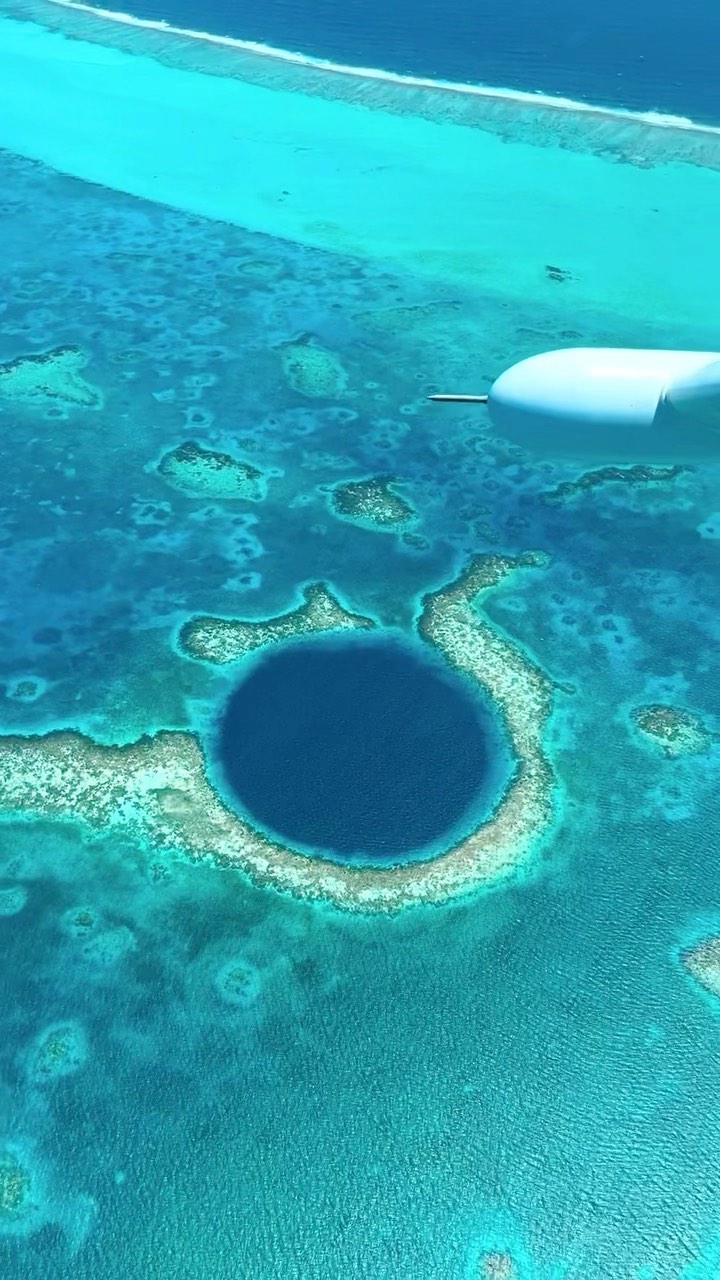
The Great Blue Hole is a world-class destination for recreational scuba divers attracted by the opportunity to dive in crystal-clear waters and see myriad species of marine life including tropical fish and spectacular coral formations.
The marine life in these areas includes nurse sharks, giant groupers, and several types of reef sharks such as the Caribbean reef shark and the Blacktip shark (Carcharhinus limbatus). Dive excursions to the Great Blue Hole are full-day trips, that usually consist of one dive in the Blue Hole and two additional dives in nearby reefs. The Great Blue Hole is in our list of Top 10 Reasons Why You Should Visit Belize.
The Great Blue Hole is a large underwater sinkhole off the coast of Belize. It lies near the center of Lighthouse Reef, a small atoll 100 kilometres (62 miles) from the mainland of Belize City.
The hole is circular in shape, over 300 metres (984 ft.) across and 125 metres (410 ft.) deep. The world’s largest natural formation of its kind, the Great Blue Hole is part of the larger Barrier Reef Reserve System, a World Heritage Site of the United Nations Educational, Scientific and Cultural Organization (UNESCO).
Glyn Collinson, a NASA scientist who recently dived the Great Blue Hole described it thus:
“It was the deepest, deep blue hole imaginable; A chasm that fell away deep into the deep, dark blue. It had been forged out of solid rock as caverns, hundreds of thousands of years ago during the last ice age. For eons, water filtered through the rock and into these great stone cathedrals, breeding multicolored stalactites and stalagmites. Then, one by one they collapsed in on each other, creating a chasm four hundred feet deep. As Earth’s swollen polar ice-caps receded, the warm Caribbean ocean swept in to fill the chasm with boiling white hands, the last rays of sunlight struck the chasm’s floor. Then, as the limestone broke down, it began to rain tiny fragments of rock, which slowly began to fill the great Blue Hole.”
“Alright,” the dive master said, jolting me back to reality. “Welcome to the Blue Hole. This one is real deep, starting with a drop off from forty feet that goes right the way down to the bottom past 400 feet.” The man held up a detailed custom drawn map of the site and pointed as he talked. “We will go down fast to one hundred and thirty feet where stalactites come down from this overhang. We will stay there for a maximum of twelve minutes, starting from the time that the first pair gets there. We all need to keep together and watch each other. To make sure that you all keep an eye on your depth, the dive pair who goes the deepest will buy a round of drinks for everyone back at the Island.” ‘Great’, I thought, ‘so much for pushing our...
Read moreGreat Blue Hole, Belize
The Great Blue Hole is a massive marine sinkhole located near the center of Lighthouse Reef, about 70 km (43 miles) from the mainland of Belize. It is part of the Belize Barrier Reef Reserve System, a UNESCO World Heritage Site.
Geological Formation
The sinkhole is roughly 300 meters (984 feet) across and 125 meters (410 feet) deep.
It was formed during multiple episodes of karstification and sea-level changes during the Pleistocene epoch. Initially, it was a limestone cave system on dry land.
During the last ice age, sea levels were lower, exposing the cave system. Subsequent collapse of the cave roof and rising sea levels led to the formation of the water-filled sinkhole we see today.
The walls reveal stratified limestone layers and stalactites, some of which are now submerged due to the inundation of seawater.
Physical and Chemical Characteristics
Depth: ~125 meters (410 feet).
Diameter: ~300 meters (984 feet).
Water: Saltwater with high clarity, allowing visibility of 30–40 meters, due to the lack of sediment inflow.
The hole exhibits stratification of water layers, with warmer, oxygenated water at the surface and cooler, slightly hypoxic water at depth.
Biological Aspects
The Great Blue Hole supports a variety of marine life, particularly in its outer rim and reef edges.
Species include reef sharks, groupers, snappers, parrotfish, and other tropical fish, as well as sponges and coral formations.
The deeper parts are relatively barren due to low light and oxygen levels.
Scientific and Recreational Significance
The Great Blue Hole is of great interest to geologists, oceanographers, and climatologists, as its formations provide evidence of past sea levels, cave development, and carbonate deposition.
It is a world-famous scuba diving destination, attracting divers eager to explore its vertical walls, stalactites, and marine biodiversity.
The sinkhole also serves as a natural laboratory for studying submarine karst systems and extreme marine environments.
Hazards
The main risks are related to diving at depth, including nitrogen narcosis, decompression sickness, and strong currents.
Surface conditions can change rapidly due to weather, and the sinkhole’s depth makes it unsuitable for casual swimming without proper...
Read moreIt was formed during several ice ages when sea levels were much lower. The collapse of a limestone cave system created this unique geological formation.
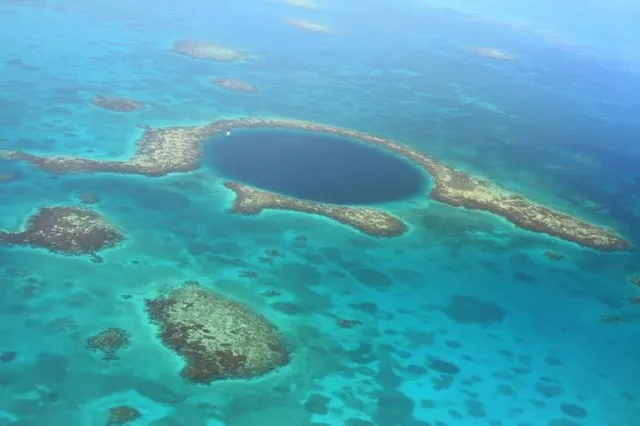
The hole is circular in shape, approximately 300 meters (984 feet) across and 125 meters (410 feet) deep. Its depth and perfect circular shape make it an ideal spot for divers to explore.
The Great Blue Hole is home to a variety of marine life, including tropical fish, sharks, and coral formations. Divers can encounter species like Caribbean reef sharks, nurse sharks, and various types of reef fish.
Diving into the Great Blue Hole is a bucket list experience for many divers. The clear, deep waters offer excellent visibility, and the underwater stalactites and stalagmites add to its allure.
While the Great Blue Hole is a captivating dive site, it can also be challenging due to its depth and the potential for strong currents. It's recommended for experienced divers.
The Great Blue Hole is part of the larger Belize Barrier Reef Reserve System, a UNESCO World Heritage Site. Conservation efforts are ongoing to protect this unique marine ecosystem.
The Great Blue Hole attracts tourists from around the world, who come to Belize specifically to dive or snorkel in its waters. Boat tours and diving excursions are available from nearby towns like Belize City...
Read more