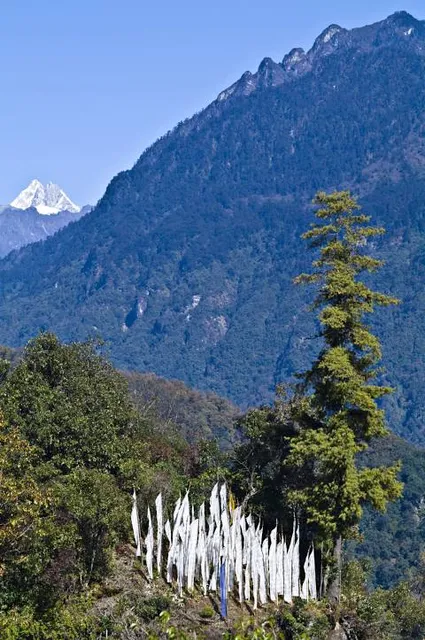
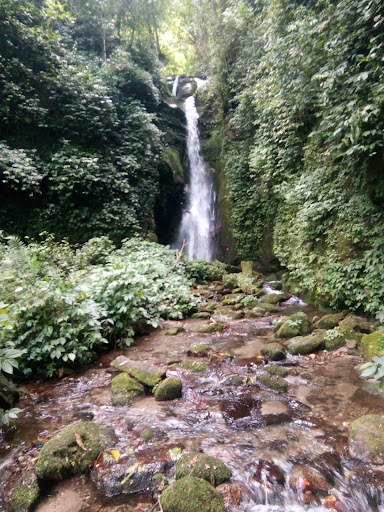
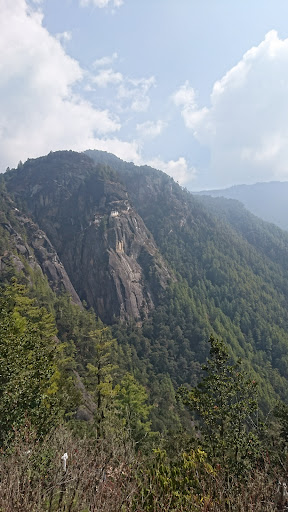
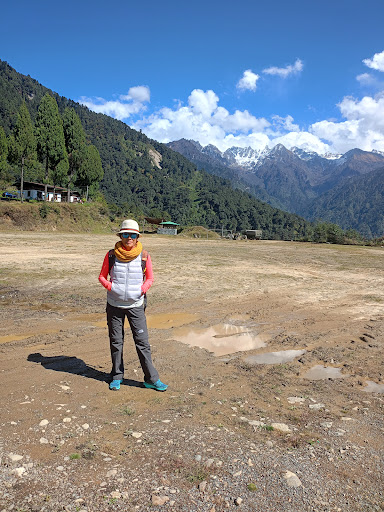
The Jigme Dorji National Park (JDNP),1] named after the late Jigme Dorji Wangchuck, is the second-largest National Park of Bhutan. It occupies almost the entire Gasa District, as well as the northern areas of Thimphu District, Paro District, Punakha, and Wangdue Phodrang Districts. It was established in 1974 and stretches over an area of 4316 km², thereby spanning all three climate zones of Bhutan, ranging in elevation from 1400 to over 7000 meters. About 6,500 people in 1,000 households live within the park, from subsistence agriculture and animal husbandry. It is listed as a tentative site in Bhutan's Tentative List for UNESCO inclusion.
The park provides sanctuary for 37 known species of mammals including several endangered, threatened or vulnerable species, such as the Bhutan takin, snow leopard, clouded leopard, Bengal tiger, bharal or Himalayan blue sheep, black musk deer, Himalayan black bear, red panda, Ussuri dhole, and spotted linsang. It is also home to the Indian leopard, Himalayan serow, sambar, barking deer, Himalayan goral, Himalayan marmot, Himalayan pika, and more than 300 species of birds. It is also the only park in Bhutan where the national animal (takin), flower (blue poppy), bird (raven) and tree (cypress) exist together.
Jigme Dorji also contains sites of cultural and economic significance. Mount Jomolhari and Mount Jitchu Drake are worshipped as homes of the local deity. The fortresses of Lingshi Dzong and Gasa Dzong are sites of historical importance. The rivers Mo Chhu, Wangdi Chhu and Pa Chhu have their sources in the glacial lakes located in the park.
Jigme Dorji National Park covers most of northern Gasa District, including the bulk of Lunana and Laya Gewogs. These gewogs are the site of some of the most notable and precarious glaciers of Bhutan. These glaciers have thawed significantly over the course of recorded history, causing lethal and destructive glacial lake outburst floods. Chief among the glaciers and glacial lakes within the park are Thorthormi,[5 Luggye,[7] and Teri Kang.[8] As the seasons allow, temporary camps of laborers work within the park to reduce water levels to assuage the threat of...
Read moreThe Jigme Dorji National Park (JDNP),1] named after the late Jigme Dorji Wangchuck, is the second-largest National Park of Bhutan. It occupies almost the entire Gasa District, as well as the northern areas of Thimphu District, Paro District, Punakha, and Wangdue Phodrang Districts. It was established in 1974 and stretches over an area of 4316 km², thereby spanning all three climate zones of Bhutan, ranging in elevation from 1400 to over 7000 meters. About 6,500 people in 1,000 households live within the park, from subsistence agriculture and animal husbandry. It is listed as a tentative site in Bhutan's Tentative List for UNESCO inclusion.The park provides sanctuary for 37 known species of mammals including several endangered, threatened or vulnerable species, such as the takin, snow leopard, clouded leopard, Bengal tiger, bharal or Himalayan blue sheep, black musk deer, Himalayan black bear, red panda, Ussuri dhole, and spotted linsang. It is also home to the Indian leopard, serow, sambar, barking deer, goral, marmot, pika and more than 300 species of birds. It is also the only park in Bhutan where the national animal (takin), flower (blue poppy), bird (raven) and tree (cypress) exist together.Jigme Dorji also contains sites of cultural and economic significance. Mount Jomolhari and Mount Jitchu Drake are worshipped as homes of the local deity. The fortresses of Lingshi Dzong and Gasa Dzong are sites of historical importance. The rivers Mo Chhu, Wangdi Chhu and Pa Chhu have their sources in the glacial lakes located in the park.Jigme Dorji National Park covers most of northern Gasa District, including the bulk of Lunana and Laya Gewogs. These gewogs are the site of some of the most notable and precarious glaciers of Bhutan. These glaciers have thawed significantly over the course of recorded history, causing lethal and destructive glacial lake outburst floods. Chief among the glaciers and glacial lakes within the park are Thorthormi,[5 Luggye,[7] and Teri Kang.[8] As the seasons allow, temporary camps of laborers work within the park to reduce water levels to assuage the threat of...
Read moreJigme Dorji National Park (JDNP) is one of the oldest protected areas in Bhutan. Following the revision of protected areas nationwide, the park was officially upgraded to a national park in 1993 following which staffs were deputed to functionally operate it in 1995. Until the establishment of Wangchuck Centennial Park, JDNP used to be the largest national park with a revised area of 4,319 km2.
Endowed with high number of endangered plants and animals supported by huge range of vegetation types and climatic regimes, JDNP is undoubtedly the conservation jewel in the Eastern Himalayas. It is also the treasure trove of medicinal plants, natural hot springs, medicinal waters, and jaw-dropping sceneries, highly unparalleled in the country. JDNP is the only park in the country that has all the four national symbols: blue poppy, takin, raven, and cypress. It is also the only park where the Royal Bengal Tiger meets the Snow Leopard.
Every year, majority of the international tourists visit the park to relish its wealth of astounding biodiversity and scenic beauties. Major trekking routes and majestic mountain peaks, such as Jhomolhari, Masangang, Jichudrakey, Tsherimgang, and Gangarpuentsum, Ganchentag, Ganglakarchung, are found in the park.
The park is very significant from the strongpoint of national economy, because four major rivers, namely, Pachhu, Wangchhu, Pochhu, and Mochhu, originate from the park, and major hydropower dams are built on these rivers.
Administratively, the park covers five Dzongkhags, viz., Gasa (entirely), Paro, Punakha, Thimphu, and Wangduephodrang, and 15 geogs. Currently, the park is being administered by five park range offices, and one sub-park...
Read more