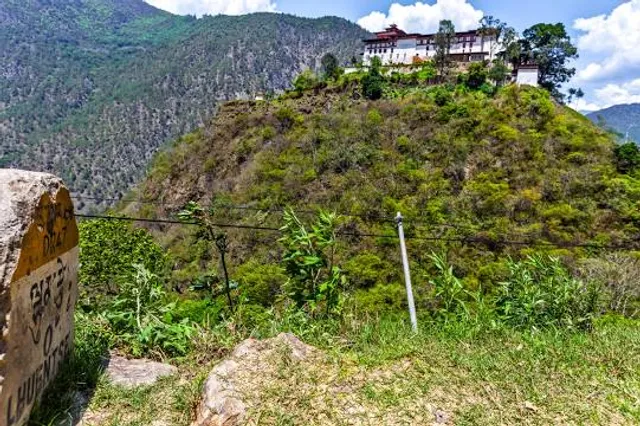
Administrative fortress Lhuntse Dzong, perched majestically on a hilltop overlooking the Kurichu River in northeastern Bhutan, is a remarkable testament to the country’s rich history and spiritual heritage. This 17th-century fortress-monastery is not only a vital religious site but also a stunning example of traditional Bhutanese architecture, featuring intricate woodwork, vibrant paintings, and beautifully crafted courtyards.
The journey to Lhuntse Dzong itself is an adventure, taking visitors through winding mountain roads with breathtaking views of lush valleys and terraced rice fields. The remoteness of the dzong adds to its charm, offering a sense of tranquility and seclusion rarely found in more accessible parts of Bhutan. Visitors are often struck by the serene atmosphere and the deep sense of spirituality that permeates the site, which is still home to many monks.
The dzong's interior is equally captivating, housing numerous sacred relics, statues, and thangkas that provide a glimpse into Bhutan’s spiritual traditions. The annual Tsechu festival held here is a vibrant celebration that draws pilgrims from across the region, featuring traditional mask dances and rituals that are both fascinating and culturally enriching.
However, Lhuntse Dzong is not the most accessible destination, and its remote location means that it receives fewer tourists compared to other more popular dzongs in Bhutan. This can be a plus for those seeking an off-the-beaten-path experience, but it also means that facilities are limited, and the journey can be challenging. Lhuntse Dzong is a hidden gem that offers a unique glimpse into Bhutan’s spiritual heart. It’s a must-visit for those interested in the country’s religious and cultural heritage, providing a peaceful retreat from the more tourist-heavy attractions. The stunning views, historical significance, and serene ambiance make Lhuntse Dzong a truly unforgettable...
Read moreThis dzong was definitely one of my favorites. Rather than be on a ridge found underneath a higher hill, this dzong is on its own hill surrounded by mountains. It makes for an impressive sight.
And unlike some of the other dzongs which are in "major population centers," this one, which is still the administrative center for an entire district, feels like it is in the middle of nowhere. The surrounding town was very small (basically one road that wound through the mountains) so you could enjoy this dzong without a bunch of cars and modern buildings in the way. As a result, Lhuentse Dzong made it easy to imagine how incredibly impressive these fortresses would have been 400 years ago.
Lhuentse Dzong is in the middle of nowhere as far as Bhutan goes. It's at least a 3 hour drive from Mongar over some pretty rough roads. Is it worth that drive? It depends on the weather, but with beautiful skies I'd say yes, the scenery along the way is beautiful. In bad weather it's a little more underwhelming of a trip.
But regardless, if you're in the area, you must see this dzong. It's...
Read moreThe origins of the dzong date back to the time of Lam Ngagi Wangchuk and are linked to the bleating of a white goat. In one tale, the Drukpa Buddhist lama Ngagi Wangchuk was scouting the area and came upon a white goat that called out "ley, ley." Recognizing that the animal was the manifestation of a local protector deity, the lama honored it by building a small outpost called Leyley Dzong.
The present structure of Dzong was built sometimes in 1654 by Chogyal Mingyur Tempa, who was Trongsa Poenlop at the very spot where Dzongchung of Lama Ngagi Wangchuk stood. According to Dasho Sonam Kinga, the numerous stones used in the dzong's fortifications were carried up the hilltop by a line of laborers who passed them hand-to-hand from the banks of the Kuri Chhu up to the construction site. Work proceeded so quickly that the dzong was described as Lhündrup Rinchentsé Dzong, which means the Fortress of the Precious Peak of Spontaneous...
Read more