Worth the arduous journey.
I tried to reach Preah Vihear from Kantharalak, Thailand, but that border had been closed due to border disputes, and no consistent public transport really existed that I knew of. I ended up hiring a driver from the guesthouse I booked into. The driver mentioned that it would be a lot easier if I just went to Phu Singh and looked through a telescope to see Preah Vihear from Thailand. He implied that it was quite difficult to get to Preah Vihear. In my mind, I was going, no matter what, even if I had to ride a horse across the mountains.
We left Kantharalak at 5:30 a.m. and arrived at Choam immigration checkpoint about 2 hours later. The roads were mostly paved, save for a few massive potholes. Choam border crossing is the home of a casino, and Preah Vihear was about 250 km away. The only way to get there was to hire a private car and driver at the cost of roughly $100. One of the Cambodian immigration officers arranged all of this for me, and a few hours later, after several stops at military checkpoints, we arrived at the base of the Dangrek Mountains around 10:30 am. I don't think my driver had been to Preah Vihear prior, because he stopped for directions on several occasions.
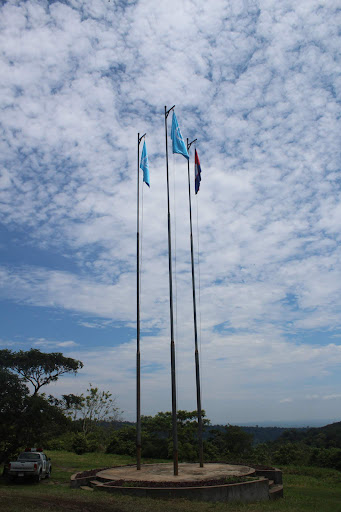
When we finally arrived, a non-descript ticket booth offered entrance tickets to the temple on a donation basis, as well as a motorbike with driver to take me up the mountain to the temple for $5/roundtrip. The driver was obviously extremely skilled because the 525 meters on a severe uphill slope to Preah Vihear Temple was quite treacherous. The path towards the temple was stone, and eroded in many places by streams of natural spring water. It was quite slippery and my flip flops didn't really have any tread left. I saw three flags on my left, the UNESCO flag, the United Nations Flag, and the Cambodian flag, and directly behind them were my long awaited ruins.
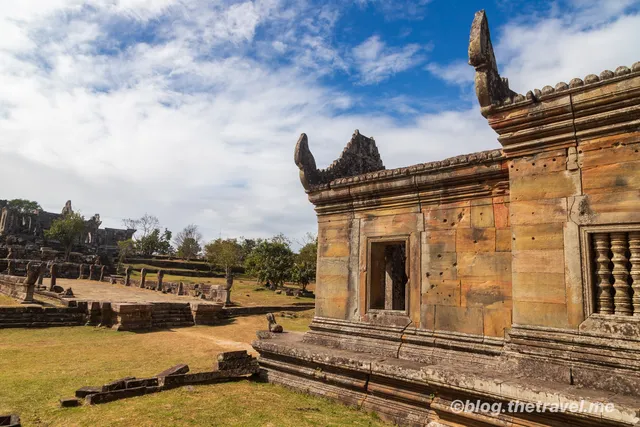
The temple was built on a north to south axis, unlike most Angkor structures that were build in a rectangle. Much of the temple had suffered damage from AK practice and crossfire, but still appeared majestic to me, all 800 meters of it. The view from the top of the temple is breathtaking, you can see the Thai side of the mountains, and if you're lucky, a Khmer soldier will lend you his telescope. I was able to look through the telescope and see a red gazebo filled with tourists and a few Thai soldiers, on the Thai side. There were no tourists from where I was standing on Cambodian soil. If you're in Southeast Asia and are able to make the journey, this temple...
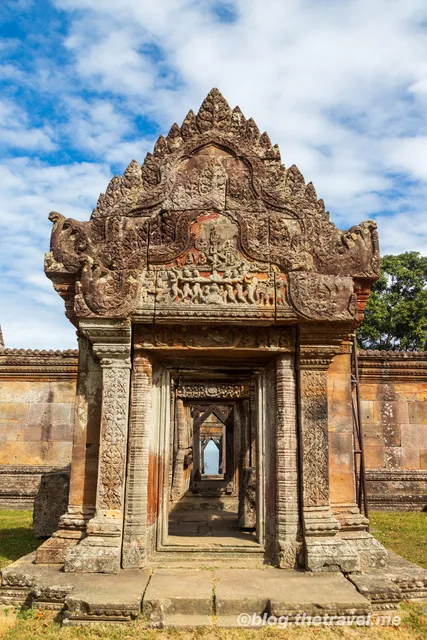
Read morePreah Vihear Temple, a UNESCO World Heritage site, is renowned for its dramatic location and impressive architecture. Perched on a cliff in the Dangrek Mountains, it offers breathtaking panoramic views of the Cambodian plain below, which many visitors find spectacular. The temple is unique among Khmer temples for its long, 800-meter north-south axis, a design that adapts to the natural environment and is a departure from the typical east-west orientation of other temples like those in Angkor. Architectural and Historical Significance The temple's history dates back to the 9th century, with most of the current structures built in the 11th and 12th centuries. It was dedicated to the Hindu god Shiva and served as a key spiritual center for the Khmer Empire. The temple complex consists of a series of sanctuaries, courtyards, and pavements connected by staircases, with five ornate entrance gates, or gopuras. These gopuras, decorated with intricate carvings and reliefs from Hindu mythology, create a journey-like experience as you ascend toward the main sanctuary at the summit. Unlike the more crowded temples of Angkor, Preah Vihear is often described as feeling more peaceful and "untouched," with trees and nature intertwined with the ancient stones, adding to its mystical charm. A Journey to the Temple Visiting Preah Vihear is more than just seeing a temple; it's an adventure. The journey itself, often a day trip from Siem Reap, winds through the Cambodian countryside, and the remote location helps to preserve a sense of tranquility and authenticity. The temple's position on the border of Cambodia and Thailand has made it the subject of historical and political disputes, but for visitors today, it stands as a testament to the architectural and spiritual brilliance of the Khmer...
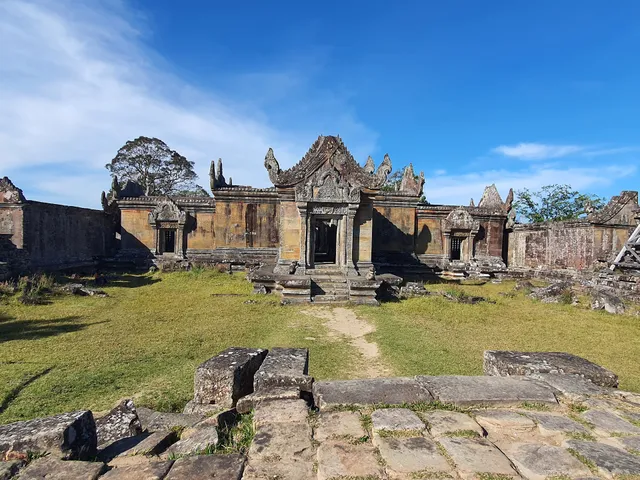
Read moreTemple of Preah Vihear: Situated on the edge of a plateau that dominates the plain of Cambodia, the Temple of Preah Vihear is dedicated to Shiva. The Temple is composed of a series of sanctuaries linked by a system of pavements and staircases over an 800 metre long axis and dates back to the first half of the 11th century AD. Nevertheless, its complex history can be traced to the 9th century, when the hermitage was founded. This site is particularly well preserved, mainly due to its remote location. The site is exceptional for the quality of its architecture, which is adapted to the natural environment and the religious function of the temple, as well as for the exceptional quality of its carved stone ornamentation.
Outstanding Universal Value: The Temple of Preah Vihear, a unique architectural complex of a series of sanctuaries linked by a system of pavements and staircases on an 800 metre long axis, is an outstanding masterpiece of Khmer architecture, in terms of plan, decoration and relationship to the spectacular landscape environment. Criterion (i): Preah Vihear is an outstanding masterpiece of Khmer architecture. It is very ‘pure’ both in plan and in the detail of its decoration. Authenticity, in terms of the way the buildings and their materials express well the values of the property, has been established. The attributes of the property comprise the temple complex; the integrity of the property has to a degree been compromised by the absence of part of the promontory from the perimeter of the property. The protective measures for the Temple, in terms of legal protection are adequate; the progress made in defining the parameters of the Management Plan needs to be consolidated into an approved, full...
Read more