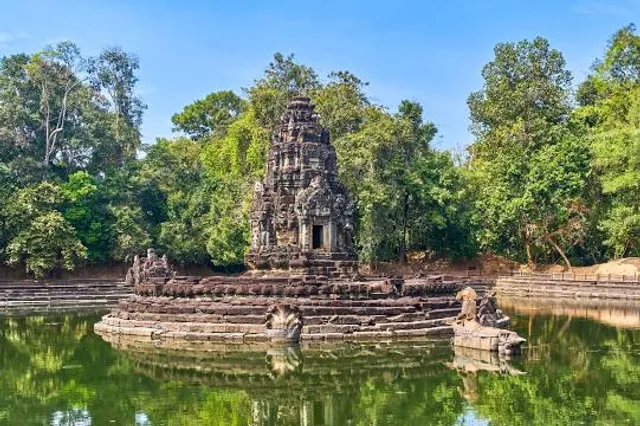
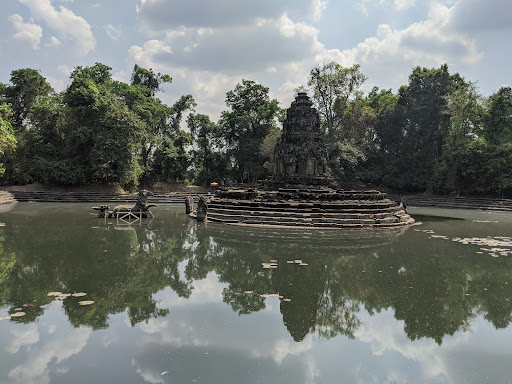
Neak Pean is one of the temples that make one dream of the olden days of luxury and beauty. It was worth while to the overpowering temples of Shiva that men and armies repaired; but it was at the tiny temple of Neak Pean that eager princesses laid their lovely offerings of wrought gold and pungent perfumes.A enter and leave from the north entrance. It was built in second half of the 12th century by king Jayavarman VII, dedicated to Buddhist, with following to Prasat Bayon art style. Although. Neak Pean is small and a collection of five ponds, it is worth a visit for its unique features. It is believed to have been consecrated to Buddha coning to the glory of Nirvana. The central pond is a replica of Lake Anavatapta in the Himalayas, situated at the top of the universe. The lake gives birth to the four great rivers of the earth. These rivers are represented at Neak Pean by sculpted gargoyles corresponding to the four cardinal points Lake Anavatapta was fed by hot springs and venerated in India for the curative powers of its waters. The orientation of the ponds at Neak Pean ensured that the water was always fresh because the pods received only reflected light. LAYOUT Neak Pean is a large square man-made pond (70 meters, 230 feet each side) bordered by steps and surrounded by four smaller ponds. A small circular island with a stepped base of seven laterite tiers is in the center of the large square pond. Small elephants sculpted in the round originally stood on the four comers. The central tower was dedicated to Avalokitesvara. CENTRAL ISLAND The bodies of two serpents encircle the base of the island and their entwine on… Neak Pean-the last word being pronounced , and the whole name signifies curved Nagas. Neak Pean is one of the temples that makes one dream of the olden days of luxury and beauty. It was worth while to live then and to be a woman among a race which has waver adored its women. To begin with there was the artificial lake, a wide extent of water in the shallows of which floated the flowering lotus. In its exact center, the surveyors of Angkor were expert stood the exquisite miniature temple of one small chamber, the sanctuary, a temple as finely ornate and as well-proportioned as an alabaster vase. With art delicious this wonder was made to appear like a vision in the land of faerie. It floated upon a full-opened flower of the lotus, the petal tips curling back to touch the water. On the corolla of the flower curved around the temple’s base, were two Nagas whose tails were twisted together at the back and who raised their fan of heads on either side of the steps in front which mounted to the sanctuary. Thus they guarded the gem and gave gracious welcome to whosoever directed her light barque to draw close to this lovely heaven. On this circular pedestal of poetic imagination rested a square temple with four carved doors, one open occupying all the fasade except for the square columns which flank it. Above rose the tower with pointed over-door groups of carvings, symbolic, graceful, inspiring Each closed door bore the figure of the humane god Vishnu standing at full height,but lest he impress too strongly his grandeur in this dainty spot, the space about him is filled with minor carving which vary on each door. Within this lovely casket was a seated stone figure. The door was ever open, suppliants might at any time lay before Buddha their offerings and...
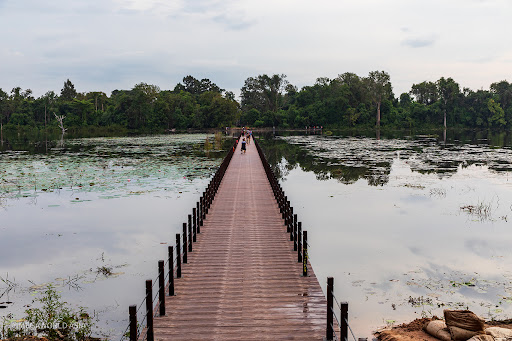
Read moreBaray is an ancient water reservoir built by raising a dam around it. It has the following main functions: refill the underground water to ensure the humidity of the sand layer under the temple to maintain the stability of the temple, irrigation in downstream water supply for daily use avoid flood in the region by storing water temporarily during the rainy season The North Baray was built under the Reign of King Jayavarman VII (1181-1218). Its original name was Jayatataka "Chey Tadak". Some local people call it "Veal Reach Dak", North Baray, or "Baray Neak Poan". The North Baray is 3,600 meters long and 930 meters wide, with Neak Poan temple as its center (like the Mebon of the other Barays), and on its western edge, there is a terrace that leads to Preah Khan Temple. It has been dried for more than 500 years. Some researchers thought that it was impossible to rehabilitate it. However, in 2007, the Water and Forest Department of APSARA National Authority repaired the system - which was found in 2005 by the Head of the Water and Forest Department - the ancient canals and dams and built water gates to control the water flow on the ancient water system of Baray. In 2008, water began to flow back into the North Baray and supplied the moat of Angkor Thom via a canal, and the moat of Preah Khan and Neak Poan temples from the groundwater. The water flowed into North Baray was 700,000 cubic meters in 2008, 3,000,000 cubic meters in 2009, 3,678,000 cubic meters in 2010, and 5,000,000 cubic meters in 2011. The North Baray with its surrounding temples such as Neak Poan, Preah Khan, and Angkor Thom is a crucial educational element for the non-water specialist public to understand the Angkorean Hydraulic System. It is the most important reservoir to supply Angkor Thom city through its own water canal from an outlet of the south-west corner of Baray. The moat of Preah Khan temple is all time full of water thanks to the North Baray too. APSARA National Authority also organizes nature tours in the southern part of the North Baray and boat ride tours with the participation of the local community to attract national and international tourists visiting the Angkor Site and allow them to find out more about the community as well as water management in Angkor. A visit to Neak Poan temple will make tourists more aware of the underground connection of its basins with the...
Read moreNeak Pean Temple
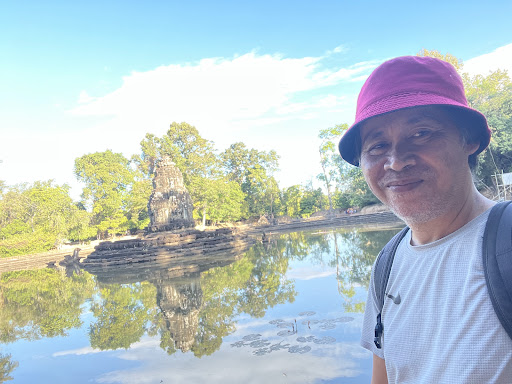
Neak Pean, located in the Angkor region of Cambodia, is a unique and historically significant Buddhist temple built in the late 12th century during the reign of King Jayavarman VII. The temple is situated on an artificial island at the center of the Jayatataka Baray, a large reservoir, and is known for its symbolic and architectural uniqueness.
The name "Neak Pean" translates to "The Entwined Serpents," referring to the sculptures of serpents (nagas) that encircle the base of the temple. These nagas are believed to represent Nanda and Upananda, two mythical serpents associated with the sacred Himalayan lake Anavatapta, whose waters were thought to cure all illnesses.
Neak Pean was originally designed for medical purposes, based on the ancient belief that bathing in the pools would balance the elements in the bather, thus curing diseases. The temple complex consists of a central sanctuary on a circular island, surrounded by four connected pools, each representing one of the four elements: Water, Earth, Fire, and Wind. These pools are connected to the central pool by stone conduits, each adorned with a spout in the shape of an animal head, symbolizing the four cardinal directions.
The central sanctuary is dedicated to the Bodhisattva Avalokiteshvara, known in Khmer culture as Lokeshvara. The temple's design and its association with healing reflect the compassionate nature of Avalokiteshvara, who is believed to help alleviate suffering.
Neak Pean's serene and picturesque setting, combined with its historical and symbolic significance, makes it a popular site for visitors to Angkor. The temple offers a tranquil environment for exploration and reflection, providing insights into the religious and architectural achievements of the Khmer...
Read more