Mount Kailash (also Kailasa; Kangrinboqê or Gang Rinpoche; Tibetan: གངས་རིན་པོ་ཆེ; simplified Chinese: 冈仁波齐峰; traditional Chinese: 岡仁波齊峰; Sanskrit: कैलास, IAST: Kailāsa), is a mountain in the Ngari Prefecture, Tibet Autonomous Region of China. It has an altitude of 6,714 m (22,028 ft).1] It lies in the Kailash Range (Gangdisê Mountains) of the Transhimalaya, in the western part of the Tibetan Plateau. Mount Kailash is less than 100 km towards the north from the western trijunction of the borders of China, India, and Nepal.[2]
Mount Kailash is located close to Lake Manasarovar and Lake Rakshastal. The sources of four major Asian rivers lie close to this mountain and the two lakes. These rivers are the Indus, the Sutlej, the Brahmaputra, and the Karnali (a tributary of the Ganges). Mount Kailash is considered sacred in four religions: Hinduism, Buddhism, Jainism[3] and Bon.
Tibetan Buddhists call it Kangri Rinpoche; 'Precious Snow Mountain'. Bon texts have many names: Water's Flower, Mountain of Sea Water, Nine Stacked Swastika Mountain. For Hindus, it is the home of the Hindu god Shiva and it is believed that Shiva resides there; for Jains it is where their first leader was enlightened; for Buddhists, the navel of the universe; and for adherents of Bon, the abode of the sky goddess Sipaimen."[9]
Climate change due to global warming is happening three times faster on the Tibetan Plateau than anywhere else in the world.[55] Mount Kailash is located in a mountain range upon the Tibetan Plateau, near the plateau's western edges. According to local observers, the land around Mount Kailash has been growing warmer in recent years; the pilgrimage season isn't as cold as it used to be.[56] According to available data from the region, glaciers are retreating, lakes are shrinking, the amount of barren land is increasing, and the eventual thawing of the permafrost in this region may lead to uncertain effects on water resources and carbon cycles.[57] The intergovernmental organisation ICIMOD is involved in ongoing efforts to generate knowledge on the ecological, social, and economic effects of climate change, and sustainable ways to cope with them, in the Chinese region around Mt Kailash and the bordering areas of Uttarakhand (India) and western Nepal, in a transboundary project called the Kailash Sacred Landscape Conservation and Development Initiative.
The region around Mount Kailash and the Indus headwaters area is typified by wide-scale faulting of metamorphosed late Cretaceous to mid Cenozoic sedimentary rocks which have been intruded by igneous Cenozoic granitic rocks. Mount Kailash appears to be a metasedimentary roof pendant supported by a massive granite base. The Cenozoic rocks represent offshore marine limestones deposited before subduction of the Tethys oceanic crust. These sediments were deposited on the southern margin of the Asia block during subduction of the Tethys oceanic crust before the collision between the Indian and Asian...
Read more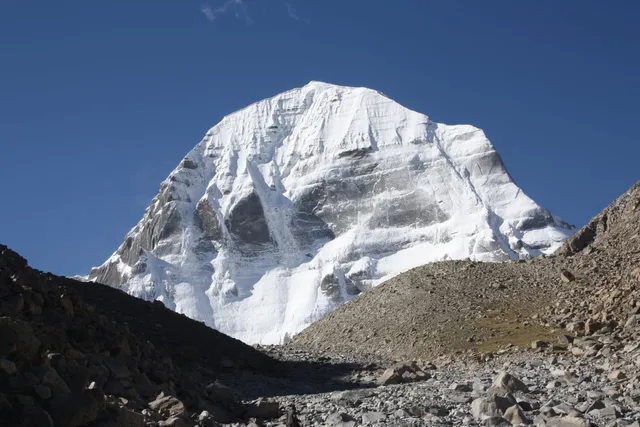
 Learn more insights from Wanderboat AI.