HTML SitemapExplore
logo
Find Things to DoFind The Best Restaurants

Mapang Yongcuo — Attraction in Hor

Name
Mapang Yongcuo
Description
Nearby attractions
Nearby restaurants
Nearby hotels
Related posts
Keywords
Mapang Yongcuo tourism.Mapang Yongcuo hotels.Mapang Yongcuo bed and breakfast. flights to Mapang Yongcuo.Mapang Yongcuo attractions.Mapang Yongcuo restaurants.Mapang Yongcuo travel.Mapang Yongcuo travel guide.Mapang Yongcuo travel blog.Mapang Yongcuo pictures.Mapang Yongcuo photos.Mapang Yongcuo travel tips.Mapang Yongcuo maps.Mapang Yongcuo things to do.
Mapang Yongcuo things to do, attractions, restaurants, events info and trip planning
Mapang Yongcuo
ChinaTibetHorMapang Yongcuo

Basic Info

Mapang Yongcuo

Burang County, Ngari Prefecture, China
4.5(963)
Open 24 hours
Save
spot

Ratings & Description

Info

Outdoor
Scenic
Adventure
Off the beaten path
attractions: , restaurants:
logoLearn more insights from Wanderboat AI.

Plan your stay

hotel
Pet-friendly Hotels in Hor
Find a cozy hotel nearby and make it a full experience.
hotel
Affordable Hotels in Hor
Find a cozy hotel nearby and make it a full experience.
hotel
The Coolest Hotels You Haven't Heard Of (Yet)
Find a cozy hotel nearby and make it a full experience.
hotel
Trending Stays Worth the Hype in Hor
Find a cozy hotel nearby and make it a full experience.

Reviews

Get the Appoverlay
Get the AppOne tap to find yournext favorite spots!
Wanderboat LogoWanderboat

Your everyday Al companion for getaway ideas

CompanyAbout Us
InformationAI Trip PlannerSitemap
SocialXInstagramTiktokLinkedin
LegalTerms of ServicePrivacy Policy

Get the app

© 2025 Wanderboat. All rights reserved.
logo

Posts

Dippu NarzaryDippu Narzary
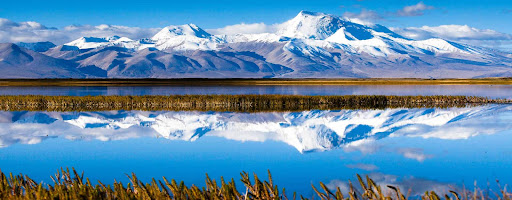
ake Mansarovar, nestled in the southwestern part of the Tibetan Plateau in Western Tibet, holds profound spiritual and cultural significance. At an elevation of 4,590 meters (15,060 feet), it is one of the highest freshwater lakes in the world and covers an area of about 320 square kilometers. Regarded as a sacred site in Hinduism, Buddhism, and Jainism, Lake Mansarovar is believed to be the abode of purity and a source of spiritual enlightenment. Pilgrims from various parts of the world embark on the challenging journey to circumambulate the lake, a ritual that holds immense religious importance. The lake is fed by glacial meltwater from the surrounding mountains, and its crystal-clear waters mirror the snow-capped peaks that encompass it. The serene and awe-inspiring landscape adds to the mystical aura of the lake. Mansarovar is often associated with Mount Kailash, considered sacred in multiple religions. The circumambulation of both the lake and the mountain is a revered pilgrimage known as the Kailash Mansarovar Yatra. The journey around this sacred lake is believed to cleanse the soul and bring spiritual blessings. Despite its remote location and challenging terrain, Lake Mansarovar remains a destination that captivates the hearts and minds of those seeking spiritual enlightenment and a connection to the divine.
Trip To TemplesTrip To Temples
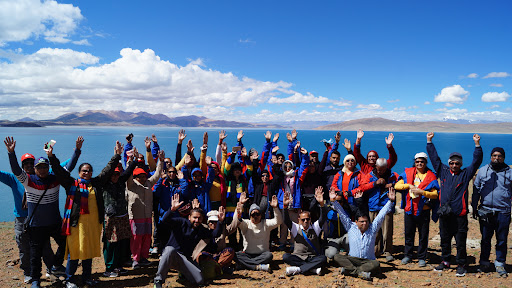
The Lake Mansarovar was formed by universe creator Brahma ji is an eternal pilgrimage place for all hinduism followers. This is the where you can connect yourself with God of All Gods - Shiva. Its believed that God Shiva & Mata Parvati take bath in lake Mansarovar I brahma muhurt (early morning). We at Trip To Temples .com feel extremely blessed to take highest numbers of pilgrims from India to lake Mansarovar & Holy Mt Kailash darshan. Divinity of the place is incomparable & we witness tears of happiness in eyes of pilgrims when they reach here & see Kailash From here. Visiting this holy place is blessing for the life & life beyond this life too. While serving pilgrims for this holy yatra, blessing by them is best what one can get for one's service. Earlier this lake used to have perimeter of approx 105 KMs but ow has around 90-95 KMs & Parikrama os the same is done by bus.It takes 3-4 hrs & we we spend some time for taking dip into the lake. One must assure that we are not making it dirty by throwing packets, old cloths or flowers in the Lake. This is the Shiva's Place, needs nothing but only devotion. Har Har Mahadev !!
Partha Pratim GogoiPartha Pratim Gogoi
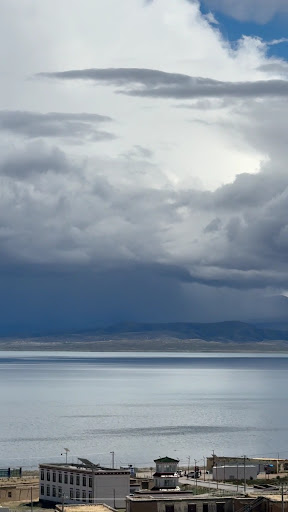
Lake Manasarovar lies at 4,590 m (15,060 ft) above mean sea level, a relatively high elevation for a large fresh water lake on the mostly saline lake-studded Tibetan Plateau. Lake Manasarovar is relatively round in shape with the circumference of 88 km (54.7 mi). Its depth reaches a maximum depth of 90 m (300 ft)[citation needed] and its surface area is 320 km2 (123.6 sq mi). It is connected to nearby Lake Rakshastal by the natural Ganga Chhu channel. Lake Manasarovar is near the source of the Sutlej, which is the easternmost large tributary of the Indus. Nearby are the sources of the Brahmaputra River, the Indus River, and the Karnali, an important tributary of the Ganges. Lake Manasarovar overflows into Lake Rakshastal which is a salt-water endorheic lake. When the level of Lake Rakshastal matched that of Lake Manasarovar, these (very narrowly) combined lakes overflowed into the Sutlej basin. Stranded beaches around Lake Rakshastal at 4586 meter would indicate that decrease in inflow and/or increase in evaporation are the cause of this lost connection to the Indus basin rather than tectonic activity.
See more posts
See more posts
hotel
Find your stay

Pet-friendly Hotels in Hor

Find a cozy hotel nearby and make it a full experience.

ake Mansarovar, nestled in the southwestern part of the Tibetan Plateau in Western Tibet, holds profound spiritual and cultural significance. At an elevation of 4,590 meters (15,060 feet), it is one of the highest freshwater lakes in the world and covers an area of about 320 square kilometers. Regarded as a sacred site in Hinduism, Buddhism, and Jainism, Lake Mansarovar is believed to be the abode of purity and a source of spiritual enlightenment. Pilgrims from various parts of the world embark on the challenging journey to circumambulate the lake, a ritual that holds immense religious importance. The lake is fed by glacial meltwater from the surrounding mountains, and its crystal-clear waters mirror the snow-capped peaks that encompass it. The serene and awe-inspiring landscape adds to the mystical aura of the lake. Mansarovar is often associated with Mount Kailash, considered sacred in multiple religions. The circumambulation of both the lake and the mountain is a revered pilgrimage known as the Kailash Mansarovar Yatra. The journey around this sacred lake is believed to cleanse the soul and bring spiritual blessings. Despite its remote location and challenging terrain, Lake Mansarovar remains a destination that captivates the hearts and minds of those seeking spiritual enlightenment and a connection to the divine.
Dippu Narzary

Dippu Narzary

hotel
Find your stay

Affordable Hotels in Hor

Find a cozy hotel nearby and make it a full experience.

Get the Appoverlay
Get the AppOne tap to find yournext favorite spots!
The Lake Mansarovar was formed by universe creator Brahma ji is an eternal pilgrimage place for all hinduism followers. This is the where you can connect yourself with God of All Gods - Shiva. Its believed that God Shiva & Mata Parvati take bath in lake Mansarovar I brahma muhurt (early morning). We at Trip To Temples .com feel extremely blessed to take highest numbers of pilgrims from India to lake Mansarovar & Holy Mt Kailash darshan. Divinity of the place is incomparable & we witness tears of happiness in eyes of pilgrims when they reach here & see Kailash From here. Visiting this holy place is blessing for the life & life beyond this life too. While serving pilgrims for this holy yatra, blessing by them is best what one can get for one's service. Earlier this lake used to have perimeter of approx 105 KMs but ow has around 90-95 KMs & Parikrama os the same is done by bus.It takes 3-4 hrs & we we spend some time for taking dip into the lake. One must assure that we are not making it dirty by throwing packets, old cloths or flowers in the Lake. This is the Shiva's Place, needs nothing but only devotion. Har Har Mahadev !!
Trip To Temples

Trip To Temples

hotel
Find your stay

The Coolest Hotels You Haven't Heard Of (Yet)

Find a cozy hotel nearby and make it a full experience.

hotel
Find your stay

Trending Stays Worth the Hype in Hor

Find a cozy hotel nearby and make it a full experience.

Lake Manasarovar lies at 4,590 m (15,060 ft) above mean sea level, a relatively high elevation for a large fresh water lake on the mostly saline lake-studded Tibetan Plateau. Lake Manasarovar is relatively round in shape with the circumference of 88 km (54.7 mi). Its depth reaches a maximum depth of 90 m (300 ft)[citation needed] and its surface area is 320 km2 (123.6 sq mi). It is connected to nearby Lake Rakshastal by the natural Ganga Chhu channel. Lake Manasarovar is near the source of the Sutlej, which is the easternmost large tributary of the Indus. Nearby are the sources of the Brahmaputra River, the Indus River, and the Karnali, an important tributary of the Ganges. Lake Manasarovar overflows into Lake Rakshastal which is a salt-water endorheic lake. When the level of Lake Rakshastal matched that of Lake Manasarovar, these (very narrowly) combined lakes overflowed into the Sutlej basin. Stranded beaches around Lake Rakshastal at 4586 meter would indicate that decrease in inflow and/or increase in evaporation are the cause of this lost connection to the Indus basin rather than tectonic activity.
Partha Pratim Gogoi

Partha Pratim Gogoi

See more posts
See more posts

Reviews of Mapang Yongcuo

4.5
(963)
avatar
5.0
6y

Lake Manasarovar (Tibetan: མ་ཕམ་གཡུ་མཚོ།,Wylie: ma pham g.yu mtsho; Chinese: 玛旁雍错 (simplified), 瑪旁雍錯(traditional) also called Mapam Yumtso, as well as Manas Sarovar (in Bengali and several other Indian languages), is a high altitude freshwater lakefed by the Kailash Glaciers near Mount Kailash in the Tibet Autonomous Region,China. The lake is revered as a sacred place in four religions: Bön, Buddhism, Hinduism, andJainism.The Sanskrit word "Manasarovar" (मानसरोवर) is a combination of two Sanskrit words; "Mānas" (मानस्) meaning "mind (in its widest sense as applied to all the mental powers), intellect, intelligence, understanding, perception, sense, conscience" while "sarovara" (सरोवर) means "a lake or large pond".Lake Manasarovar lies at 4,590 m (15,060 ft) above mean sea level, a relatively high elevation for a large freshwater lake on the mostly saline lake-studded Tibetan Plateau.

Lake Manasa sarovar is relatively round in shape with the circumference of 88 km (54.7 mi). Its depth reaches a maximum depth of 90 m (300 ft) and its surface area is 320 km2 (123.6 sq mi). It is connected to nearby Lake Rakshastal by the naturalGanga Chhu channel. Lake Manasarovar is near the source of the Sutlej, which is the easternmost large tributary of the Indus. Nearby are the sources of the Brahmaputra River, the Indus River, and the Ghaghara, an important tributary of the Ganges.

Lake Manasarovar overflows into Lake Rakshastal which is a salt-water endorheic lake. These lakes used to be part of the Sutlej basin and were separated due to tectonic activity. In Hinduism According to Hinduism, the lake was first created in the mind of the Lord Brahma after which it manifested on Earth.In Hinduism, Lake Manasarovar is a personification of purity, and one who drinks water from the lake will go to the abode of Shiva after death. He or she is believed to be cleansed of all their sins committed over even a hundred lifetimes.

Like Mount Kailash, Lake Manasarovar is a place of pilgrimage, attracting religious people from India, Nepal, Tibet and neighboring countries. Bathing in Manasarovar and drinking its water is believed by Hindus to cleanse all sins.Pilgrimage tours are organized regularly, especially from India, the most famous of which is the yearly "Kailash Manas Sarovar Yatra". Pilgrims come to take ceremonial baths in the waters of the lake.

Lake Manasarovar has long been viewed by the pilgrims as being nearby to the sources of four great rivers of Asia, namely theBrahmaputra, Ghaghara, Sindhu and Sutlej, thus it is an axial point which has been thronged to by pilgrims for thousands of years. The region was closed to pilgrims from the outside following the Battle of Chamdo; no foreigners were allowed between 1951 and 1980. After the 1980s it has again become a part of the Indian pilgrim trail.

According to the Hinduism, the lake was first created in the mind of Brahma after which it manifested on Earth. Hence it is called "Manasa sarovaram", which is a combination of the Sanskrit words for "mind" and "lake". The lake is also supposed to be the summer abode of the hamsa. Considered to be sacred, the hamsa is an important element in the symbology of the subcontinent, representing wisdom and beauty.According to Hindu theology, there are five sacred lakes; collectively called Panch-Sarovar; Mansarovar, Bindu Sarovar, Narayan Sarovar, Pampa Sarovar and Pushkar Sarovar.They are also mentioned inShrimad Bhagavata Purana. The People who belong to this region are called Manasarovariya. Most of those who follow Hinduism here belong to the Koli tribe called Manasarovariya Patels or Mandhata Patels and they claim that their tribe are descendants of the ancient King Mandhata ofSuryavansha or Ikshvaku dynasty. There is a mountain nearby named after him. It is calledGurla Mandhata and is the highest peak of...

   Read more
avatar
5.0
33w

Lake Manasarovar (Sanskrit: मानसरोवर, romanized: Mānasarōvar), also called Mapam Yumtso (Tibetan: མ་ཕམ་གཡུ་མཚོ།, Wylie: ma pham g.yu mtsho, THL: ma pam yu tso; Chinese: 瑪旁雍錯; pinyin: Mǎ páng yōng cuò) locally,a] is a high altitude freshwater lake near Mount Kailash in Burang County, Ngari Prefecture, Tibet Autonomous Region, China. It is located at an elevation of 4,600 m (15,100 ft), near the western trijunction between China, India and Nepal. It overflows into the adjacent salt-water lake of Rakshastal via the Ganga Chhu. The sources of four rivers: Indus, Sutlej, Brahmaputra, and Karnali lie in the vicinity of the region.

The lake is sacred in Hinduism, Buddhism, Jainism and Bon religion. People from India, China, Nepal and other countries in the region undertake a pilgrimage to the region. The pilgrimage generally involves trekking towards Lake Manasarovar and a circumambulation of the nearby Mount Kailash.

Etymology The Sanskrit word "Manasarovar" (मानसरोवर) is a combination of two Sanskrit words, Mānas (मानस्) meaning "mind" (generally denotes the mental powers associated including intellect, perception, conscience)[3] and sarovar (सरोवर) meaning "lake or a large pond".[4] The lake is called as Mapam Yumtso (Tibetan: མ་ཕམ་གཡུ་མཚོ།, Wylie: ma pham g.yu mtsho, THL: ma pam yu tso; Chinese: 瑪旁雍錯; pinyin: Mǎ páng yōng cuò) and Tso Madröpa locally. In his Tibetan-English dictionary, Sarat Chandra Das states that Mapam Yumtso is derived from Mapam meaning unconquerable or invincible and Tso Madröpa is derived from Madropa meaning "ground heated by the Sun" both used in combination with Tso, the Tibetan word for lake.[5]

Geography

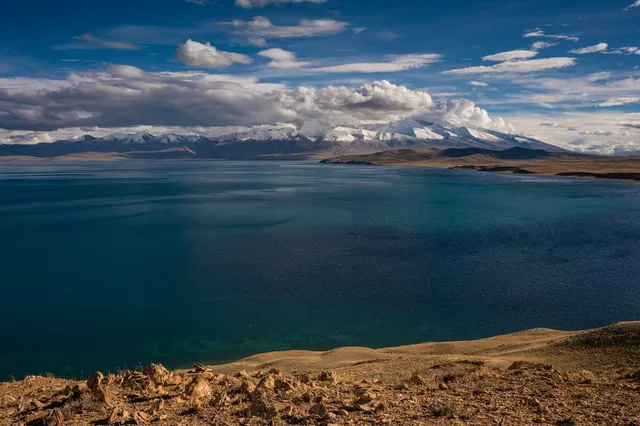
Topography of the region showing Manasarovar (right) and Rakshastal lakes with Mount Kailash. Lake Manasarovar is located in Ngari Prefecture, Tibet Autonomous Region of China.[6 It is located in the southwest region of Tibet north of the western tripoint of the border between China, India and Nepal.8] It is visible from the Lapcha La pass above the Limi valley in Nepal on a clear day.[9] The freshwater lake lies at 4,600 m (15,100 ft) above mean sea level on the mostly saline lake-studded Tibetan Plateau and is one of the highest freshwater lakes in Asia.[611]

Spread over a surface area of 320 km2 (120 sq mi), Lake Manasarovar is relatively round in shape with a circumference of 88 km (55 mi) and a maximum depth of 100 m (330 ft).[12] Manasarovar overflows into the salt-water endorheic lake of Rakshastal via the natural Ganga Chhu channel.[1014] The major rivers rising from the region include Yarlung Tsangpo (which becomes the Brahmaputra), the Indus, the Sutlej and the Karnali, a tributary of Ganges.[15

Climate

Map of the Manasarovar region The weather is fairly dry during April to June with day time temperatures of more than 5 °C (41 °F) and night time temperatures close to 0 °C (32 °F). The temperature starts to decrease in October with January being the coldest. Winters have day time temperatures below freezing with colder nights.17] Monsoons bring rain from late June to August with cold winds.[18]

Global warming is described as happening more rapidly on the Tibetan Plateau than anywhere else in the world.[19 According to locals, the land around the region has been growing warmer in recent years with winters not as cold as it used to be.21] The retreating glaciers and thawing of the permafrost in the Tibet region might lead to uncertain effects on water resources of the region. These effects along with population explosion and tourism has put severe stress on the fragile...

   Read more
avatar
5.0
3y

Har Har Mahadev 🙏🙏🙏🙏

The Sanskrit word "Manasarovar" (मानसरोवर) is a combination of two Sanskrit words; "Mānas" (मानस्) meaning "mind (in its widest sense as applied to all the mental powers), intellect, intelligence, understanding, perception, sense, conscience"while "sarovara" (सरोवर) means "a lake or a large pond deep enough for a lotus".

Lake Manasarovar lies near Mount Kailash, and is an integral part of a Kailash-Manasarovar pilgrimage.

In Hinduism

Lake Manasarovar and Mount Kailash are believed to be the abode of Shiva. This is where the holy river the Ganges is believed to be tamed by Shiva and sent to nourish the fertile valleys below the Himalayas. It is sometimes conflated with Meru.[3] For the Khas Hindu shamans of the nearby region of Humla (northwest Nepal), a ritual bath in Lake Manasarovar is an important step in gaining their shamanic powers.

In the Bon religion

The Bon religion is also associated with the holy place of Zhang Zhung Meri sacred deity. When Tonpa Shenrab, the founder of the Bon religion, visited Tibet for the first time and bathed in the lake.

In Buddhism

Buddhists associate the lake as the mother principle, with Kailash as the father principle. The Yamantaka shrine here is one of the eight guardian deities, who is shown in the act of a sexual embrace to unite compassion and wisdom. A traditional 32-mile circuit around the mountain, called kora, is believed to be particularly holy walk.

The lake has a few monasteries on its shores, the most notable of which is the ancient Chiu Monastery built on a steep hill, looking as if it has been carved right out of the rock.

In Jainism

In Jainism, Lake Manasarovar is associated with the first Tirthankara, Rishabha.[3] As per Jain scriptures, the first Tirthankar, Bhagwan Rishabhdev, had attained nirvana on the Ashtapad Mountain. The son of Bhagwan Rishabhdev, Chakravati Bharat, had built a palace adorned with gems on the Ashtapad Mountain located in the Himalayas. There are many stories related to Ashtapad Maha Tirth like Kumar and Sagar's sons, Tapas Kher Parna, Ravan and Mandodri Bhakti, among many others.

It is located about 50 kilometers to the northwest of Nepal, about 100 kilometers east of Uttarakhand, and in the southwest region of Tibet. The lake lies at 4,590 m (15,060 ft) above mean sea level, a relatively high elevation for a large freshwater lake on the mostly saline lake-studded Tibetan Plateau. It freezes in the winter. According to Brockman, it is one of the highest freshwater lakes in Asia (with the highest being the Tilicho Lake in Nepal at altitude of 4919 m).

Lake Manasarovar is relatively round in shape. It is connected to nearby Lake Rakshastal by the natural Ganga Chhu channel. Lake Manasarovar is near the source of the Sutlej, which is the easternmost large tributary of the Indus. Nearby are the sources of the Brahmaputra River, the Indus River, and the Karnali, an important tributary of the Ganges.

Lake Manasarovar overflows into Lake Rakshastal which is a salt-water endorheic lake. When the level of Lake Rakshastal matched that of Lake Manasarovar, these (very narrowly) combined lakes overflowed into the Sutlej basin.

Lake Manasarovar and Mount Kailash are visible from the Lapcha La pass, located above the Limi valley in district...

   Read more

Page 1 of 7
Previous
Next