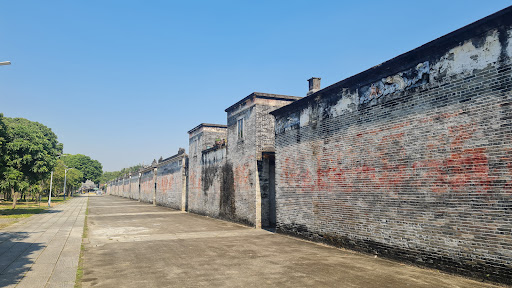
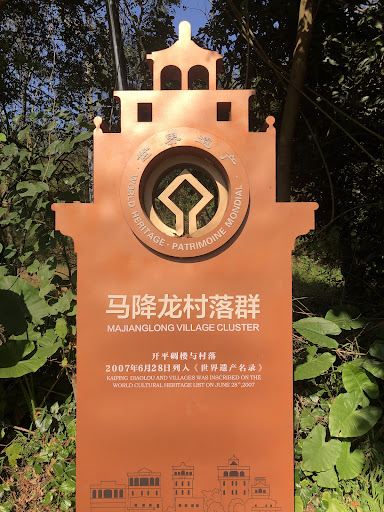
Diaolou (simplified Chinese: 碉楼)are fortified multi-storey watchtowers in rural villages, generally made of reinforced concrete. These towers are located mainly in Kaiping (开平),Guangdong province (广東省), China. In 2007, UNESCO designated the Kaiping Diaolou and Villages (开平碉楼与村落) a World Heritage Site. These buildings demonstrate a unique fusion of 19th- and 20th-century Chinese and Western architectural styles. Diaolou structures were built from the time of the Ming dynasty to the early 20th century, reaching a peak during the Warlord Era in the 1920s and 1930s, with the financial aid of overseas Chinese, when there were more than three thousand of these structures. Today, approximately 1,800 diaolou remain standing, and mostly abandoned, in the village countryside of Kaiping. Today, a few of these towers were renovated and being used as residence, and some, opened to visitors as museums. I recently visited two groups of Diaolou villages. One is Liyuan Gardens (立园)owned and built by Xie Weili 謝維立and his father Xie Shengpan 謝圣泮back in 1920s. The other is Zili Village (自力村) group of Diaolou built between 1900 and 1930 by the Fang (方)relatives. Most of these towers were built of reinforced concrete with exterior walls more than two-foot thick. Most have four, five, and even six floors. The main function of these buildings were for defence against bandits attacks, and secondly use for...
Read moreA Kaiping Diaolou (碉楼) is (was) a fortified multi-storey watchtower constructed usually over concrete, in the countryside villages around the Kaiping area, at its peak between 1920 and 1930 when some three thousand were built.
All made by families who had worked a long time outside China, overseas Chinese (华侨), mostly in North America but also South America, Southeast Asia (e.g. Malaya) and Australasia.
Although the diaolous were built primarily as protection against forays by bandits in the Warlord Era, many of them also served as living quarters. Some of them were built by a single family, some by several families together or by entire village communities. The height allowed seeing strangers a long way away; but also the tower and its boundary used up less of the agriculture land. Only one gate in the boundary, and door into the house not on the ground floor.
In 2007, UNESCO designated the Kaiping Diaolou and Villages a World Heritage Site, which covers four separate Kaiping village areas: Sanmenli, Zilicun, Jinjiangli, and Majianglong...
Read moreKaiping Diaolou and Villages feature the Diaolou, multi-storeyed defensive village houses in Kaiping, which display a complex and flamboyant fusion of Chinese and Western structural and decorative forms. They reflect the significant role of émigré Kaiping people in the development of several countries in South Asia, Australasia and North America, during the late 19th and early 20th centuries. There are four groups of Diaolou and twenty of the most symbolic ones are inscribed on the List. These buildings take three forms: communal towers built by several families and used as temporary refuge, residential towers built by individual rich families and used as fortified residences, and watch towers. Built of stone, pise , brick or concrete, these buildings represent a complex and confident fusion between Chinese and Western architectural styles. Retaining a harmonious relationship with the surrounding landscape, the Diaolou testify to the final flowering of local building traditions that started in the Ming period in response to...
Read more