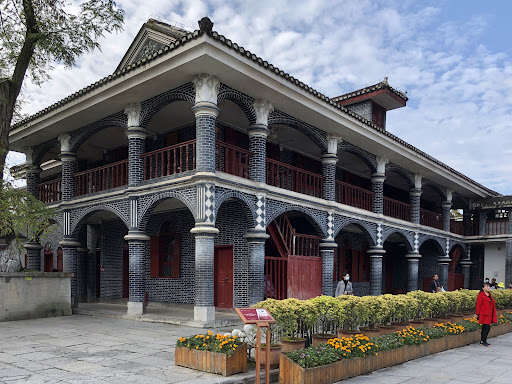
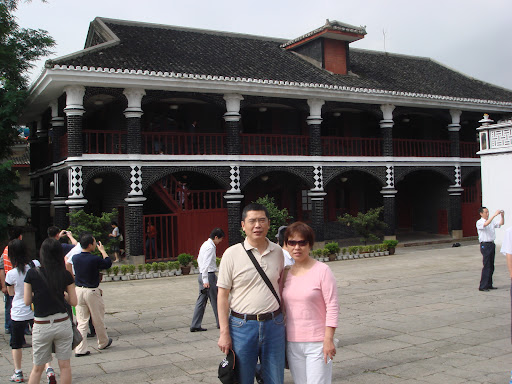
The site is a two-storeyed wood-and-brick building built in the 1930s. It was originally the private mansion of Bai Huizhang, a warlord and the Commander of the Second Division, No.25 Army of Qian (Guizhou Province) Army. There is a corridor on the first floor, and the floors have colonnades on all sides. The building is 25.75 meters wide, 16.95 meters deep, and 16.95 meters high, and covers an area of 528 square meters. In early January of 1935, the First Army of the Red Army arrived in Zunyi after the Long March. From January 15 to 17, the Central Government held the Extended Conference of the Political Bureau, also called Zunyi Conference, here. It animadverted the Left opportunism in the Fifth Anti Encirclement Campaign and at the beginning of the Long March. It confirmed the military principles of Mao Zedong, and elected him a member of the Standing Committee of the Political Bureau. It replaced the top commanding right of Bo Gu and Li De with the Central Commanding Group consisting of Mao Zedong, Zhou Enlai and Wang Jiaxiang. Zunyi Conference is an important event in the history of the Communist Party of China. It saved the party, the Red Army and the revolution. It is a vital turning point in the history. The meeting room of the conference is a rectangular hall on the second floor in the east, covering 27 square meters. In the west wall there are some windows, and two closets against the east wall with a clock hanging on it. In the middle of the hall there is a rectangular table surrounded by a circle of foldable chairs. In the building there are the former residences and offices of Zhou Enlai, Vice Chairman of the Central Military Committee, Zhu De, Commander in Chief of the Red Army, Liu Bocheng, General Chief of Staff, Ye Jianying, Chief of Staff, Peng Dehuai, Commander of the Third Corps, and Yang Shangkun, the...
Read moreZunyi confrence is held at this place The Zunyi Conference (simplified Chinese: 遵义会议; traditional Chinese: 遵義會議; pinyin: Zūnyì huìyì) was a meeting of the Communist Party of China (CPC) in January 1935 during the Long March. This meeting involved a power struggle between the leadership of Bo Gu and Otto Braun and the opposition led by Mao Zedong. The result was that Mao left the meeting in position to take over military command and become the leader of the Communist Party. The conference was completely unacknowledged until the 1950s and still no detailed descriptions were available until the fiftieth anniversary in 1985. The names and numbers of participants in the conference have always been disputed. These details are of importance to the largely Soviet view that elected members of the party were outvoted by non-members. Those who are most strongly agreed to have attended by all are Mao Zedong, Zhou Enlai, Zhu De, Chen Yun, Liu Shaoqi, Zhang Wentian, Bo Gu, Liu Bocheng, Li Fuchun, Lin Biao,...
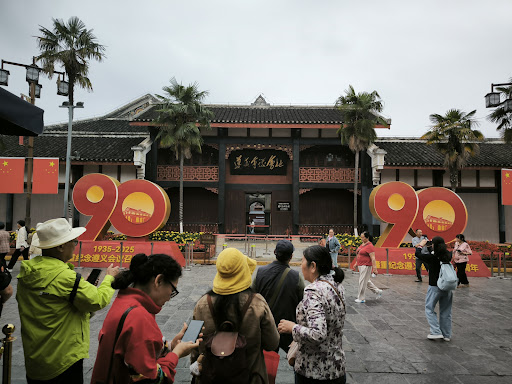
Read moreหนึ่งในสถานที่ประวัติศาสตร์สำคัญของพรรคคอมมิวนิสต์จีน “อนุสรณ์การประชุมจุนยี่” อนุสรณ์การประชุมจุนยี่ (遵义会议纪念馆) ในมณฑลกุ้ยโจว เป็นการระลึกถึง “การประชุมจุนยี่” ที่มีนัยสำคัญต่อประวัติศาสตร์ของพรรคคอมมิวนิสต์จีน เนื่องจากเป็นการประชุมหารือแผนการรบแบบจรยุทธ์กับพรรคก๊กมินตั๋ง อีกทั้งกองทัพปลดแอกประชาชนจีนยังได้ลงมติให้เหมา เจ๋อตงขึ้นเป็นผู้นำสูงสุดของพรรคในการประชุมครั้งนี้ด้วย อนุสรณ์แห่งนี้ได้รับการยกย่องให้เป็นอนุสรณ์สถานหลังสถาปนาสาธารณรัฐประชาชนจีนแล้ว ภายในประกอบไปด้วยห้องประชุมจุนยี่ และนิทรรศการที่ระลึกถึงการประชุม และเมืองนี้ยังขึ้นชื่อเรื่องสุราเหมาไถ...
Read more