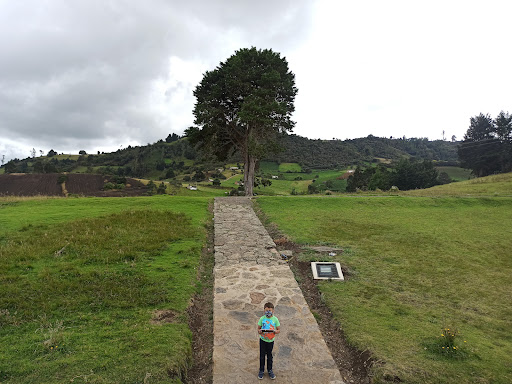
For any visitor curious about Colombia's colonial past and more specifically the struggle for independence this is the focus of a great deal of attention.
This was the site of a key military victory over the Spanish which played a role in ending Spanish rule over Colombia.
On August 7, 1819, after Bolívar secured a narrow victory at Vargas Swamp Battle, both armies headed towards Bogotá, which was lightly defended. The capture of the capital in the hands of the Patriot Army would effectively cut off the advance of the republican army and give the strategic initiative to its opponents. At 6:00 a.m., the Spanish forces (Newgranadians-Venezuelan loyalist soldiers) departed from Motavita towards Casa de Teja, a distance of only 25 km which the Spaniards completed in 7 hours 30 minutes, at an average pace of 18 minutes per kilometer. At 10:00 a.m. General Santander's forces departed from Tunja toward Casa de Piedra and the road to Bogota. The Patriot forces completed the 16 km in 4 hours (at an average pace of 15 minutes per kilometer).[citation needed]
The Republican forces split in two: the vanguard reached Casa de Teja at 1:30 p.m., while the rearguard stopped a kilometer and a half behind to get some rest. Shortly before 2:00 p.m., Capitan Andres Ibarra and his forces spotted Casa de Teja and the vanguard of the Republican Army. The Spaniards spotted him too, and Coronel Sebastian Dias, chief of the vanguard of the Spanish army ordered to follow and engage what he believed was only a small observation force. They returned and General Santander ordered Lieutenant Coronel Paris to attack the Republican forces.
The Spanish vanguard crossed a strategic bridge over the Teatinos River and took attack positions there. Meanwhile, the full force of the Patriot army under Santander had reached Casa de Piedra. The Spanish rearguard was still several kilometers behind, so General Anzoátegui ordered to block the way between the vanguard and the rearguard of the Spanish forces. The rearguard, outnumbered, retreated to a small hill close to Casa de Piedra.
Simón Bolívar's forces arrived from Paipa, after the Vargas Swamp battle. He ordered a flank attack on the Spanish rearguard: battalions Barcelona and Bravos de Paez were to attack on the right side while the Legion Britanica and Rifles Battalion attacked on the left. The enemy assumed battle positions: in the center were three artillery pieces surrounded by royal battalions 12 and 22, and on the wings, cavalry units. Arthur Sandes commander of Rifles Battalion charges the royalist artillery. Outnumbered, the Spanish rear guard began to retreat without any clear direction. Therefore, Bolívar ordered lancers units to attack the center of the Republican infantry, while a full cavalry squadron ran away from the battle via the road towards Samaca. Bareiro attempted to break the blockage of the Patriot forces and rendezvous with the Spanish vanguard but heavy enemy fire forced him and his forces to surrender.
Meanwhile, one kilometer and a half behind Casa de Piedra, the Patriot vanguard managed to ford the river and was approaching the rear of the Republican vanguard force. Once it reached them, the vanguard forces engaged in battle, while the rearguard attempted to cross the river by force, using bayonets. The Spanish forces fled, leaving on the bridge their leader, Coronel Juan Taira. As the assembly of enemy prisoners began, the battle was over shortly after 4:00 p.m.
At least 1,600 troops and several of the Spanish commanders, including Barreiro himself, were captured at the end of the battle. New Granada's liberation was assured by this victory, which left the road to Bogotá and the city itself practically undefended, as the survivors headed towards other locations. After the battle, Santander and Anzoátegui were promoted to Divisional General. On the orders of Santander, Colonel Barreiro and 38 more were executed in Bogotá on October 11, 1819, because of the Decree of War to the Death.
Worth seeing the memorial to the British forces who fought for...
Read more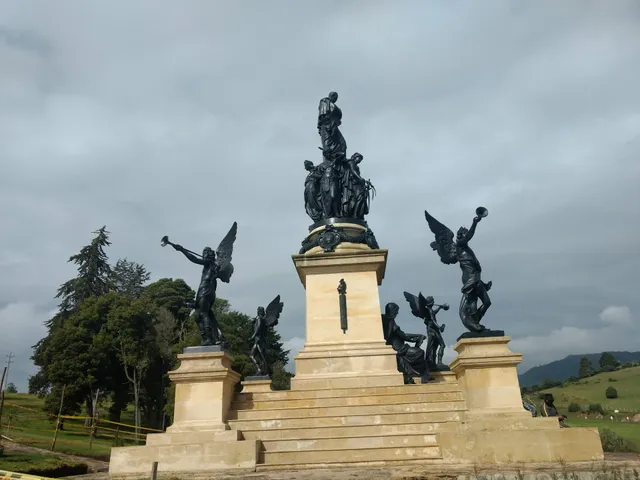
 Learn more insights from Wanderboat AI.