This article needs additional citations for verification. Please help improve this article by adding citations to reliable sources. Unsourced material may be challenged and removed.
Find sources: "Mljet" – news · newspapers · books · scholar · JSTOR (June 2012) (Learn how and when to remove this template message)
Mljet
Zalazak.jpg
Sunset over the Mljet lakes
Croatia - Mljet.PNG
Geography
Location Adriatic Sea
Coordinates 42°44′N 17°31′ECoordinates: 42°44′N 17°31′E
Archipelago Adriatic islands
Area 98.01 km2 (37.84 sq mi)
Length 37 km (23 mi)
Width 3.2 km (1.99 mi)
Coastline 135.185 km (84.0001 mi)
Highest elevation 514 m (1,686 ft)
Highest point Veliki grad
Administration
Croatia
County Dubrovnik-Neretva
Largest settlement Babino Polje (pop. 270)
Demographics
Population 1,088 (2011)
Pop. density 11.34 /km2 (29.37 /sq mi)
Ethnic groups 98% Croats
2% others
Mljet (pronounced mʎɛ̂t]; Latin: Melita, Italian: Meleda) is the southernmost and easternmost of the larger Adriatic islands of the Dalmatia region of Croatia. The National Park includes the western part of the island, Veliko jezero, Malo jezero, Soline Bay and a sea belt 500 m wide from the most prominent cape of Mljet covering an area of 54 km2.[1] The central parts of the park are Veliko jezero with the Isle of St. Mary, Malo jezero and the villages of Goveđari, Polače and Pomena.
Mljet was discovered by ancient Greco-Roman geographers, who wrote the first records and descriptions. The island was first described by Scylax of Caryanda in the 6th century BC; others prefer the text, Periplus of Pseudo-Scylax. In both texts, it is named Melite and supported by Apollonius of Rhodes.[4 Agathemerus and Pliny the Elder call the island Melita.5]
Agesilaus of Anaxarba in Cilicia, the father of Oppian, was banished to Mljet by the Roman Emperor Septimius Severus (AD 145–211)[6.
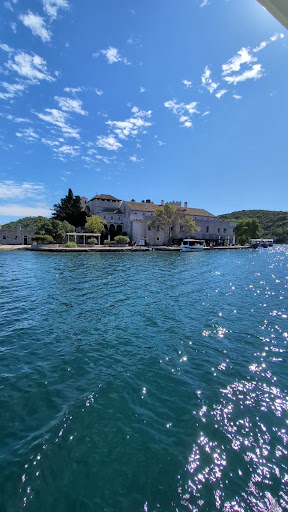
Monastery of Saint Mary
Mljet is mentioned around 950 by the Byzantine Emperor Constantine VII Porphyrogenitos in his Of Ruling an Empire as one of the islands held by the Narentines. The island was often a controversy of ownership between them and Zachlumia until the stronger unifications of the Serbian realm in the 12th century. Ancient Greeks called the island "Melita" or "honey" which over the centuries evolved to become the Slavic name, Mljet (pronounced [mʎɛt]).
Mljet has been regarded as the "Melita" on which Saint Paul was shipwrecked (Acts of the Apostles 27:39–28:11), this view being first expounded in the 10th century, by Eastern Roman Emperor Constantine Porphyrogenitus. Saint Paul's shipwreck is generally placed on the Mediterranean island of Malta. Mljet and Malta had the same name in the Greek and Roman sources; the mention of a viper in Acts 28:3–5 was thought to be in favour of Mljet (there are snakes on both Mljet and Malta but only the former is home to a venomous snake). A harbour named after the Saint exists on both islands.
The Benedictines from Pulsano in Apulia became the feudal lords of the island in 1151, having come from Monte Gargano in Italy. They came ashore in the Sutmiholjska cove and in 1187–1198 the Serbian Prince Desa of the House of Vojislavljević built and donated to them the Church and Monastery of Saint Mary on the islet in the Big Lake (Veliko Jezero) towards the north-west end of the island. Pope Innocent III issued a document consecrating the...
Read more

 Learn more insights from Wanderboat AI.