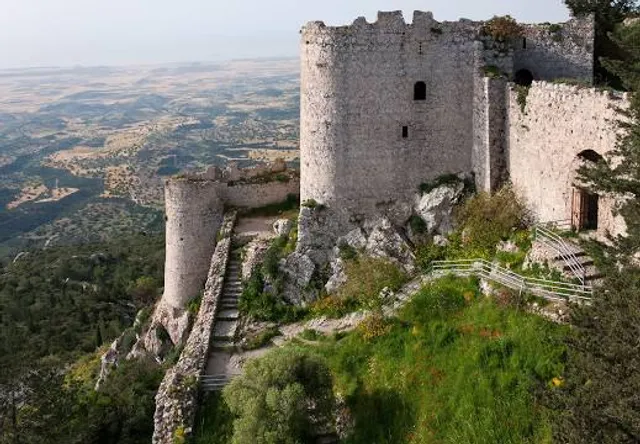
Kantara is situated to the west of the Buffavento Castle with the St. Hilarion Castle standing further to the east forming a protective axis in the Kyrenia mountain range of Northern Cyprus. As both of the other castles are visible from Buffavento, it was used to pass signals between them. The castles were built in conjunction during the Byzantine period but the date of their commission remains unknown. Among the theories put forward to explain their origin the popular are: In 965 (after the expulsion of the Arabs from the island), in 1091 by the rebel Rapsomates, during the rule of Eumathios Philokales (1091–1094), in the late 11th century after the Cilician coast was overrun by the Seljuk Empire or in 1096 as a countermeasure for the upheaval caused by the First Crusade. The name of the castle derives from the Cypriot Maronite Arabic word kandak which means stone bridge. Serving as a watchtower for pirate raids, an administrative centre and a place of incarceration the castle saw next to no fighting. In 1191, it was taken by Richard the Lionheart during his campaign against the island's ruler Isaac Komnenos of Cyprus. Richard subsequently sold the island to the Knights Templarwhose rule abruptly ended after a major revolt in Nicosia. Cyprus was thus resold to the Guy of Lusignan of the House of Lusignan. A period of peace ended with the death of Hugh I of Cyprus in 1218. A struggle over who should act as the kingdom's regent ensued, pitting the House of Ibelinwith the local supporters of Frederick II, Holy Roman Emperor. Frederick's arrival in Limassol in 1228 escalated the conflict into an open war. In 1229, the castle came under siege by the Ibelins, who bombarded it with trebuchets, reportedly destroying several buildings. The castle's garrison surrendered a year later when its commander Gauvain de Cheneche was killed by a crossbow bolt. Afterwards, the Lusignans continued their reign interrupted only by occasional palace coups. In 1373, Cyprus was invaded by the Republic of Genoa imprisoning the local nobility. According to Philip of Novara's chronicle prince John of Antioch managed to escape from Famagusta after disguising himself as the valetof his cook. John subsequently fled to Kantara, from which he organised a successful counter offensive that expelled the Genoese after the latter failed to capture Kantara. Recognizing the importance of the three Kyrenian castles James I of Cyprus and Peter II of Cyprusvastly expanded their fortifications. During their reign Kantara was transformed into a garrison castle, barracks and an enormous cistern were erected. Another cistern located at the basement of the castle was converted into a prison and later made into rooms for the captain of garrison. In 1489, the Republic of Venice acquired the island, 1519 Italian engineers branded the castle as obsolete. At which time the Kyrenian mountain castles fell into disuse, the last garrison departing in 1525. The castle was finally dismantled in 1560. Kantara's buildings remain in a relatively good condition until they were subjected to looting in the early 20th century. In 1905, the castle was classified as historic heritage due to the efforts of the French archaeologist Camille Enlart. In 1914, British colonial authorities under George Jeffery undertook restoration work at the castle, in an effort to attract sightseers. In 1939, the foundation of the horseshoe tower was refurbished in order to prevent it...
Read moreOf the three crusader castles of Buffavento, St Hilarion and Kantara, Kantara lies furthest to the east. At 630m above sea level, it is also the lowest of the three. Some would say it is the least exciting, as it is easy to reach compared with the other two. However it has by far the best views, its summit standing on a pinnacle with views all round. The name "Kantara" in Arabic means a bridge or an arch. This is an appropriate name, as the castle is located at a point which bridges the mountain range and commands views of both the north and the south coasts. On a clear day, it is possible to see across both sides of the Karpaz peninsula, and on to the distant mountains of Turkey. In winter is sometimes possible to see the snows of Lebanon, over 160km away. Very little is known of the castle's early days. It is thought to have been built by the Byzantines, probably after the last of the Arab raids in the late 10th century. However there are no remains or records dating from that time. Its first mention was in 1191, during Richard the Lionheart's Crusade to the Holy land. It was at Kantara that the self-styled king, Isaac Commenos, sheltered before surrendering to the English King. We have much more information about the castle from the Lusignan and Venetian periods, which lasted from 1191 to 1571. In the 13th century, the castle was remodelled by the Lusignans, and during the next few hundred years, the castle often served as a shelter for defeated barons and kings. When the Genoese conquered Famagusta and Nicosia in 1373, Kantara remained undefeated in the hands of the King. It was here too, that Prince John, the king's brother, fled, disguised as a cook, after his escape from the Genoese. The story goes that the prince, having been captured in Famagusta with the rest of the Royal Family, was imprisoned in irons. With the aid of his faithful servant and cook, he escaped, dressed as the cook's scullion, with an old cooking pot over his head, and carrying a frying pan which he was supposedly taking to...
Read moreKantara Kalesi, Kıbrıs'taki Beşparmak Dağları'nda bir kaledir. Adanın kuzey kıyısıyla Mesarya Ovası'nı kontrol edebilmek için inşa edilmiş.iskele yönünden boğazı geçtikten sonra kurtuluş köyü istikametinden , Ergazi , Turnalar, Ardahan köyleri üzerinden doğal güZellikleri göre göre Kantara ya ulaştık. Yol çok güzel ve yeni yapılmış hiç bir sıkıntı çekmiyorsunuz. Hafta içi gittiğimden yollar bana aitti desem yalan olmaz. Her taraf dağa çıkış çam ağaçları ve Kıbrıs’a özgü bitki örtüsü ile çevrili. Denizin getirdiği güzel hava dağların temiz oksijeni ile birleşince güzel bir hava soluyorsunuz. Telefon ve harita uygulamaları sorunsuz çalıştı her noktada internetimiz çekiyordu. Tadını çıkara çıkara yaklaşık 1 saat içinde kantara kalesine vardık. Etrafta 2-3 kıbrıs Rum kesiminden gelen adanın güney sahipleri ziyarete gelmişti. Etraf ta çöpler çok fazla . Etrafa atılmış plastik atıkları her noktada görmek mümkün. Bu tip kaleleri en son İsviçre Fransa arasında sıklıkla gördüm ve ziyaret ettim. İnanın bir başka milletin elinde olsa burası çok daha farklı olur maalesef kıymet bilmiyoruz. Kale kayalık bir zemine en dik noktada inşa edilmiş çok güzel bir noktada adanın hem kuzey hem güney denizini iki noktadan görüyor. Ortaçağ insanı gerçekten bu işleri iyi biliyor. Küçük bir kale olmasına rağmen çok güzel bir manzaranın sizi karşılıyor olması muhteşem. Yazık ki oturup bir çay kahve içilecek bir yerin olmaması çok kötü. Etrafta bir görevli dahi yoktu. Birazda tarihi bilgi verelim. Wikipediden alıntıdır. Kantara Kalesi "Kantara" sözcüğü Arapça "köprü" anlamına gelmektedir. Kesin olarak hangi tarihte yapıldığı bilinmese de çoğu kaynağa göre Bizanslılar tarafından Arap saldırılarının sona erdiği 965 yılından sonra yapıldığı yazmaktadır. Buna karşın İngiliz kralı I. Richard'ın adayı aldığı tarihe kadar kale hakkında herhangi bir kayıt yoktur. Bu kayıt kendini Kıbrıs kralı ilan eden İsaakios Komnenos'un Guy de Lusignan yönetimindeki İngiliz ordularından kaçmak için buraya sığındığı, daha sonra Girne Kalesi düştükten sonra kaleyi terk edip teslim olduğu yönündedir. 1373 yılında Cenevizlilerin adaya saldırısı sırasında Lefkoşa ve Mağusa düşse de, Kantara Kalesi konumunun da yardımıyla Kıbrıs Kralı II. Peter'in elinde kaldı. Ceneviz istilasının sona ermesinden ve Mağusa'nın Cenevizlilerin elinde kalmasından sonra, 1391 yılında I. James kalenin surlarını güçlendirdi. Bu dönemde kale önemini korumaktaydı. Daha sonra Mağusa'nın geri alınmasından sonra bile kale korunmaya devam etti. 1489 yılında ada Venedikliler tarafından ele geçirildi. Bu tarihten itibaren kale önemini kaybetmeye başladı. Beşparmak Dağları'ndaki Kantara, St. Hilarion ve Bufavento kaleleri Venedikliler tarafından önemli kabul edilmediği ve asker azlığının da bir etkisi olarak terk edildi. Bazı kaynaklara göre kale 1525 yılında terk edildi. Ancak bazı diğer kaynaklar kalenin 1529 yılında "sağlam bir kale" olduğunu yazmıştır. Kalenin terk edilişine ilişkin kesin bir tarih olmasa da 1562 yılında bir diğer yazar kalenin harabe halinde olduğunu bildirmiştir. Kale 1914 yılında aslına sadık kalınarak onarıldı ve sağlamlaştırıldı diye Wikipedi de...
Read more