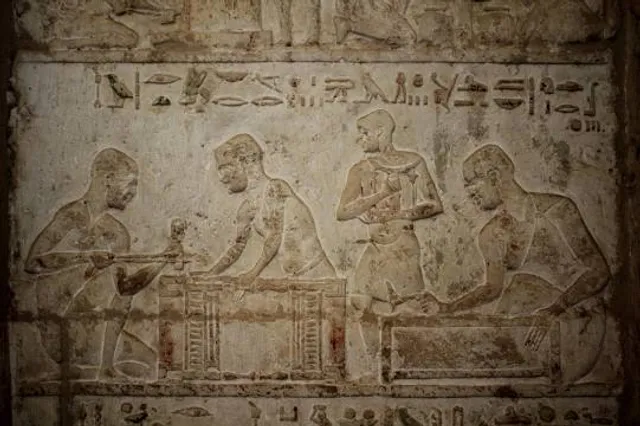
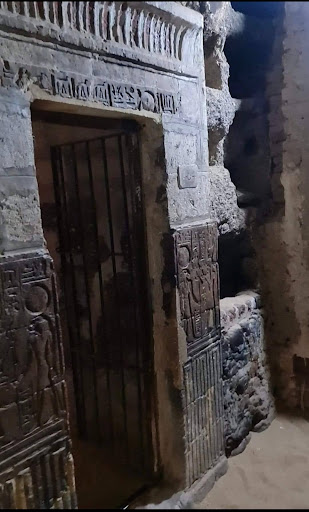
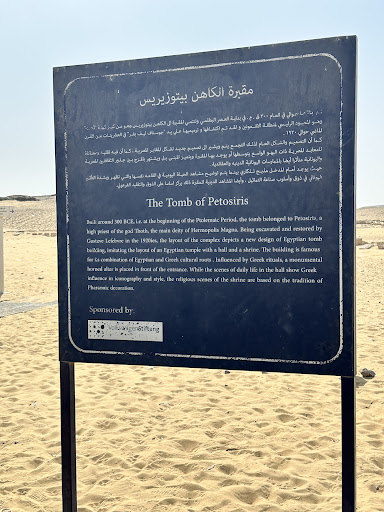
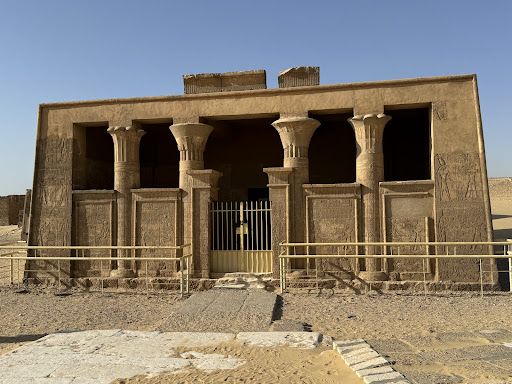
The Tomb of Petosiris, located at Tuna el-Gebel, is one of the most fascinating and well-preserved tombs from the Greco-Roman period in Egypt. Petosiris was a high priest of Thoth, and his tomb stands out for its unique blend of Egyptian and Greek artistic styles.
The tomb's architecture, with its intricate carvings and colorful reliefs, offers a glimpse into both the religious and daily life of ancient Egyptians under Hellenistic influence. Inside, the walls depict traditional Egyptian scenes, such as offerings to the gods, alongside more Greek-influenced depictions of daily life, agriculture, and family activities. This blend of cultures reflects the period's syncretism, where Egyptian and Greek traditions merged.
What makes the tomb even more significant is its role as a necropolis for the priests of Thoth, demonstrating the high status that Petosiris and his family held. The tomb not only honors him as a priest but also immortalizes the cultural fusion that...
Read moreThe tomb of Petosiris, the High Priest of the god Thoth in Hermopolis, is an interesting site. The mummified ibis birds and baboons are remarkably well preserved. Another fascinating mummified being is Isadora, whose love story reminds me of Romeo and Juliet.
I’m giving this site four stars because, unfortunately, it looks like a garbage dump. There is so much trash scattered everywhere that it takes away from the site’s beauty. Despite being a historical landmark, it is not treated like a proper tourist destination. There were numerous guards on duty, yet none of them seemed to care about cleaning up. When I raised the issue, the supervisor gave a poor excuse, blaming it on the “day after a holiday.” It was a Wednesday, and it was obvious that the garbage had been there for...
Read morePetosiris, called Ankhefenkhons, was the high priest of Thoth at Hermopolis and held various priestly degrees in the service of Sakhmet, Khnum, Amen-Re and Hathor. Petosiris was the son of Sishu and Nefer-renpet. He lived in the second half of the 4th century BCE, during the 28th Dynasty. In his tomb, located in the necropolis at Tuna el-Gebel, Petosiris prided himself on having re-established the fortunes of the temples in which he served.
There is a pseudepigraphic onomantic text, Petosiris to Nechepso, and it is possible that the priestly Petosiris described in this article is the inspiration for the attribution of authorship.[1] Nechepso lived in the 7th century BCE and that the text is likely 2nd...
Read more