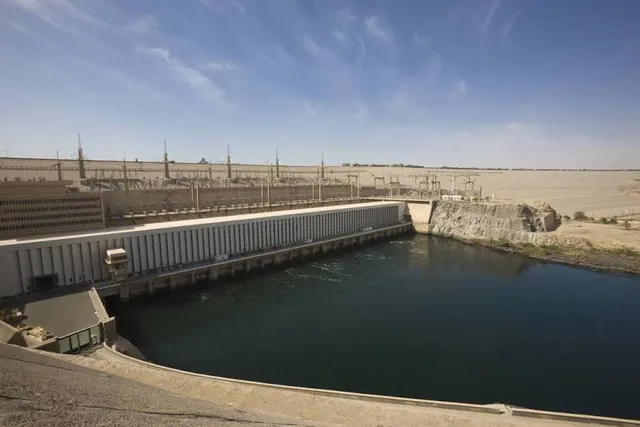
The Aswan High Dam is a massive and crucial infrastructure project located on the Nile River in Aswan, Egypt. It is one of the most significant engineering feats of the 20th century and has had a profound impact on Egypt's economy, agriculture, and society.
Key features and information about the Aswan High Dam:
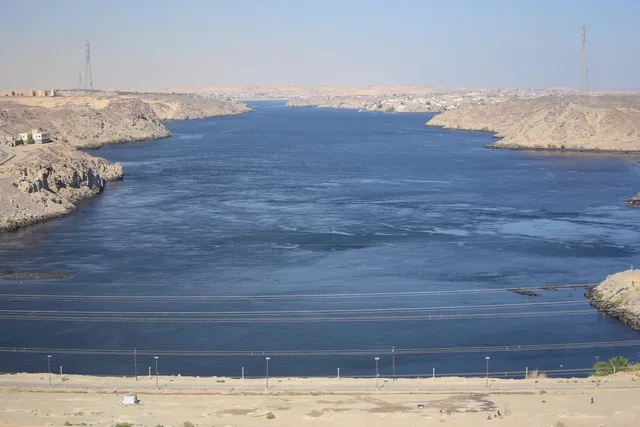
Location: The Aswan High Dam is situated in the southern part of Egypt, near the city of Aswan. It spans the Nile River, creating a vast reservoir known as Lake Nasser, which extends into southern Egypt and northern Sudan.
Construction: The construction of the Aswan High Dam began in 1960 and was completed in 1970. The project was a joint effort between Egypt and the Soviet Union, with the Soviet Union providing technical expertise and financial support.
Purpose: The primary purposes of the Aswan High Dam were to control the flow of the Nile River, manage flooding, and regulate the water supply. It also generates hydroelectric power, providing a significant source of electricity for Egypt's growing population and industries.
Lake Nasser: The creation of Lake Nasser behind the dam has resulted in the formation of one of the world's largest artificial lakes. The lake provides a vast water reservoir, helping to stabilize water flow throughout the year and allowing for improved irrigation and agricultural development.
Impact on Agriculture: The Aswan High Dam has had a transformative effect on Egypt's agriculture. With better control over water resources, the dam has enabled increased cultivation and crop yields in previously arid areas, contributing to food security and economic growth.
Hydroelectric Power: The dam's hydroelectric power station has a significant capacity and generates a substantial portion of Egypt's electricity supply. This has been crucial for meeting the increasing energy demands of the country.
Relocation of Temples: During the construction of the dam, several ancient temples and historical sites were at risk of being submerged by Lake Nasser. To preserve these treasures, international efforts were undertaken to relocate several temples, including the Abu Simbel temples, to higher ground.
The Aswan High Dam stands as a symbol of human ingenuity and engineering prowess. It has played a vital role in transforming Egypt's water management, agriculture, and energy sectors, contributing to the country's development and growth. Additionally, the creation of Lake Nasser has also become a popular tourist destination, attracting visitors who wish to experience the scale and significance of this...
Read moreAfter the Aswan Low Dam nearly overflowed in 1946, planning began for a new, larger dam some seven kilometers upstream. In 1952, Greek-Egyptian engineer Adrian Daninos designed a plan, but King Farouk preferred British hydrologist Harold Edwin Hurst's option to build dams in Sudan and Ethiopia (due to reduced evaporation). After the Free Officers Movement, of which Gamal Abdel Nasser was a member, seized power, Daninos's plan was chosen for political reasons. International political developments also led the USA and the UK to withdraw from the High Dam Project and led Nasser to collaborate with the USSR. In 1958, the USSR provided the first loan, and two years later, construction of the dam could actually begin. In 1964, the first phase of the dam project was completed, and the reservoir began to fill. In 1970, the Aswan High Dam was completed, but it took another six years for the reservoir to reach its maximum capacity. The Aswan High Dam was designed by Nikolai Alexandrovich Malyshev of the Moscow Hydroproject Institute, along with several Egyptian engineers. The embankment dam is one of the largest in the world: 3,830 meters long (at the top), 40 meters wide (at the base), 111 meters high, and has a capacity of 44.3 million cubic meters. Lake Nasser provides Egypt with a vast supply of irrigation water, allowing Egyptian fields to yield an average of 1.8 harvests per year. Besides controlling flooding and providing irrigation water, the dam also generates electricity: with an installed capacity of 2,100 MW, the dam's power station produces approximately 10 billion kWh annually. However, the dam also has drawbacks: the reservoir is slowly but surely silting up, and because no new silt is being supplied, the Nile Delta is eroding and losing its fertility. Soil pollution due to the use of enormous amounts of fertilizer, salinization due to incorrect irrigation methods, declining fish catches for Egypt, and so on. And then there are the social and cultural disadvantages: 100,000 to 120,000 people were forced to relocate, and many Egyptian and Nubian monuments disappeared under the water. Only the most important monuments, such as Abu Simbel, could be relocated. The construction of the Aswan High Dam is not an unusual situation: with almost all megaprojects, the consequences, both positive and negative, are proportional. To end on a less negative note: the construction of the Aswan High Dam (and the saving of 22 Egyptian/Nubian monuments) is an achievement of almost unprecedented proportions; upon completion, it was the tallest earthen dam...
Read moreThe Aswan Dam, or more specifically since the 1960s, the Aswan High Dam, is an embankment dam built across the Nile in Aswan, Egypt, between 1960 and 1970. Its significance largely eclipsed the previous Aswan Low Dam initially completed in 1902 downstream. Based on the success of the Low Dam, then at its maximum utilization, construction of the High Dam became a key objective of the government following the Egyptian Revolution of 1952; with its ability to control flooding better, provide increased water storage for irrigation and generate hydroelectricity the dam was seen as pivotal to Egypt's planned industrialization. Like the earlier implementation, the High Dam has had a significant effect on the economy and culture of Egypt. Before the High Dam was built, even with the old dam in place, the annual flooding of the Nile during late summer had continued to pass largely unimpeded down the valley from its East African drainage basin. These floods brought high water with natural nutrients and minerals that annually enriched the fertile soilalong its floodplain and delta; this predictability had made the Nile valley ideal for farming since ancient times. However, this natural flooding varied, since high-water years could destroy the whole crop, while low-water years could create widespread drought and associated famine. Both these events had continued to occur periodically. As Egypt's population grew and technology increased, both a desire and the ability developed to completely control the flooding, and thus both protect and support farmland and its economically important cotton crop. With the greatly increased reservoir storage provided by the High Aswan Dam, the floods could be controlled and the water could be stored for later release over multiple years.
The Aswan Dam was designed by the...
Read more