Hawara is an ancient necropolis area and an archaeological site of Ancient Egypt, south of the site of Crocodilopolis ('Arsinoe', also known as 'Medinet al-Faiyum') at the entrance to the depression of the Fayyum oasis. This is believed to have been Amenemhet's final resting place. At Hawara there was also the intact (pyramid) tomb of Neferu-Ptah, daughter of Amenemhet III. This tomb was found about 2 km South of the king's pyramid. The first excavations at the site were made by Karl Lepsius, in 1843. William Flinders Petrie excavated at Hawara, in 1888, finding papyri of the 1st and 2nd centuries CE, and, north of the pyramid, a vast necropolis where he found 146 portraits on coffins dating to the Roman period, famous as being among the very few surviving examples of painted portraits from Classical Antiquity, the "Fayoum portraits" The huge mortuary temple that originally stood adjacent to this pyramid is believed to have formed the basis of the complex of buildings with galleries and courtyards called a "labyrinth" by Herodotus (see quote at Labyrinth), and mentioned by Strabo and Diodorus Siculus. (There is no historicity to the assertion of Diodorus Siculus that this was the model for the labyrinth of Crete that Greeks imagined housed the Minotaur,) The demolition of the "labyrinth" may date in part to the reign of Ptolemy II, under whom the Pharaonic city of Shedyt (Greek Crocodilopolis, the modern Medinet el-Fayum) was renamed to honour his sister-wife Arsinoë; a massive Ptolemaic building program at Arsinoe has been suggested as the ultimate destination of Middle Kingdom limestone columns and blocks removed from Hawara, and now lost.
Pharaoh Sobekneferu of the Twelfth dynasty also built at the complex. Her name meant "most beautiful of Sobek", the sacred crocodile.
Among the discoveries made by Flinders Petrie were papyrus manuscripts, including a great papyrus scroll which contains parts of books 1 and 2 of the Iliad (the "Hawara Homer" of the Bodleian...
Read moreVisited 14 October 2022.
This was the first site we stopped at on our day of visiting the lesser known pyramids of Egypt.
Hawara is located an hour and a half south of Giza and is often missed by tourists. We were the only tourists there during our visit.
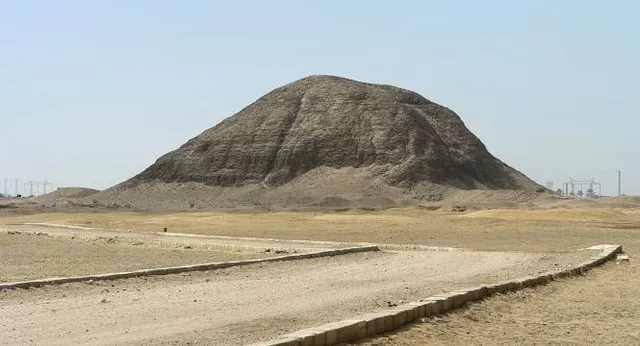
After driving parallel to an irrigation canal through the farm lands of Hawara the Pyramid of Amenemhat III looms up to your left and this brings you to the ubiquitous security checkpoint/entrance.
The pyramid was built for the burial of the 12th Dynasty king Amenemhat III. He was the sixth king of that Dynasty and believed to have died approximately 1814BC.
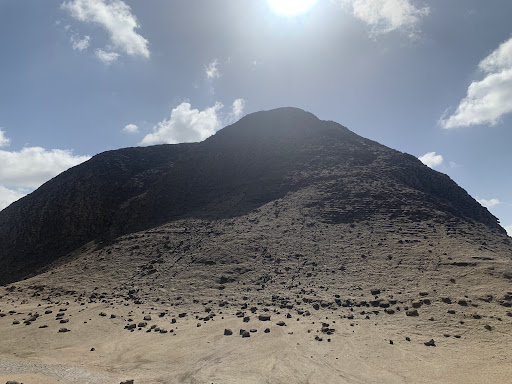
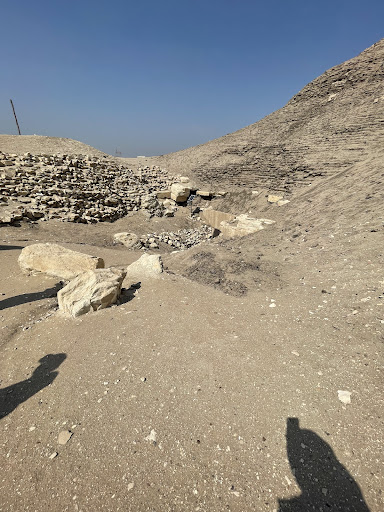
Like most of the Middle Kingdom pyramids it was built of mudbrick around a limestone core and a limestone casing. Most of the casing stones were pillaged throughout history and what we are left with today is the eroded mudbrick mountain. It was built after the failure of the Black Pyramid at Dahshur which is why is has a gentler slope.
Once on the site there is a small display of large pieces of stone which could have been part of the temples which once existed here but were destroyed in antiquity. There are a couple of pieces which appear to be headless busts.
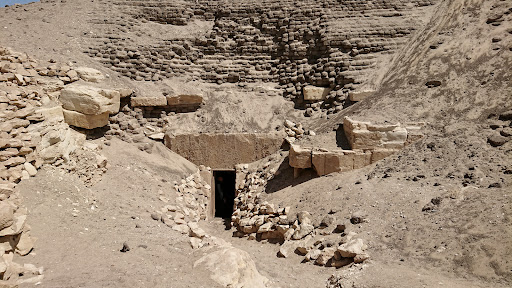
You can walk around the perimeter of the pyramid which is bounded by an irrigation channel which scholars believe either cut through or lies on top of the famed Labyrinth. Once at the channel you can view numerous large blocks that have been uncovered and they lie on the opposite side. You can also see the entrance to the Pyramid on the south side. Unfortunately water from the canal has leaked in over the years and everything below the pyramid is completely flooded.
While we were the only visitors there, one of the soldier-guards shadowed us a few feet behind us the entire time which was definitely not required but nonetheless felt a little...
Read moreThe place is really cool. But the way to get to is really bad because of the renovations in the roads. I think in 2 months it will be ok, the other thing bad about it is the pyramid is closed because of the underground water. The sight is huge but need lots of excavations & care, it will be a gem if it is looked after.
The pyramid is for king Amenemhat III, Middle Kingdom, 12th dynasty, its burial chamber was made out of a single quartzite monolith which was lowered into a larger chamber lined with limestone. This monolithic slab weighed an estimated 110 tons according to Petrie. A course of brick was placed on the chamber to raise the ceiling then the chamber was covered with 3 quartzite slabs (estimated weight 45 tons each). Above the burial chamber were 2 relieving chambers. This was topped with 50 ton limestone slabs forming a pointed roof. Then an enormous arch of brick 3 feet thick was built over the pointed roof to support the core of the pyramid.
On the southern side of the pyramid there was a labyrinth palace but all under ruins.
On the west side of the pyramid, there is a canal, was dug in the modern time, dividing the cemetery area which is sad. However the view is beautiful.
On the eastern side of the pyramid there were lots of tombs from all eras. Some discovered, most of them still under the ground.
In general, it is not worth...
Read more