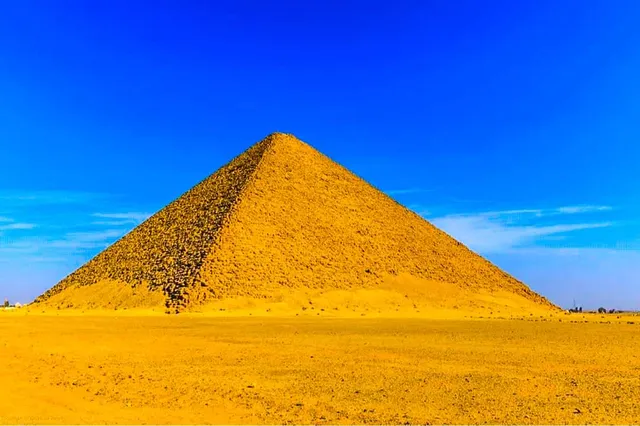
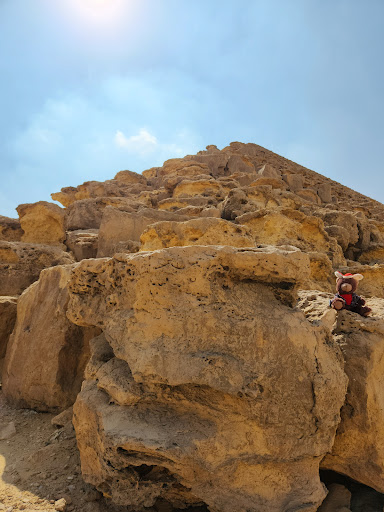
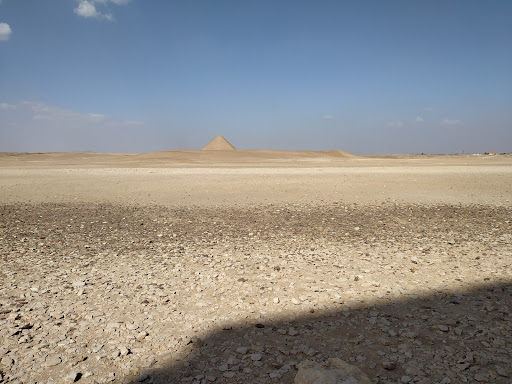
The Red Pyramid, also known as the North Pyramid, stands as a remarkable testament to ancient Egyptian architecture and engineering. Let me take you on a journey to explore this awe-inspiring monument:
Historical Marvel:
The Red Pyramid is the largest pyramid located at the Dahshur necropolis near Cairo, Egypt.
Its name derives from the rusty reddish hue of its red limestone stones.
Constructed during the Fourth Dynasty, it was built by Pharaoh Sneferu around 2575–2563 BCE.
Unlike its predecessors, the Red Pyramid represents Egypt’s first successful attempt at constructing a “true” smooth-sided pyramid.
Architectural Features:
Material: The pyramid is primarily made of limestone.
Dimensions:
Height: 105 meters (344 feet).
Base: Approximately 220 meters (722 feet).
Volume: A staggering 1,694,000 cubic meters (2,216,000 cubic yards).
Slope: The pyramid’s sides rise at an angle of 43°22’.
Comparison: While it is the third largest Egyptian pyramid, it follows the Great Pyramid of Khufu and the Pyramid of Khafre at Giza.
Unique Characteristics:
Local Name: Residents affectionately call it el-heram el-watwaat, which translates to “the Bat Pyramid.”
Color Transformation: Originally, the Red Pyramid was cased with white Tura limestone. However, over time, much of the white casing was removed for other construction in Cairo, revealing the red limestone beneath.
Construction Mystery:
The Red Pyramid’s design may have been influenced by engineering challenges faced during the construction of Sneferu’s earlier pyramids.
The Meidum Pyramid collapsed, and the Bent Pyramid underwent significant angle adjustments midway through construction.
Some believe that the Meidum Pyramid was the first attempt at a smooth-sided pyramid, and its instability led to changes during the Bent Pyramid’s construction.
In summary, the Red Pyramid stands as a testament to ancient ingenuity, a beacon of Egypt’s rich history, and a marvel that continues to captivate visitors from around the...
Read moreAmazing! If you want the whole pyramid for yourself and crawl down through steep tunnel slowly and enjoy the chamber alone, these two pyramids are your best experience! Dahshur village people are very nice - no hassle absolutely - great natured people! It's stuffy inside, so wear proper clothing for climbing. You smell urine all the way since the entrance, especially in the chamber. If no-one urinated here, it'd be a purely sacred experience. If you come across a large tour group, then bad luck - the traffic jam won't be pleasant for climbing and breathing. The pyramids' doors close at 4 pm. The police want you to leave the site before 4:30pm. It's 2km to the ticket office. 60LE=€3.4 for both pyramids inside! Students 30LE. Each take half an hour. Red took me 30min slowly. Bent 50min. 3km walk between Red and Bent. Black not open. White destroyed. Most people come on tours. If you are a budget traveler, you can come by metro to Helwan 10EP 45min. Outside Helwan metro, there are loads of tuktuk - 19km for 30, 40 or more LE, but also a minibus station with locals. I asked Dahshur, 3.5LE take me to the bridge - another minibus station. I took a bus to Mazghuna and get off after 3.5km. I paid the full ride 3.5LE anyway out of gratitude. There're also tuktuk, but it's a wonderful 2km walk through oasis cultivations. The best version I've ever seen in Egypt! However, a kind moto picked me up and took to Dahshur village. The best cane juice ever in Egypt! Cairo the worst. Get enough food for your day. It's 2km walk to the gate. There are also a lot of tuktuk. The walk is less amazing but still palm forest. After the gate, 2k+3k. Closure at 4pm, so go early if you use public transport. It took me 9:30am-12:30 to arrive at the gate, and 13:00 at Red. WC next to Red. The toilet lady expects tip. That's how they run toilets on the sites - personally I wouldn't appreciate it if the tickets were too...
Read moreVisited 11 October 2022
Included with the Cairo Pass.
Located an hour south east of Giza is the Dahshur Necropolis and home to the Red Pyramid.
The site is surprisingly much less frequented by visitors and this gives the site a very favourable feel when there. There are no hawkers, no camels or horses either. There is an army base located to the north and due to this the site was not open to visitors for many years. Thankfully that changed. Beyond the base is the saqqara site. You will also be able to observe the step pyramid of Djoser in the distance.
Originally it was covered in a white limestone casing called Tura but these were looted like so many of the other sites of Egyptian antiquity. This left the red limestone blocks visible which gives its name to the pyramid today. This pyramid is the third highest after the two large pyramids on the Giza Plateau. Also this was the first true pyramid built by Sneferu after his attempts of the Bent Pyramid and the Pyramid of Meidum. Scholars believe this pyramid was built between 2575-2563BC.
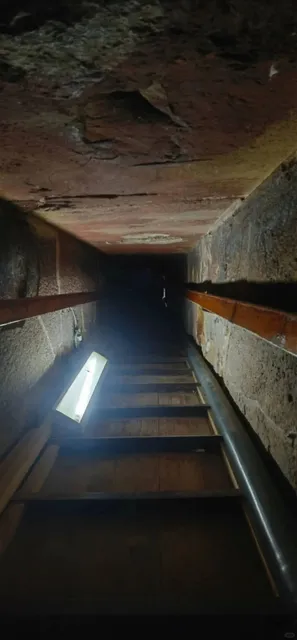
Once at the base there is a short climb up to the entrance to the shaft plunging inside. For those who are short it can be navigated by hunching over and walking. For those who are taller it is better to crawl on all fours backwards down and forwards up, though it can be slow going. It is well worth the adventure to view the gallery inside which is very similar to the Great Pyramid. Once in the gallery there is a wooden staircase to climb that takes you to the secondary chamber. It is not as hot inside as the Giza Pyramids and this is likely due to the low numbers of visitors.
For some reason the grey ghosts that gate keep at all sites in Egypt ask you for money at the shaft entrance to do nothing and as we did throughout our visit to Egypt we promptly...
Read more