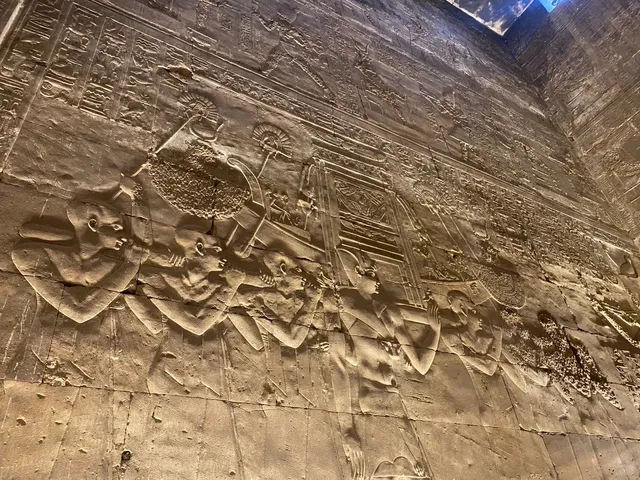
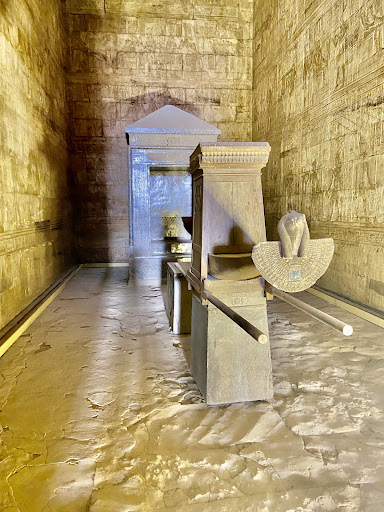
Temple of Edfu is youngest of other contemporary Temples of ancient Egypt as it is only about 2300 years old as compared to 3000 to 3500 years of some other temples. It was built during the time Ptolemaic dynasty with it's capital at Edfu when it was at it's zenith. It is believed that the temple is built at a place where Horus fought and defeated Seth. It is the second largest Temple in Egypt and took almost 180 years to be completed. It fell on disuse after the decline of Ptolemaic empire and pagan worship was banned. Drifting sand dunes covered the temple to a depth of almost 30 to 40 feet under the sand. It was discovered and excavated after 1860. Because of its comparatively young age and being buried under the sand it is the best preserved Temple in Egypt. Undamaged reliefs and inscriptions not only give the details of construction of whole structure but s also give information about the practices and way of life of those days. It is now one of the most sought after tourist destinations. Plan of the Temple include great temple entrance, vast courtyard, vestibule for entry in to inner temple, Hypo style hall, sanctuary or the room of the Gods. On addition to all there it also has, ant chamber, inner passage way and a nilometer. Main entrance : pylons forming the entrance are gigantic and stand 118 feet high. The walls have reliefs of King fighting battles, of God's and Kings and also inscriptions describing various reliefs. The vast courtyard is surrounded on three sides by 32 huge columns. The top of the columns have beautiful floral and Pam designs. The walls are covered in reliefs of God Horus and Hathor. Entry of vestibule to inner temple was guarded by two giant 10 feet statues of God Horus. Today only the statue at right stands regally. Feet of the other statue on the left were destroyed and upper torso lies up right on ground. Vestibule - inner temple. Vestibule roof is supported by 12 columns. It had two rooms on either side. From here is the entry to Hypo style hall. This is also supported by 12 columns. Capitals of all the columns are decorated with floral, Palm or papyrus designs. The walls are full of reliefs and descriptions about them. Sanctuary : the room of the Gods. There is a granite shrine which must have carried an image of God Horus. From this you exit on passage of victory which rooms around back of the Temple. When yo leave the Temple of Horus you leave with a sense of...
Read moreThe Temple of Edfu is one of the best-preserved monuments of Ancient Egypt and one of the most impressive religious buildings you can visit in the country. Dedicated to the falcon-headed god Horus, the temple was constructed during the Ptolemaic period, between 237 BC and 57 BC. Located in the city of Edfu, on the west bank of the Nile between Luxor and Aswan, it offers one of the clearest examples of how temples functioned in ancient times.
The temple was begun under Ptolemy III in 237 BC and completed nearly 180 years later under Ptolemy XII. Despite being built during Greek rule, the temple’s architecture, decoration, and rituals follow the traditional pharaonic style, showing how strongly the Egyptian religious identity endured through centuries.
Walking through the temple today is like stepping back in time. The massive pylon at the entrance stands 36 meters high, decorated with reliefs of Horus striking down enemies, a symbol of divine protection. Inside, the vast courtyard, hypostyle halls with towering columns, and the sanctuary still carry detailed carvings and inscriptions. These inscriptions include not only hymns to Horus but also detailed texts about temple rituals, festivals, and even construction methods. In fact, the Edfu inscriptions are one of the most important sources we have about ancient Egyptian religion.
The temple played a vital role in the annual Festival of the Sacred Marriage, where the statue of Hathor from Dendera was brought to Edfu to unite with Horus, symbolizing fertility and cosmic renewal. This festival was celebrated with processions, offerings, and ceremonies that connected the gods with the people and ensured prosperity for Egypt.
Unlike many temples that suffered destruction, the Temple of Edfu remained buried under sand and silt for centuries, which preserved it almost intact until its excavation in the 19th century by Auguste Mariette. Today, it stands as one of the largest and most complete temples in Egypt, stretching 137 meters long and 79 meters wide.
Visiting Edfu is an unforgettable experience. The combination of monumental architecture, well-preserved reliefs, and the unique atmosphere of a sacred space makes it feel alive with history. It is one of the best places to understand not just the religion of Ancient Egypt, but also the endurance of their culture through the...
Read moreThe Edfu Temple, also known as the Temple of Horus, is an ancient Egyptian temple located in the town of Edfu, in the Aswan Governorate of Egypt. It is one of the best-preserved temples in Egypt and is considered to be one of the most important archaeological sites in the country.
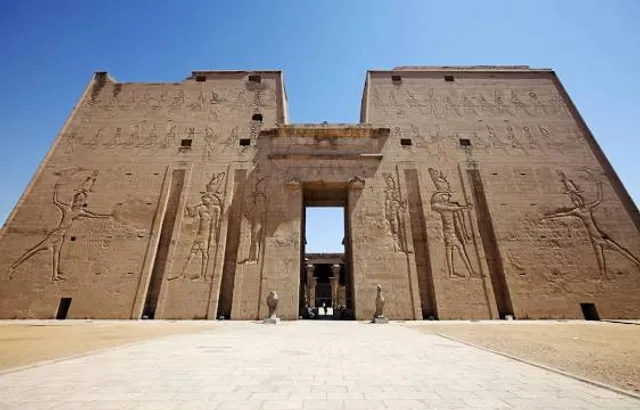
Here are some interesting facts about the Edfu Temple:
Dedicated to Horus: The temple was dedicated to the worship of Horus, the falcon-headed god of kingship and protection.
Built during the Ptolemaic period: The construction of the temple began in 237 BC during the reign of Ptolemy III and was completed in 57 BC during the reign of Ptolemy XII.
Well-preserved: Despite being over 2,000 years old, the temple is remarkably well-preserved, with much of its original structure and decoration still intact.
Largest temple in Egypt: The Edfu Temple is the largest temple in Egypt, covering an area of approximately 150 meters by 79 meters.
Important religious center: The temple was an important religious center in ancient Egypt, and its priests played a significant role in the country's spiritual life.
Architectural significance: The temple's architecture is a mix of ancient Egyptian and Greek styles, reflecting the cultural exchange between the two civilizations during the Ptolemaic period.
Hieroglyphics and carvings: The temple's walls are adorned with intricate hieroglyphics and carvings, which provide valuable insights into ancient Egyptian mythology and culture.
Restoration efforts: The temple has undergone several restoration efforts, including a major restoration project in the 1980s, which helped to preserve the site for future generations.
The Edfu Temple is a remarkable example of ancient Egyptian architecture and culture, and it continues to be an important tourist destination and...
Read more