HTML SitemapExplore

Tiger Tank — Attraction in Mortagne-au-Perche

Name
Tiger Tank
Description
The Tiger I was a German heavy tank of World War II that operated beginning in 1942 in Africa and in the Soviet Union, usually in independent heavy tank battalions. It gave the German Army its first armoured fighting vehicle that mounted the 8.8 cm KwK 36 gun. 1,347 were built between August 1942 and August 1944.
Nearby attractions
Nearby restaurants
Nearby hotels
Chalet de Malvoue
2 Rue Maurice Duhamel, 61120 Vimoutiers, France
Related posts
Keywords
Tiger Tank tourism.Tiger Tank hotels.Tiger Tank bed and breakfast. flights to Tiger Tank.Tiger Tank attractions.Tiger Tank restaurants.Tiger Tank travel.Tiger Tank travel guide.Tiger Tank travel blog.Tiger Tank pictures.Tiger Tank photos.Tiger Tank travel tips.Tiger Tank maps.Tiger Tank things to do.
Tiger Tank things to do, attractions, restaurants, events info and trip planning
Tiger Tank
FranceNormandyMortagne-au-PercheTiger Tank

Basic Info

Tiger Tank

Char Tigre, La Butte du Sap, 61120 Vimoutiers, France
4.5(337)
Open until 12:00 AM
Save
spot

Ratings & Description

Info

The Tiger I was a German heavy tank of World War II that operated beginning in 1942 in Africa and in the Soviet Union, usually in independent heavy tank battalions. It gave the German Army its first armoured fighting vehicle that mounted the 8.8 cm KwK 36 gun. 1,347 were built between August 1942 and August 1944.

Cultural
Scenic
Family friendly
attractions: , restaurants:
logoLearn more insights from Wanderboat AI.
Open hoursSee all hours
TueOpen 24 hoursOpen

Plan your stay

hotel
Pet-friendly Hotels in Mortagne-au-Perche
Find a cozy hotel nearby and make it a full experience.

hotel
Affordable Hotels in Mortagne-au-Perche
Find a cozy hotel nearby and make it a full experience.

hotel
The Coolest Hotels You Haven't Heard Of (Yet)
Find a cozy hotel nearby and make it a full experience.

hotel
Trending Stays Worth the Hype in Mortagne-au-Perche
Find a cozy hotel nearby and make it a full experience.

Reviews

Things to do nearby

Soirée RedCactus Poker X Le 33 à LISIEUX (14)
Tue, Dec 30 • 7:30 PM
30 Boulevard Jeanne d'Arc, 14100 Lisieux
View details
Get the Appoverlay
Get the AppOne tap to find yournext favorite spots!
Wanderboat LogoWanderboat

Your everyday Al companion for getaway ideas

CompanyAbout Us
InformationAI Trip PlannerSitemap
SocialXInstagramTiktokLinkedin
LegalTerms of ServicePrivacy Policy

Get the app

© 2025 Wanderboat. All rights reserved.

Reviews of Tiger Tank

4.5
(337)
avatar
4.0
6y

This Tiger with Fahrgestell number 251055, Turret Number 251113.

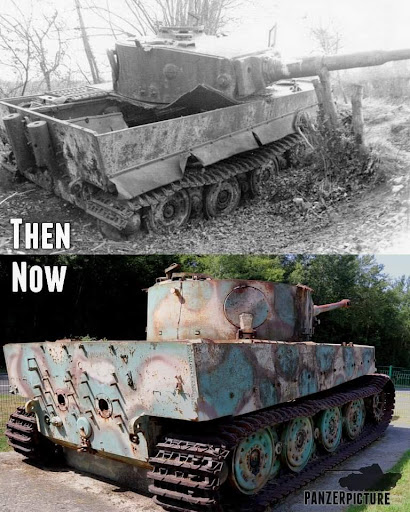
This late-production Tiger, with steel road-wheels, is one of the several remaining Tigers of the 102nd SS Heavy Panzer Battalion and originally carried the number 224 on the side of its turret.

But many sites still claim it's the tank that carried the turret number 231, but that Tiger was commanded by Hans Lorits and was knocked out at Ussy on august 14, 45 kilometers from vimoutiers.

The Tiger at Vimoutiers was actually commanded by Unterscharführer Reisske and on august 20 his Tiger participated in a counter-attack launched from Vimoutiers to Trun in an etempt to breakthrough the Falaise's pocket.

It was during this phase of the operation that Tiger 224 which took the 979 road breaks down, reisske order it's crew to place starches to blow it up and leave it behind, but only succeded in blowing of the engine deck covers and jaiming the turret.

So the Tiger wasn't lost because of fuel shortest but to a big mechanical problem wich states loss of oil pressure resulting in engine failure. All this is based on actuall testimony of Ekkehard Förster and SS-Unterscharführer Wilhelm Fey.

After the war Tiger 224 was sold to a scrapper name Morat, but the Tiger was to hard to move and Mr Morat only removed the easily removable parts and the gearbox, after Morat died his sister sold the tank to a scrapper in Caen, that started cuting up the Tiger, and removing the turret, this is were the the cutting marks ontop and on the side of the turret come from. When the local people of Vimoutiers heard of what was going to happen to the tank, the tank was bought for 6,000 Francs, to be place as a monument. in 1975, the tank was recovered by Alain Roudeix, it was restored and placed on the spot it sits now.

So in 2017 a plan was made to restore the tank and place it into an new museum in the town of vimoutiers, but until then only a fence is placed around the tank to prevent any other people from...

   Read more
avatar
5.0
3y

Very rare Tiger I, although not in the best of shapes. Worth visiting if you're in the area.

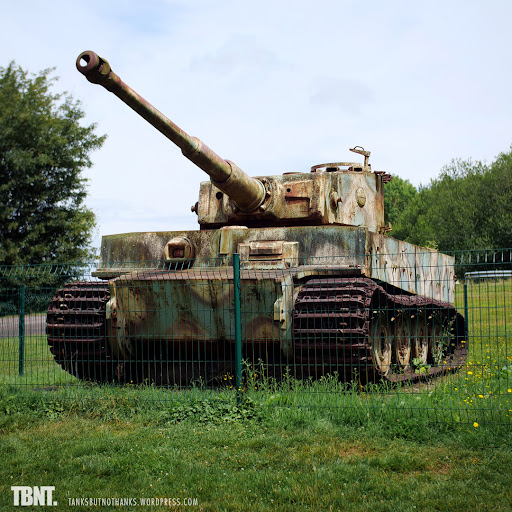
This particular vehicle is one of only seven original Tigers in the world. It is a late production model with a simplified running gear, rubber-saving steel road wheels, monocular gunsight and the low late-style commander‘s cupola. Probably due to a lack of fuel its crew had to abandon the tank during the German retreat from the closing Falaise pocket in August 1944. Standard procedure for Tiger crews was to destroy their tanks so that they would not fall into enemy hands – as it had famously happened to Tiger 131 in Tunisia. Two explosive charges were carried on every vehicle for this purpose. One was placed in the gun breech and the other one in the engine bay. You can still see where the latter cracked open the top hull armour plate near the turret.

Since the disabled 57-ton colossus was blocking the road, the advancing Canadians decided to bulldoze it into the ditch where the wreck began rusting away for decades. Several junk dealers have owned the Vimoutiers Tiger over the years – and besides unsuccessfully trying to cut it up for scrap (as can be seen on the turret) they have seemingly taken quite a few parts off, e.g. the exhaust. In 1975 the Tiger was bought by the town of Vimoutiers, recovered and became a local historical landmark and popular...

   Read more
avatar
5.0
1y

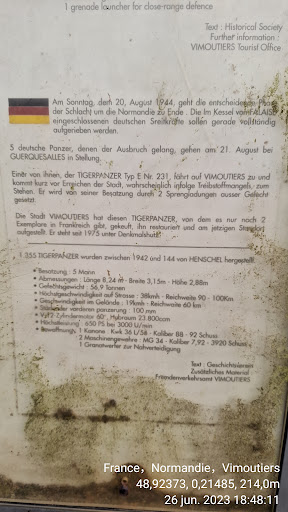
The Tiger tank, officially known as the Panzerkampfwagen VI Tiger Ausf. E, was a formidable German heavy tank which played a significant role in the armored battles of World War II. The Tiger tank was highly effective in combat, thanks to its combination of firepower, protection, and mobility. It could engage enemy tanks at long ranges with its main gun and withstand hits from most Allied anti-tank weapons. Despite its strengths, the Tiger tank had several weaknesses, including mechanical reliability issues, high fuel consumption, and difficulties with transportation due to its weight and size. Its complex design also made maintenance and repair challenging, especially under battlefield conditions. The one on display here suffered a similar fate and per the signage, likely ran out of gas and was made inoperable by its crew.

There is an area to pull off the road to park. There is also signage to explain the history of the tank. Stopped on our way from Paris to Normandy - worth the additional time to stop and see...

   Read more
Page 1 of 7
Previous
Next

Posts

Richard Van santenRichard Van santen
This Tiger with Fahrgestell number 251055, Turret Number 251113. This late-production Tiger, with steel road-wheels, is one of the several remaining Tigers of the 102nd SS Heavy Panzer Battalion and originally carried the number 224 on the side of its turret. But many sites still claim it's the tank that carried the turret number 231, but that Tiger was commanded by Hans Lorits and was knocked out at Ussy on august 14, 45 kilometers from vimoutiers. The Tiger at Vimoutiers was actually commanded by Unterscharführer Reisske and on august 20 his Tiger participated in a counter-attack launched from Vimoutiers to Trun in an etempt to breakthrough the Falaise's pocket. It was during this phase of the operation that Tiger 224 which took the 979 road breaks down, reisske order it's crew to place starches to blow it up and leave it behind, but only succeded in blowing of the engine deck covers and jaiming the turret. So the Tiger wasn't lost because of fuel shortest but to a big mechanical problem wich states loss of oil pressure resulting in engine failure. All this is based on actuall testimony of Ekkehard Förster and SS-Unterscharführer Wilhelm Fey. After the war Tiger 224 was sold to a scrapper name Morat, but the Tiger was to hard to move and Mr Morat only removed the easily removable parts and the gearbox, after Morat died his sister sold the tank to a scrapper in Caen, that started cuting up the Tiger, and removing the turret, this is were the the cutting marks ontop and on the side of the turret come from. When the local people of Vimoutiers heard of what was going to happen to the tank, the tank was bought for 6,000 Francs, to be place as a monument. in 1975, the tank was recovered by Alain Roudeix, it was restored and placed on the spot it sits now. So in 2017 a plan was made to restore the tank and place it into an new museum in the town of vimoutiers, but until then only a fence is placed around the tank to prevent any other people from climbing onto it.
TANKS BUTNOTHANKSTANKS BUTNOTHANKS
Very rare Tiger I, although not in the best of shapes. Worth visiting if you're in the area. This particular vehicle is one of only seven original Tigers in the world. It is a late production model with a simplified running gear, rubber-saving steel road wheels, monocular gunsight and the low late-style commander‘s cupola. Probably due to a lack of fuel its crew had to abandon the tank during the German retreat from the closing Falaise pocket in August 1944. Standard procedure for Tiger crews was to destroy their tanks so that they would not fall into enemy hands – as it had famously happened to Tiger 131 in Tunisia. Two explosive charges were carried on every vehicle for this purpose. One was placed in the gun breech and the other one in the engine bay. You can still see where the latter cracked open the top hull armour plate near the turret. Since the disabled 57-ton colossus was blocking the road, the advancing Canadians decided to bulldoze it into the ditch where the wreck began rusting away for decades. Several junk dealers have owned the Vimoutiers Tiger over the years – and besides unsuccessfully trying to cut it up for scrap (as can be seen on the turret) they have seemingly taken quite a few parts off, e.g. the exhaust. In 1975 the Tiger was bought by the town of Vimoutiers, recovered and became a local historical landmark and popular tourist attraction.
StefanieStefanie
The Tiger tank, officially known as the Panzerkampfwagen VI Tiger Ausf. E, was a formidable German heavy tank which played a significant role in the armored battles of World War II. The Tiger tank was highly effective in combat, thanks to its combination of firepower, protection, and mobility. It could engage enemy tanks at long ranges with its main gun and withstand hits from most Allied anti-tank weapons. Despite its strengths, the Tiger tank had several weaknesses, including mechanical reliability issues, high fuel consumption, and difficulties with transportation due to its weight and size. Its complex design also made maintenance and repair challenging, especially under battlefield conditions. The one on display here suffered a similar fate and per the signage, likely ran out of gas and was made inoperable by its crew. There is an area to pull off the road to park. There is also signage to explain the history of the tank. Stopped on our way from Paris to Normandy - worth the additional time to stop and see despite the rain.
See more posts
See more posts
hotel
Find your stay

Pet-friendly Hotels in Mortagne-au-Perche

Find a cozy hotel nearby and make it a full experience.

This Tiger with Fahrgestell number 251055, Turret Number 251113. This late-production Tiger, with steel road-wheels, is one of the several remaining Tigers of the 102nd SS Heavy Panzer Battalion and originally carried the number 224 on the side of its turret. But many sites still claim it's the tank that carried the turret number 231, but that Tiger was commanded by Hans Lorits and was knocked out at Ussy on august 14, 45 kilometers from vimoutiers. The Tiger at Vimoutiers was actually commanded by Unterscharführer Reisske and on august 20 his Tiger participated in a counter-attack launched from Vimoutiers to Trun in an etempt to breakthrough the Falaise's pocket. It was during this phase of the operation that Tiger 224 which took the 979 road breaks down, reisske order it's crew to place starches to blow it up and leave it behind, but only succeded in blowing of the engine deck covers and jaiming the turret. So the Tiger wasn't lost because of fuel shortest but to a big mechanical problem wich states loss of oil pressure resulting in engine failure. All this is based on actuall testimony of Ekkehard Förster and SS-Unterscharführer Wilhelm Fey. After the war Tiger 224 was sold to a scrapper name Morat, but the Tiger was to hard to move and Mr Morat only removed the easily removable parts and the gearbox, after Morat died his sister sold the tank to a scrapper in Caen, that started cuting up the Tiger, and removing the turret, this is were the the cutting marks ontop and on the side of the turret come from. When the local people of Vimoutiers heard of what was going to happen to the tank, the tank was bought for 6,000 Francs, to be place as a monument. in 1975, the tank was recovered by Alain Roudeix, it was restored and placed on the spot it sits now. So in 2017 a plan was made to restore the tank and place it into an new museum in the town of vimoutiers, but until then only a fence is placed around the tank to prevent any other people from climbing onto it.
Richard Van santen

Richard Van santen

hotel
Find your stay

Affordable Hotels in Mortagne-au-Perche

Find a cozy hotel nearby and make it a full experience.

Get the Appoverlay
Get the AppOne tap to find yournext favorite spots!
Very rare Tiger I, although not in the best of shapes. Worth visiting if you're in the area. This particular vehicle is one of only seven original Tigers in the world. It is a late production model with a simplified running gear, rubber-saving steel road wheels, monocular gunsight and the low late-style commander‘s cupola. Probably due to a lack of fuel its crew had to abandon the tank during the German retreat from the closing Falaise pocket in August 1944. Standard procedure for Tiger crews was to destroy their tanks so that they would not fall into enemy hands – as it had famously happened to Tiger 131 in Tunisia. Two explosive charges were carried on every vehicle for this purpose. One was placed in the gun breech and the other one in the engine bay. You can still see where the latter cracked open the top hull armour plate near the turret. Since the disabled 57-ton colossus was blocking the road, the advancing Canadians decided to bulldoze it into the ditch where the wreck began rusting away for decades. Several junk dealers have owned the Vimoutiers Tiger over the years – and besides unsuccessfully trying to cut it up for scrap (as can be seen on the turret) they have seemingly taken quite a few parts off, e.g. the exhaust. In 1975 the Tiger was bought by the town of Vimoutiers, recovered and became a local historical landmark and popular tourist attraction.
TANKS BUTNOTHANKS

TANKS BUTNOTHANKS

hotel
Find your stay

The Coolest Hotels You Haven't Heard Of (Yet)

Find a cozy hotel nearby and make it a full experience.

hotel
Find your stay

Trending Stays Worth the Hype in Mortagne-au-Perche

Find a cozy hotel nearby and make it a full experience.

The Tiger tank, officially known as the Panzerkampfwagen VI Tiger Ausf. E, was a formidable German heavy tank which played a significant role in the armored battles of World War II. The Tiger tank was highly effective in combat, thanks to its combination of firepower, protection, and mobility. It could engage enemy tanks at long ranges with its main gun and withstand hits from most Allied anti-tank weapons. Despite its strengths, the Tiger tank had several weaknesses, including mechanical reliability issues, high fuel consumption, and difficulties with transportation due to its weight and size. Its complex design also made maintenance and repair challenging, especially under battlefield conditions. The one on display here suffered a similar fate and per the signage, likely ran out of gas and was made inoperable by its crew. There is an area to pull off the road to park. There is also signage to explain the history of the tank. Stopped on our way from Paris to Normandy - worth the additional time to stop and see despite the rain.
Stefanie

Stefanie

See more posts
See more posts