Just a South African honouring our fallen. Unfortunately modern South Africa doesn't value these men when we rewrote our history that everything before 1994 was "Apartheid". Many honourable people in our history just blackwashed as colonisers.
My mom's side is 1820s settler Cornwall-Scottish. Pascoe and Tweedie. But up to now I only knew of my Great Grandfather on my dad's father's side Jules Delvaux, who was from Belgium not South Africa when he fought in WW1. He met my Great Grandmother on my father's side Louise Grabowsky (Polish) at a POW camp as she was working for Red Cross. Apparently after the battle of Meine he was one of those rounded up to be executed to boost troop morale. (This is only how I know it). She had connections with German officers being an aristocrat, and pleaded that he be saved. Another man was executed in his place. After the war he and her were so tired from the war of all of it they moved to Durban South Africa. He was a violin music teacher. She renounced her Polish Countess title we know little of her history.
My English and Scottish side has been in South Africa 200 years.. On both sides of my parents. It makes me wonder (history is weird like that) if ancestors of my Scottish and English heritage, the South African ancestors from South Africa then AND my Great-Grandfather Jules Delvaux on the Belgium side all shared a moment on the western front.. Showing a photo of their family, pondering their futures.....
Which is me, English speaking but fully South African in culture where the southern tip of Africa a hemisphere away is my home, never stayed in UK, don't know that world. With a very French name (Jean-Michel Delvaux) while not speaking a word...
Read moreAfter visiting most memorials in the Somme region, I would say this one is one of the best. There is a large, free carpark for cars, coaches, and bikes next to the reception. There is a small picnic area at the entrance and a cafe (selling ice cream and cold drinks only) with free toilets.
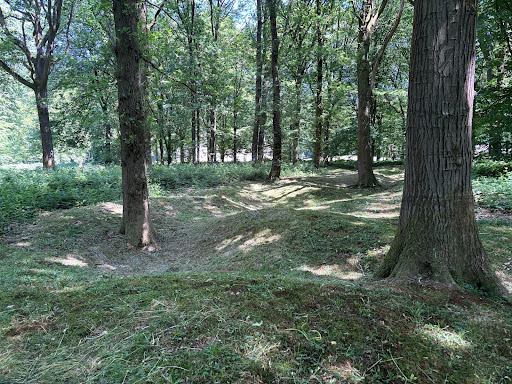
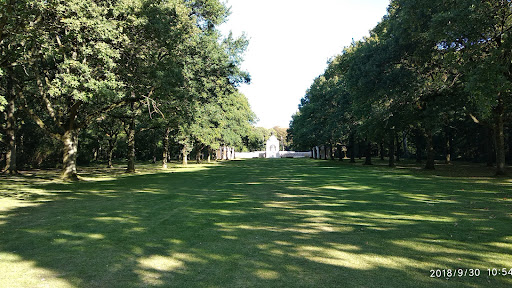
Start your tour behind the visitor centre at the "first stone", a small stone pillar which marks the entry point where the 1st South African Infantry Brigade first entered Delville Wood on July 15th 1916. You can follow the pillars on a short trail through the woods, following the German trenches which were taken over by the South Africans. These trenches are maintained to varying degrees throughout the huge woods, some are very easy to see and walkable and some are completely covered by undergrowth. The woods is very beautiful and atmospheric. At the end of you trail you reach the last tree, the only tree which survived WWI in this area. There is a small memorial here with more information.
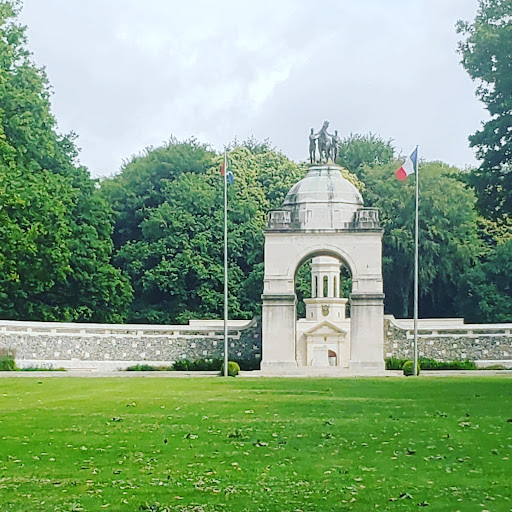
Next to the Last Tree is a large memorial with a museum inside the main courtyard of the memorial! It is not clearly sign posted so you will need to walk around a little to find the entrance. The museum is free and air conditioned, it tells the story of the South African forces and the battle of Delville Wood through displays of artefacts, memorials, artworks, and information boards. The museum is build in a donut shape around the memorial courtyard and is a unique and dynamic experience. Definitely worth a visit to learn to little-known, deeply moving story of the South African...
Read moreThis striking memorial commemorates the 10,000 men of the South African forces lost throughout the Great War. Delville Wood was chosen as the site for the memorial because it was here that the South African Brigade was all but destroyed in taking and holding Delville Wood during the battle of the Somme in 1916.
In contrast to the hell of one hundred years ago, today it is a beautiful and calm spot. Amongst the trees behind the memorial and museum is the only tree to survive the fighting in 1916. Scattered about are the remains of old trenches and shell holes and we must not forget that not all of the dead were recovered after the fighting ended. There are surely men still interred in this halllowed ground.
Opposite the entrance lies Delville Wood Cemetery, the final resting place for more than 5,500 men from the Commonwealth who fell during the fighting at Delville Wood and elsewhere during the Battle...
Read more