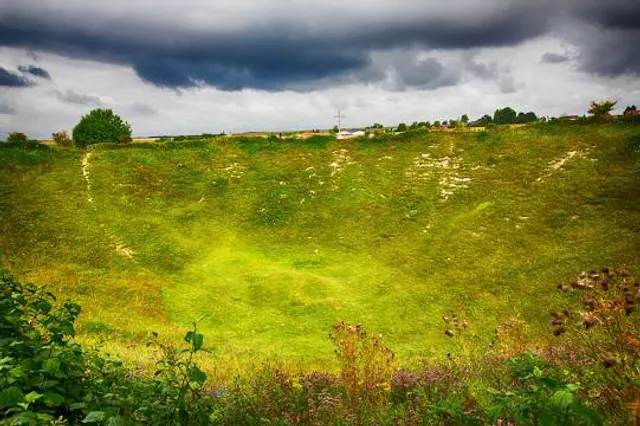
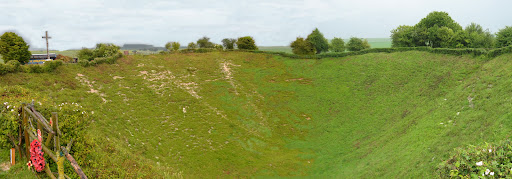
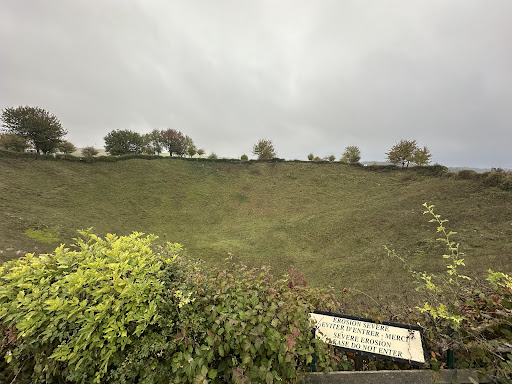
Without doubt this crater is very evocative and really brought it home to me the sacrifice that others made to bring about peace in Europe. It leaves behind an enduring symbol of what so many of the British and other nationalities went through during the battle of the Somme. It’s surrounded with information boards and plaques that remember the many people that died there. It’s only when viewing the crater you can begin to imagine the magnitude of the explosion and the catastrophic impact it would have had just before the soldiers left the trenches to ‘go over the top’ to almost certain death. Over a million died in this area often to no avail. This included soldiers but also nurses, doctors and many others who performed vital, non combative roles close to the front lines.
Following this we took time out to visit some of the other less visited graveyards in the area just to pay our respects to the many fallen that time should never forget. The site is privately owned and they rely only on donations to maintain the memorial. It’s clear that there is still some work to be done to restore the wooden walkways, the cross beams of which each bears the name of the many victims of this historic episode.
There is no entrance fee and it’s very easy to park outside...
Read moreThe Lochnagar mine crater on the 1916 Somme battlefields in France is the largest man-made mine crater created in the First World War on the Western Front. It was laid by the British Army’s 179th Tunnelling Company Royal Engineers underneath a German strongpoint called “Schwaben Hohe”. The mine was exploded two minutes before 07:30 am Zero Hour at the launch of the British offensive against the German lines on the morning of July 1st, 1916. On 1st July 1978 the piece of ground containing this huge crater was purchased by Richard Dunning. The historical significance of the site and the fact that this ground still contains the undiscovered remains of German, French and British soldiers from the Great War of 1914-1918 convinced Richard that it was a place which should be preserved. Richard’s aim is to preserve the site and to make it a Garden of Remembrance and a place where visitors to the Somme can find a quiet opportunity for reflection. As a memorial it commemorates the men and women of all nations whose lives were affected by the Great War...
Read moreNot just any big hole in the middle of the fields! On July 1, 1916, at 7:29 AM, two massive explosions sound just in succession just south of the village of La Boisselle: the Allied Somme Offensive has begun! In the months leading up to the offensive, the tunneling companies of the Royal Engineers dug very carefully a mine under the "Schwabenhöhe", a German field fortification, where in two rooms a total of 27,000 kg of ammonal explosive charges are placed. Earth and debris are blown into the air for more than a kilometer and when the smoke has disappeared, the "Schwabenhöhe" has turned into a 30m deep and 100m wide crater that is soon occupied by British troops. The Lochnagar mine, like the Y Sap mine north of La Boisselle, blew a huge hole in the ground, but weakened the German positions around the village less than expected. Instead of a quick conquest of La Boisselle, the planners thought it only took 20 minutes, the village had not been conquered by the end of the day, and the death toll was a...
Read more