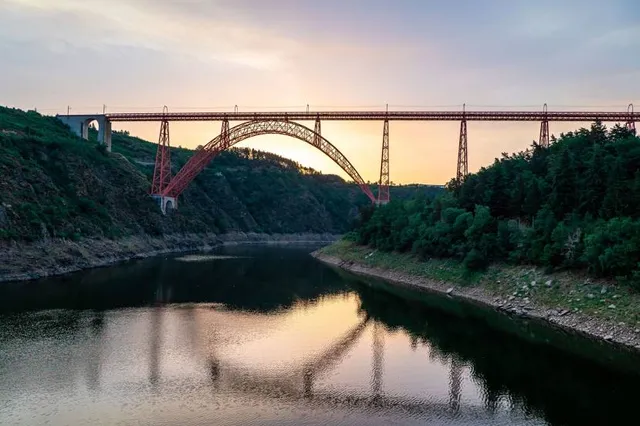
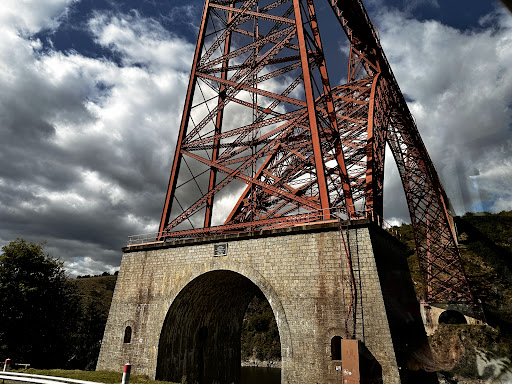
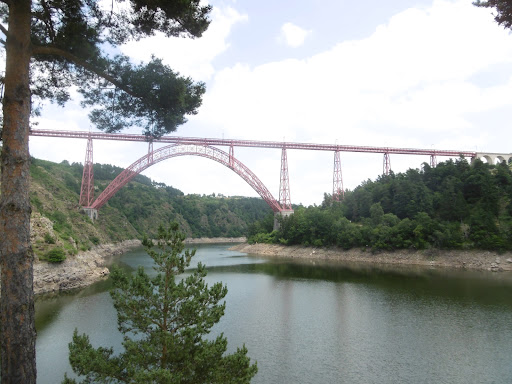
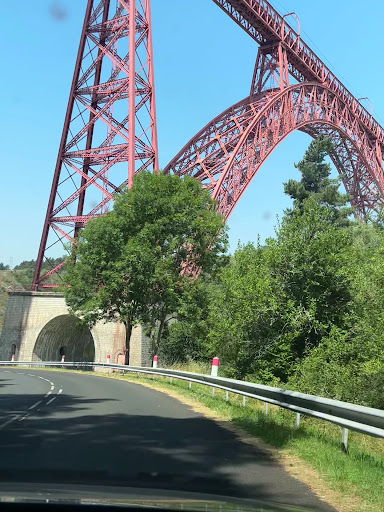
The Viaduc de Garabit was designed by the French engineer Gustave Eiffel, best known for the Eiffel Tower. It was constructed between 1880 and 1884 to carry the Paris-Béziers railway line across the deep Truyère River valley. The viaduct is made of iron, is 565 meters (1,854 feet) long, and has a central arch spanning 165 meters (541 feet), one of the largest of its kind at that time. The bridge reaches a height of 124 meters (407 feet) above the river, making it one of the tallest railway bridges in the world upon its completion. The Viaduc de Garabit was a significant milestone in civil engineering, pushing the boundaries of what was possible with iron construction. Eiffel's design ensured that the structure was both lightweight and incredibly strong, capable of supporting the heavy trains of the time. The bridge played a crucial role in improving transportation in the region, connecting the rural areas of central France with the more industrialized parts of the country. It also showcased the potential of iron as a building material, influencing the design of future large-scale structures. The Viaduc de Garabit remains in use today and symbolizes French engineering prowess. It is also a popular tourist attraction, admired for its beauty and historical significance. The viaduct is particularly stunning when illuminated at night, with its red ironwork glowing against the...
Read moreGeweldig voorbeeld van de architectuur van Gustav Eiffel.
Het Viaduc de Garabit is een spoorboogbrug ontworpen door de Franse ingenieur Gustave Eiffel en gelegen bij Ruynes-en-Margeride (departement Cantal) in het Franse Centraal Massief. De brug overspant de rivier de Truyère. De brug werd gebouwd door Gustave Eiffel & Cie en afgewerkt in 1884, maar het duurde tot 1888 vooraleer de spoorweglijn in dienst genomen werd. Ze was daarna een tijdlang de hoogste brug ter wereld. Momenteel rijdt er per dag slechts één passagierstrein over: de Corail-spoorlijn van Clermont-Ferrand naar Béziers.
De eigenlijke overspanning werd ontworpen door Maurice Koechlin, een medewerker van Eiffel. Door de aanwezigheid van de Mistral was het al op voorhand uitgesloten dikke (betonnen) profielen te gebruiken. Daarom werd voor gietijzer gekozen, net zoals later bij de bouw van de Eiffeltoren.
De boog is opgebouwd als tweescharnierboog, met aan de ene zijde twee, en aan de andere kant vier zijoverspanningen. De centrumlijn van de boog volgt een bijna perfecte parabool, zodat de boog quasi enkel op druk...
Read moreWe drove by accidentally on highway, and thought it looks so familiar to the famous bridge in film Cassandra Crossing. Googled it, confirmed! Only 2 trains pass over the viaduc each day now in very slow vitesse, which gives it a special nostalgic feeling of the old world. Effeil built it in 1884 and 5 years later he...
Read more