What to say? This is a bizarre museum: threadbare, dusty, tawdry, yet at the same time, proudly over-celebrating the life of one of history's greatest killers.
It's as if the people of Gori know they shouldn't celebrate Stalin, yet they do so, halfheartedly and embarrassed.
There's a bored guard in police uniform looking at a monitor just inside the front door. On the side of the entry hall there's a sparse gift shop with a few Stalin mugs, t-shirts and booklets. A manager sits at a desk next to the guard. The gift shop attendant does double-duty at the ticket window (admission is 10 Georgian lari for the museum, 5 extra to view Stalin's train car outside the museum).
No video is allowed in the museum, though pictures are permitted. The manager scolded me for taking a panorama of the entry hall, but without conviction, assuming from my turning my camera that I was videoing the hall.
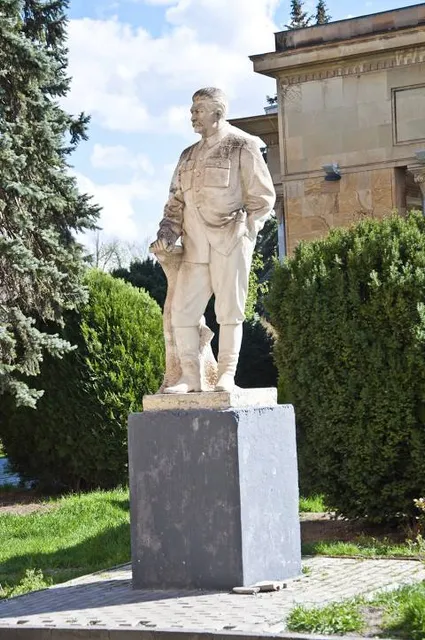
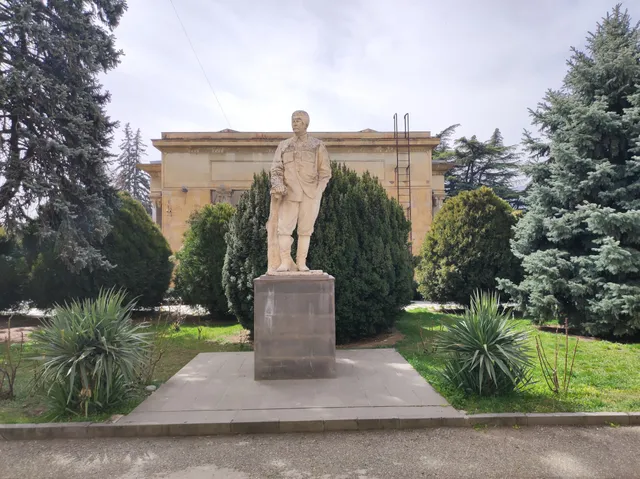
The main museum is upstairs. You ascend to it via a grand stairway with a statue of Stalin facing you at the landing. The red carpet leading upstairs is frayed and worn. Upstairs, the flooring is a bit spongy. And the connection to Stalin seems marginal. There are lots of pictures and records in the upstairs rooms. I was intrigued to find several pages of Stalin's original meteorological records from his first job on display. But overall, there are more knick-knacks and photos than anything else. Lots of gifts given Stalin, pipes he smoked, etc.
Outside is the house Stalin was born into and lived in until age 4. It sits in a Soviet-era heroic-shrine setting, with a roof overhead and columns surrounding it. I believe the museum and birth-house display pre-date Stalin's death. Inside, the museum's ultimate display is a copy (one of 12) of Stalin's death mask.
And of course, almost nothing at all about the man's victims, the tens of millions who died at Stalin's hands, the millions in the gulag, the millions of peasants systematically starved. They are voiceless and monument-less, while this villainous man retains his colonnaded shrine.
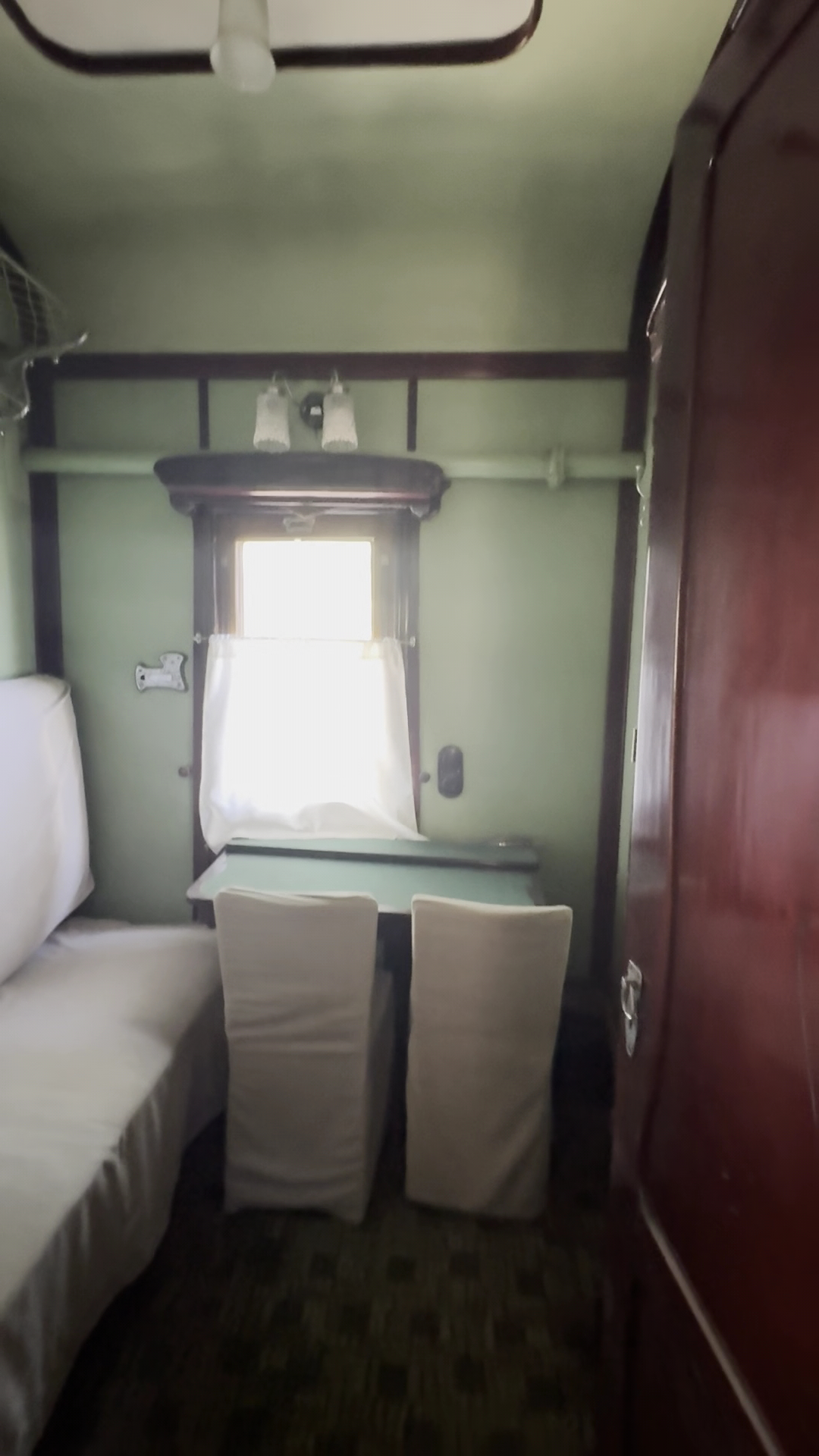
Also outside is Stalin's personal railroad car! What fun! You get to see the bed he slept in and the rooms for his guards! The day we visited there was a miniscule children's carnival with a jump house and little rides set up on the museum's mall amidst the flowers. Fun!
There is absolutely nothing marvelous about this museum. The marvel is that it...
Read moreInteresting museum to visit in town which is birthplace of Stallin. I don't understand why taking photo or videos is forbidden inside, that's not the way you will attract more tourists. Or this is the way museum wanna show how was it living under Stallin boot? Museum represented the life of this soviet georgian guy in subjective way, if I didn't miss something here. For example there is no any document about relation between USSR and Yugoslavia, we know Stallin also wanted Tito's Yugoslavia into Warsaw pact, he even sent agents to kill Tito, all of them failed. Tito got irritated by this Stallin's action so he sent him letter saying: "You already sent dosenz of soviet agents to kill me, we discovered all of them, and they are all dead. I can also send an agent to kill you. And that one will be enough". After that Stallin stopped sending agents to kill Yugoslav president. As you know Yugoslavia was leader of so called "Nesvrstani" group of the countries which wasn't either pro-west nor pro-east orientated. There is no mention of Stallin gruesome politics toward people who disagree with him, sending thousands to remote places in Syberia... I am not saying Tito was a doll, he also commited a lot of crimes after WWII in Yugoslavia mostly toward croats sending them on Goli Otok ("yugoslav Syberia"). Other than that it's true museum is full of black-white photos, but you can also see Stallin uniforms, some personal stuff, gifts he received, and his office and house in which he was born. So it was a nice experiance to visit this museum and trying not to think for how many deaths this guy is responsible because people disagree...
Read moreRegardless of your political views, I highly recommend visiting this museum. I realize that Comerade J.V. Stalin is a controversial historical figure. However, we did not endure the hardships of the Tsar or the struggles of the post revolutionary RSFSR (USSR).
Comerade Stalin personally saved my Grandparents lives although my great-grandfather and great uncle were executed for betraying the RSFSR.
For his time, his strong-willed leadership brought results to the USSR in building non-existent infrastructure, organizing society into a productive cohesive unit, and defeating the Nazis through sheer will, industry and hard fighting.
For those of us Russians, who were born in the West during the Cold War, we would not be free today had this man and his leadership style been absent from the USSR from 1935 to 1945.
What I liked about the museum were the variety of exhibits, Stalin's home and early life, his work translating political literature from Russian to Georgian, all were on display.
The original artifacts from the Kremiln, his desk and phone, his conference room, and his reports were also present.
Stalin, in actuality, was an accomplished bureaucrat. He authored numerous reports on the progress of the USSR and the war effort. These were on display. The museum also has a section illustrating the negative aspects of Stalin to balance the narrative.
However, we did not live in his time. We did not have to fight massive plagues of diseases, crop failures, corruption, and invasions. We should try to understand why, but not...
Read more