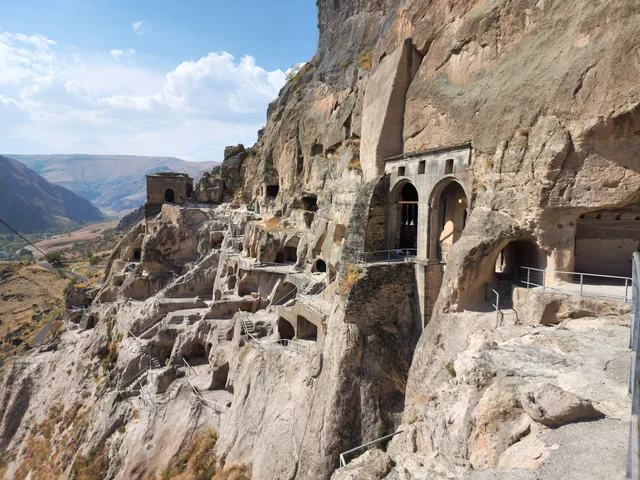
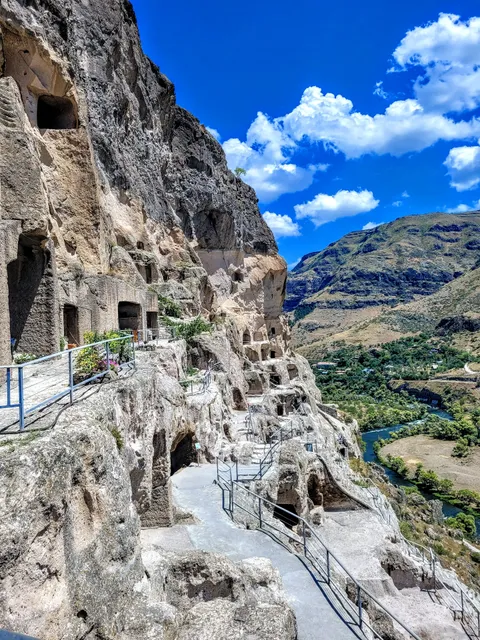
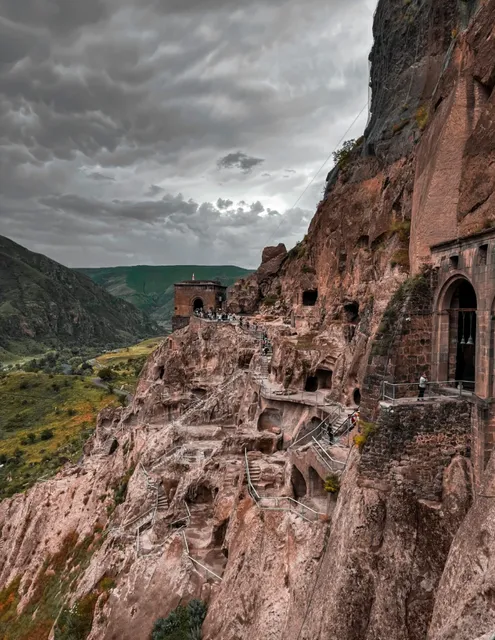
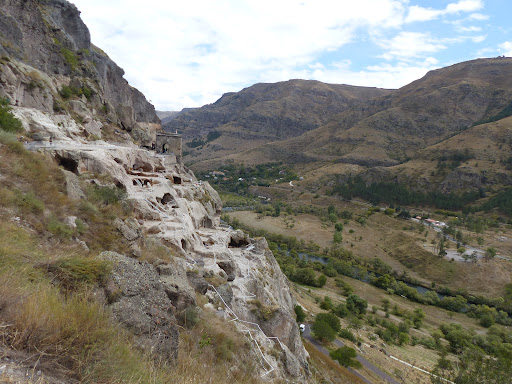
Vardzia (Georgian: ვარძია) is a cave monastery site in southern Georgia, excavated from the slopes of the Erusheti Mountain on the left bank of the Kura River, thirty kilometres from Aspindza. The main period of construction was the second half of the twelfth century. The caves stretch along the cliff for some five hundred metres and in up to nineteen tiers. The Church of the Dormition, dating to the 1180s during the golden age of Tamar and Rustaveli, has an important series of wall paintings. The site was largely abandoned after the Ottoman takeover in the sixteenth century. Now part of a state heritage reserve, the extended area of Vardzia-Khertvisi has been submitted for future inscription on the UNESCO World Heritage List.
Soviet-era excavations have shown that the area of Vardzia was inhabited during the Bronze Age and indicated the reach of Trialeti culture. Cave settlements such as Uplistsikhe are known along the Kura River from at least the fifth century BC, while rock cut architecture in the context of Georgian Christianity is known from Zedazeni and Garedzhi from the sixth century AD, and more locally from Vanis Kvabebi, Cholta and Margastani from the eighth century. Four distinct building phases have been identified at Vardzia: the first during the reign of Giorgi III (1156–1184), when the site was laid out and the first cave dwellings excavated; the second between his death and the marriage of his successor Tamar in 1186, when the Church of the Dormition was carved out and decorated; the third from that date until the Battle of Basian c.1203, during which time many more dwellings as well as the defences, water supply, and irrigation network were constructed; while the fourth was a period of partial rebuilding after heavy damage in the earthquake of 1283.
A number of documentary sources supplement the knowledge derived from the site's physical fabric. The collection of chronicles known as the History of Georgia refers to Tamar erecting a church to house the icon of the Virgin of Vardzia after receiving divine help in her campaigns, before transferring the monastery from Upper or Zeda Vardzia. Tamar is said to have departed from Vardzia during her campaign against the Muslims, and her ensuing victory at Basian is celebrated in the Hymns in Honour of the Virgin of Vardzia by Ioane Shavteli. The History of Georgia also relates how Vardzia escaped the Mongol invaders in the 1290s. The Persian Safavid chronicler Hasan Bey Rumlu describes Vardzia as a "wonder", "impregnable as the wall of Alexander the Great", before recounting its sack by the Persians under Shah Tahmasp I in 1551; a near-contemporary note in the Vardzia Gospel tells of its repatriation from a Persian bazaar. After the arrival of the Ottomans in 1578, the monks departed and the site...
Read morePlus Size Review: I was a little nervous being obese and wanting to travel to Vardiza. It's definitely not "easy," but there are plenty of shaded, cave rooms to rest when needed. Just take it slow, hold onto the guardrails, and you'll be fine. IF YOU HAVE KNEE ISSUES DONT DO IT!!! The stairs down are exhausting, even for non-plus sized people. It was several flights...
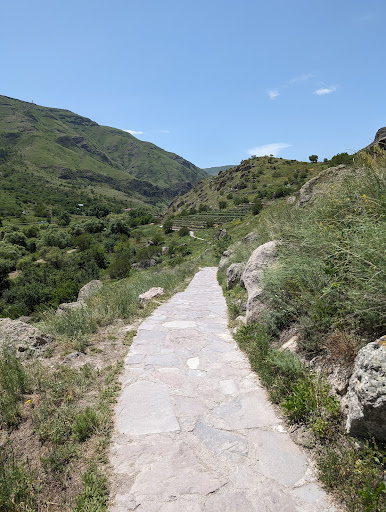
Upon arrival to the upper entrance, where the bus drops you off, there is an incline to walk up. Nothing major. I just stopped a couple times for photos and kept walking.
As for Vardiza... A nice thing is, you choose which rooms you want to go to. If you just want to explore a couple levels, that's doable... You just have to maze your way, which is a challenge. There were a couple times where I let my husband explore a lower room or two while I rested in the shade.
I was recommended to go back the way I came, probably due to my size... But I did the stairs just fine. I think all in all we walked about 5,000 steps (with taking the bus). There were a ton of steps in there, but except for the exit steps... It's little by little.
Couple notes...
-Bathrooms at the bottom cost 1 Lari. Have some coins on hand for the bathroom! There was an additional bathroom at the top, but I didn't use that one to know if it cost as well
-Yes, wear solid shoes. A lot of the steps are uneven and there are rocks along the path... I tripped several times, even with my chacos.
-Parking lot is small, but there's an additional lot just around the corner. 3 GEL for two hours. Supposed to be an additional 1 GEL per extra hour.
-TAKE THE BUS UP, it's only 2 GEL per person. Only goes up, not down. Wait for bus behind the ticketing building. We hopped on beside a tree just opposite of the building.
-Take water, drink it, and refill at the top near entrance of caves. There were a couple of water stations along the way, including near the church in the Spring room.
Thirsty for something else? Near the church there's also a little shop with drinks and souvenirs. There's even a table to sit down for a few.
-We did not take a guide and probably missed a lot. I would imagine it's hard to keep on take. Some rooms were labeled, which was...
Read moreIncredibly beautiful! One of Georgia's most fascinating and wonderful historical sites is located in the southwestern part of the country. The rock wall in the slope of the Erusheti Mountain on the left bank of the Mtkvari (Kura) River was changed here in the second half of the 12th century into a huge cave monastery, or rather into a cave city. Although King Giorgi III founded Vardzia as a fortress, his daughter, the legendary Queen Tamar, soon turned the border fortress into a monastery. The monastery grew into a real city and religious center where more than 2,000 monks lived during its heyday. Spread over thirteen floors there are approximately 400 rooms, 15 churches (including the Church of Dormition), 25 wine cellars and various other spaces such as stables, a refectory, a bakery, pharmacies, a library, etc., etc., etc. The city's water supply system is certainly worth mentioning: thanks to a reservoir located higher in the mountains and a ceramic pipe system, enough water could be supplied daily for 50,000 people. Although it was primarily a monastery, Vardzia also functioned as a shelter for the population from the surrounding area in times of emergency or war. Man and nature have taken their toll over the centuries: a major earthquake in 1283 shook away the outer walls of many caves and in 1551 Vardzia was plundered by the Persians. After the conquest of the region by the Ottomans in 1578, the monastery was completely abandoned. During the Soviet period, scientific study of the cave monastery began: in 1938 Vardzia became a museum, and in 1970/71 the first archaeological excavations took place. Only after the fall of the Soviet Union did Vardzia (partly) become a functioning monastery again... and one of the most beautiful (tourist)...
Read more