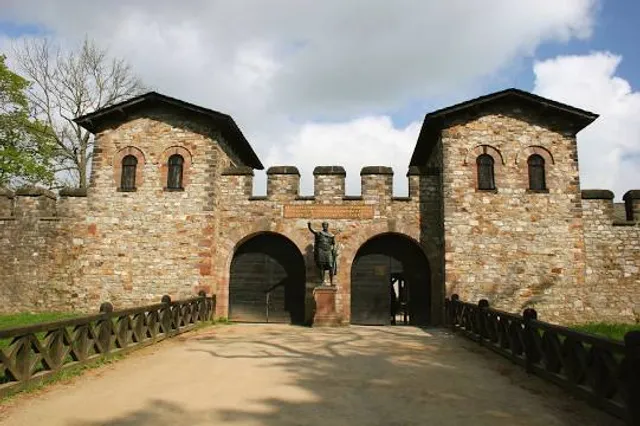
The Saalburg is a Roman fort located on the main ridge of the Taunus, northwest of Bad Homburg, Hesse, Germany. It is a cohort fort, part of the Limes Germanicus, the Roman linear border fortification of the German provinces. The Saalburg, located just off the main road roughly halfway between Bad Homburg and Wehrheim is the most completely reconstructed Roman fort in Germany. Since 2005, as part of the Upper German limes, it forms part of a UNESCO World Heritage site.[1] In the modern numbering system for the limes, it is ORL 11. The earliest examinations of the site were undertaken from 1853 to 1862 by the Nassau Antiquarian Society under the direction of Friedrich Gustav Habel (1793–1867).[2] But the great impulse to provincial Roman archaeology in Germany came in 1892, when the Reichs-Limes-Kommission (the Imperial Commission for the Roman borders), then chaired by Theodor Mommsen began to research the course of the Limes Germanicus in its entirety, as well as the location of all its forts. In the course of this enormous project, not completed for decades, intensive exploration of the Saalburg and its surroundings was pursued by the archaeologists charged with this stretch of the limes, Louis Jacobi (1836–1910) and his son and successor Heinrich Jacobi (1855–1946). In 1897, Kaiser Wilhelm II, following a suggestion by L. Jacobi, ordered the reconstruction of the Saalburg fort according to the detailed results of its excavation.[3] As a result, the Saalburg became the most completely reconstructed fort on the entire limes. It also houses the Saalburg Museum, one of the two most important institutions dedicated to the study of the German Limes (the other being the Limesmuseum of Aalen).[4] From 1967 to 1993, the museum was directed by the well-known archaeologist Dietwulf Baatz, whose many publications fostered a broad interest in provincial Roman archaeology well beyond specialist circles.Although the Saalburg is known mainly as an archaeological park and museum, it also serves a number of scientific functions less obvious to the visitor.
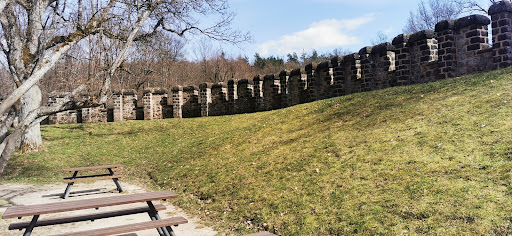
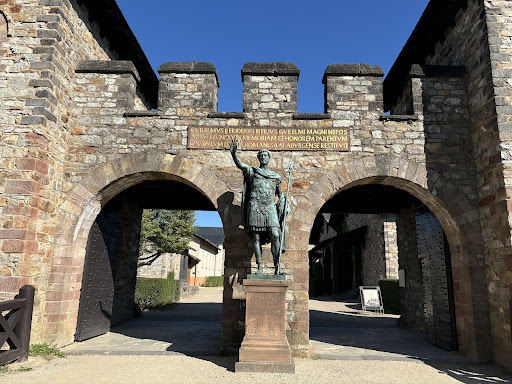
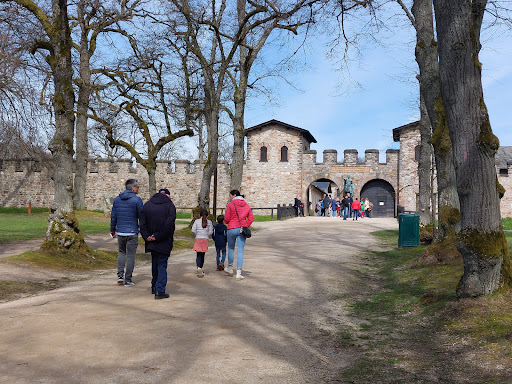
The most striking features for the modern visitor are the fully reconstructed walls and gates, the principia with its aedes (shrine containing the signa militaria or standards), the assembly hall, the horreum (provisions store), the two barracks buildings with their rebuilt interior contubernia and the partially reconstructed praetorium.
The horreum contains an informative exhibition, focusing on cultural, historical, architectural, and military aspects of Roman Germania. The museum exhibits a large collection of well-preserved military and domestic equipment from the Saalburg and other sites in the area as well as a series of architectural and terrain models.
Since its reconstruction, the Saalburg has functioned also as an internationally renowned centre of research, concerned with provincial Roman archaeology in general, the limes in particular. The heart of the centre is a specialised library of 30,000 volumes and 2,200 slides. The Saalburgmuseum regularly organises colloquia and has its own series of academic...
Read moreI visited during the brief late-March availability. The weather was good and lent itself to a fine visit. The grounds are well maintained and clean. There is plenty of open space for children to run around and burn energy, the entirety of the Fort is Baby-stroller/ wheelchair accessible with a few minor exceptions in the buildings. There exists a Cafe (closed during my visit) and well-maintained public restrooms. The Fort itself has numerous displays of Roman and ancient Germanic artifacts. The displays are narrated in both German and English. Good information, good artifacts and displays show quite well what this site (and several others in Germany) were like in appearance and operation/ purpose. I very much look forward to visiting again. The surrounding area has a full-fledged restaurant and near-limitless hiking trails. The forest has suffered somewhat from invasive beetle damage and is being "recycled" ; lots of downed trees and disrupted terrain but still quite enjoyable to hike through. PARKING can be a total nightmare; be patient and recognize that the parking area is pretty much a cul-de-sac. It terminates on the back-side of a slope and is very painful to turn around in. Try to park BEFORE the main entrance...
Read moreFor Ancient Rome aficionados, this place will blow your mind. Roman ruins, reconstructions, displays and ancient artefacts abound. You can easily spend an entire morning or afternoon here, wandering through the reconstructed fort. Bearing in mind it was built prior to the Great War, so the architecture reflects archaeological thinking from the late Nineteenth Century. However that does not detract from the poignant atmosphere of the place. There are some excellent displays on ancient Roman life and the magnificent horse head from an equestrian statue, possibly of Augustus found nearby. The staff are super welcoming and helpful and the taverna offers some tasty examples of antique Roman fare. In close proximity to the fort you can see the Limes and a reconstruction of the frontier palisade, as well as the site of the Roman outpost that preceded the larger fortress. Well worth a visit if you’re interested in...
Read more