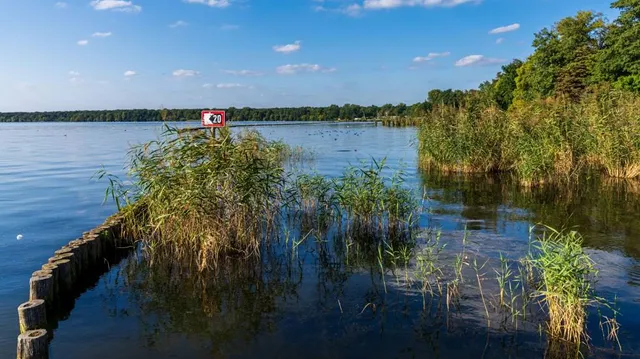
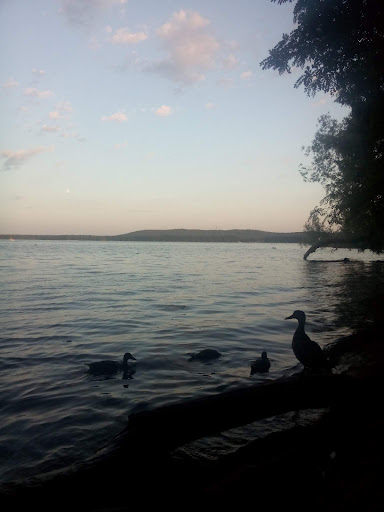
Müggelsee is probably my favorite one in Berlin. It's quite big, maybe one of the largest in town, it got a proper sandy beach (which you have to pay for, unfortunately) and the little hill that overlooks the lake, only makes the view more interesting. On the hill you've got a bunch of restaurants and cafes from which you can admire a beautiful panorama of Berlin.
The lake is located in a really picturesque neighborhood that looks more like an independent village rather than an area of the city, also because, in order to get there, you have to go through a big forest, which separates it from the urban jungle.
Getting there it's gonna be an easy task, thanks to the great invention of the S-bahn. From Alexanderplatz, without changing, it only takes one hour plus 10 minutes walking from the station.
Something that I truly love about this place is the fact that it's surrounded by pure Nature, which, of course, makes everything more pretty. Water is crystal clear, overall a very clean lake. Restaurants and bars, not too many though, can be found around Müggelsee. If you want to have more culinary options, then I would rather go into town, which only takes 5 minutes.
Definitely a place that needs...
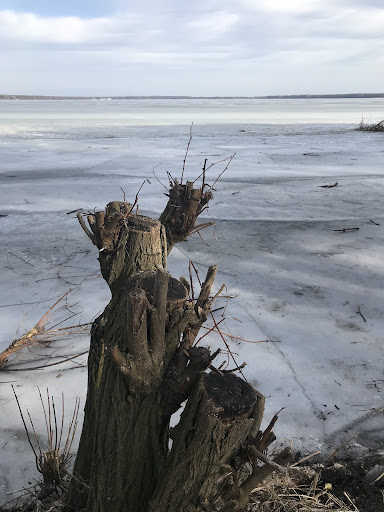
Read moreI visit Müggelsee 🌊 on a Saturday afternoon, and it was a beautiful day, partially cloudy ⛅ with 11°C. I enjoyed walking🏃 in the woods till I reached the lake, which was frozen ⛄. There were many people with kids, dogs🐕 and 🚲. Everyone was nicely maintaining social distance 🙌. It's ideal for a day outing with family or friends. There are small kiosks that sell snacks and drinks by the lake but don't entirely rely on them as they could be closed, so I recommend that you pick-up food 🍟 and beverage🥤from the town. Please note if you are coming by public transport you could face some delays with tram and bus schedules. Other than that, don't let the cold weather stop you from exploring in...
Read moreDer See hat eine Wasserfläche von über 7,4 Quadratkilometern (maximal 4,3 Kilometer lang; 2,6 Kilometer breit; dies schließt Die Bänke im Osten ein) und ist bis zu acht Meter tief. Der See und die am Südrand gelegenen Müggelberge, mit 115 Metern die höchsten natürlichen Berliner Erhebungen, entstanden während des Pleistozäns. Auf dem Kleinen Müggelberg wurde 1961 der vielbesuchte heutige Müggelturm errichtet, der einen weitreichenden Ausblick über den See und die Wälder bis hin zur Silhouette Berlins bietet.
Durch den Müggelsee fließt die Spree, die von der ehemaligen Schleuse Große Tränke, vier Kilometer westlich von Fürstenwalde, bis Köpenick als Müggelspree bezeichnet wird. Auf der Ostseite mündet das Fredersdorfer Mühlenfließ von Nordnordosten kommend in den See. Das am Nordufer des Müggelsees gelegene Wasserwerk Friedrichshagen entnimmt dem See einen Großteil seines Rohwassers. Außerdem befinden sich zahlreiche Tiefbrunnen in Ufernähe, die neben einem geringen Anteil Grundwasser vor allem Uferfiltrat fördern. Seit 2013 liegt jedoch die Sulfatbelastung im Müggelsee regelmäßig über den Trinkwassergrenzwerten, was langfristig problematisch für die Trinkwasserversorgung der Hauptstadt sein könnte. Die Sulfate stammen zum großen Teil aus den Tagebaugebieten des Lausitzer Braunkohlereviers.
Das heutige Strandbad Müggelsee wurde 1929/1930 nach Plänen von Martin Wagner und Friedrich Hennings erbaut, nachdem die alte Freibadanlage im September 1928 abgebrannt war.
Am 24. Mai 1932 landete das Flugschiff Dornier Do X auf dem Müggelsee, das seinerzeit größte Flugzeug der Welt, nach einem zweijährigen Repräsentationsflug durch Europa und nach Süd- und Nordamerika.
Anfang des 20. Jahrhunderts war der Müggelsee ein beliebtes Ziel für Maler, darunter Ernst Oppler, Ernst Ludwig Kirchner und Walter...
Read more