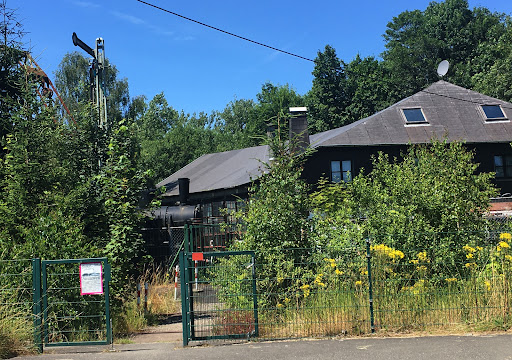
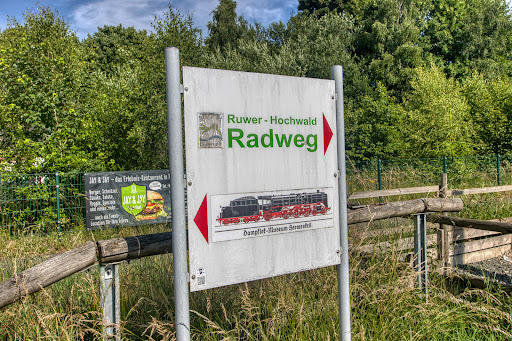
Hallowed ground for steam locomotives. All it takes is a ride from Neubrücke (Western Palatinate) in a Mercedes mini bus (Scherer Line 880). The bus radio updated everyone on traffic jams on the A6 near Heilbronn.
Audacious maples and a boatload of felines (a pleasant surprise if one is mentally prepared for 'cave canem' signs). Public toilets are on the premises. (50 cents for non visitors).
The next train to Angkor Wat will depart any minute.
Face to face with a BORSIG behemoth [or however that was called in the olden tongue], freight locomotive 441106. Call sign: 1'Eh3 (the first two ciphers indicate the wheel arrangement: 1'= pivoting front bogie, one axle; E = decapod underpinning, 5 wheel bearing axles; h, elevated steam pressure; 3, the locomotive comes with a concealed third cylinder, crank mounted somewhere deep in its gizzards). The corresponding US notation for the wheel arrangement would be 2-10-0. Nearly too straightforward. - Smoke deflector plates (aka elephant ears).
One of the mighty external cylinders that powered the wheels via eccentric attachments. (Alpha tested by spinning wheels with foot treadles.)
The larger part of the engines date from the late 30ties and early 40ties. Whatever survived the era of retributions. Timeline related, there is shaped charge magic [improved mule kicks] and AP [armor piercing Armageddon] - it is still hard to visualize what could frazzle such bolides. Derailments I will buy.
Disassembled drive rods. You know that you have trespassed into the home of a giant (Jack and the Beanstalk), if you see a set of those. Certainly beyond Märklin scale, H0 (1:87).
Enough brake pad power to stop the potter's wheel of any unmoved mover. Just snap your fingers.
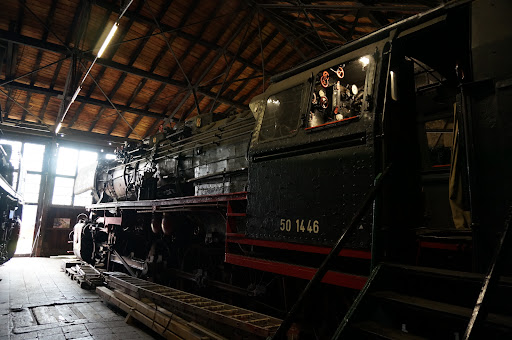
In the control center. The every hungry maws of the furnance still hankering for sustenance. (Wasn't there a fairy tale about an always willing stoker and his lazy rival.) The job may have had some perks. No shortage of pressure outlets if you want to inflate a rubber duck for free. All the dials will show gauge pressure (pressure above normal atmospheric pressure, with 1 kg/cm² being roughly the same as 1 atm). It might be different in an Enterprise class vessel, alien or homemade. Practical handle, gauge pressure should be in the 2 bar range (=2 atm) for most wheeled devices in common use, including pedal powered ones. - Most of the exhibits are padlocked.
In a coach this would have been the crank wheel for the parking brake. Lifting jack transmission.
Bric-à-brac display, a DEMAG crane with pulley and surplus wheels with crank-me attachments.
The buffers could be repurposed for a ring-the-bell challenge.
The pie-chart shed dates from 1888, just waiting for an inauguration. Reminder, somebody entered world history riding high on a steam buffalo that year. Bill Cody bested.
Standard leaf spring suspensions, a hand-me-down from the stage coach era. The suspended part should rest on the 'tines of the antler'. Däniken handle, Apis carrying a sun disk.
The 16 meter (diameter) turntable dates from 1910. Selfsame principle as a dispensing box for stitching needles. Turn the opening to the desired needle size and shake free. Basic safety feature, shoot the bolt home to make sure that the turntable stays put in the desired position.
The turntable operating room topped by a semaphoric weather vane. The bent sinister heraldic was borrowed from panels indicating switch settings. - Aspiring tank commanders may have had to man railway turntables after Versailles. As long as they got familiar with traversing heavy gear.
Railroad wheels are flanged (and even slightly beveled, the latter by intention). The edge of the turntable rim has been scalloped (semi-scalloped) to prevent jolting.
Another diesel powered switcher. Round 'em up and fence them in.
Christo, I always wanted to wrap-up a whole Gare du Nord. - Enough eyelets to start a boot making factory. The red wheels are an indication that this train once operated in bushfire prone...
Read more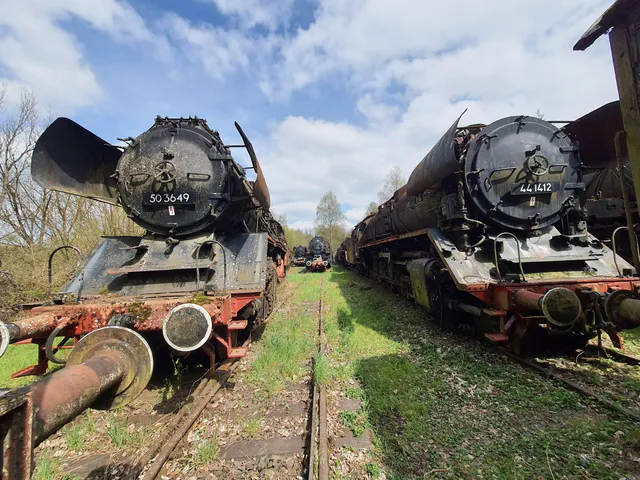
 Learn more insights from Wanderboat AI.