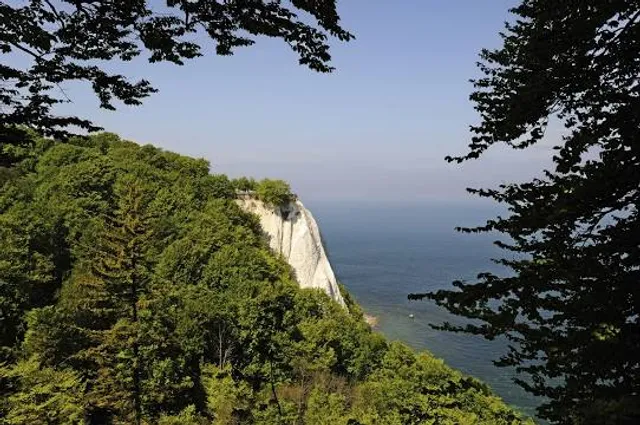
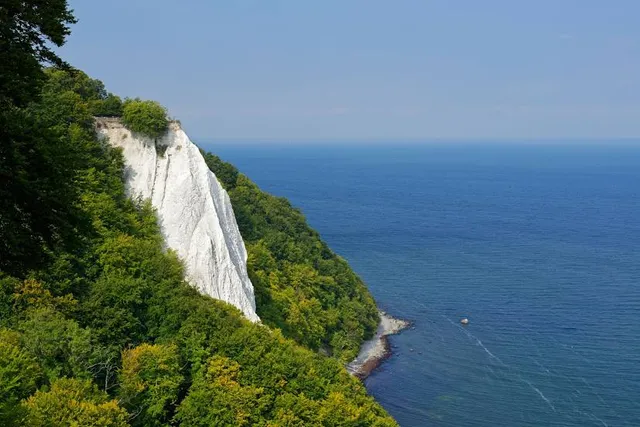
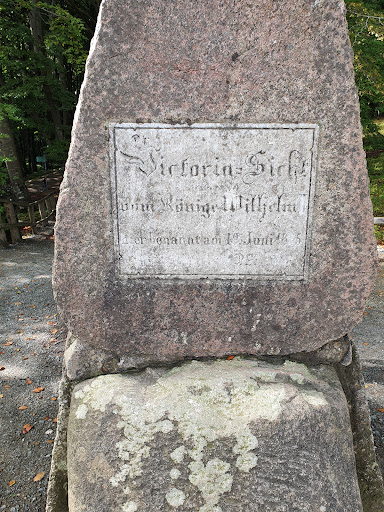
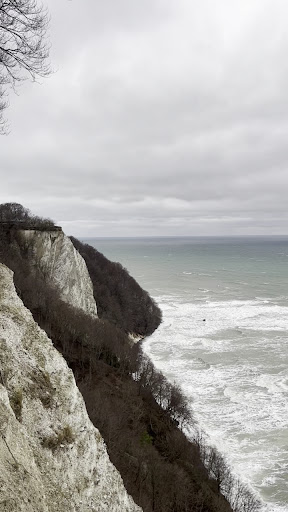
Königsstuhl itself is best seen from the viewing point of Victoria View (Victoria-Sicht) to the south.
A special date for Rügan residents and visitors to the Baltic Sea island of Rügen alike is the night of February 23rd to 24th, 2005. That night, one, if not the landmark of Rügen, ceased to exist: the Wissower clinics.
There is hardly a visitor to the Jasmund National Park who has not stood in awe in front of the bright white battlements of the Wissower Klinken - on this fateful night around 50,000 cubic meters of chalk fell into the Baltic Sea; only two meager stumps remained.
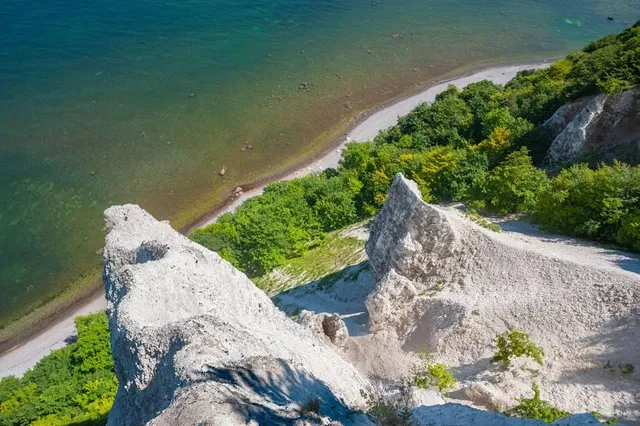
But even if the original chalk cliffs no longer exist, the number of tourists has not decreased - around 1.5 million people visit the approximately 13 km long chalk coast between Sassnitz and Lohme with its photogenic sights, the Wissower Klinken fragment, Ernst-Moritz- Arndt view , Kieler Ufer with the Teufelsstein, Viktoria view , Stubbenkammer and Königsstuhl.
All visitors to the chalk coast are strongly advised to only use the designated paths and descents. Going it alone can cost your life. That was made clear on December 26th, 2011, when a ten-year-old girl was buried under falling chalk and mud at Cape Arkona . It is not possible to make any serious predictions about when and where the next termination will take place and what extent this will be.
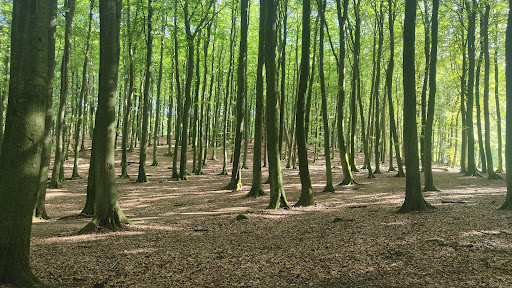
But the beauty of the chalk coast and the Stubnitz, the "green lung" of the Jasmund National Park, can be hiked and explored on the paths designated by the National Park Office.
Just like Caspar David Friedrich did, who made Rügen world famous with his drawings and paintings. With his work "Chalk Cliffs on Rügen" he set a monument to the chalk coast. Contrary to popular belief, however, he did not depict the Wissower clinics in this painting from 1818, as they did not even exist 200 years ago. At that time, the chalk knobs had not yet been washed out of the steep coast. The constant changes on the coast of Rügen can be seen in an impressive way at the...
Read moreTo miejsce to finał spaceru po bukowym lesie. Nie da się podjechać blisko samochodem. To co google pokazuje w pobliżu to parking dla autokarow. Samochód zostawia się na parkingu Großparkplatz Hagen, a później idzie przez bukowy las. Mija się jezioro, info wyboru ma kilka punktów widokowych na klify. Dla mnie ten jest najfajniejszy.
Parking płatny (w zależności od czasu), do tego na min jakąś knajpka i płatna toaleta. Na parkingu jest też wydzielona część dla kamperów. Idzie się głównie w cieniu, Można jest podjechać rowerem. Widok na klify fantastyczny. Z góry można sobie uświadomić, jak są wysokie. Cytując klasyki polskiego kina, bunkrów nie ma, ale i tak jest zaj...
Z ciekawostek - jak ktoś romantyczny - niezłe miejsce na oświadczyny - taki balkonik wystający za klif z widokiem na Bałtyk. Cały zaś w cieniu, dookoła jakieś bajorka i jeziora (o dziwo bez komarów). Ktoś się silił na zorganizowanie ścieżki dydaktyczne i od czasu do czasu są tablice informacyjne (po niemiecku), które nieco przybliżają historię miejsca, florę i faunę. Po drodze są resztki słowiańskiego grodu - jest mała tablica z opisem jak wyglądał mor obronny - gdybym wcześniej nie poczytał o historii Rugii, nawet nie zwróciłem uwagi.
Las bukowy fantastyczny.
Bliżej wybrzeża można trafić na ciekawe okazy krzemienia (wykorzystywany lokalnie do wyrobu narzędzi i broni) w czasach, których nie pamiętają najstarsi górale. Zdecydowanie warto przyjechać, 10-15 min...
Read moreSind mit den Fahrrädern vom Parkplatz Hagen bis zum Busplatz am Königsstu gefahren. Dort haben wir Räder angeschlossen und sind losgewandert. Super Blick zum Königsstuhl. Trotz Nachsaison relativ viel Gedränge besonders an den Aussichtsstellen zum Königsstuhl, aber am Weg Richtung Kieler Bach entzerrt es sich. Ansonsten aber sehr guter Wanderweg. Ein Förster war ganz emsig, kam angerannt und fotografierte Touristen, die den Weg (ohne dabei rücksichtslos zu sein) verließen und wollte sofort die Ausweise sehen. Ja, bei der Masse an Touristen muss man die Natur erhalten, es gibt auch durchaus genug I*ten. Aber ein freundlicher Hinweis bringt evtl weit mehr, als sofort abzustrafen. Wir hatten auch kurz unwissentlich den Weg verlassen, da auch Trampelpfade sich teilweise nicht vom Hauptweg unterscheiden, da sie so gut ausgetreten sind und auch nicht an jedem Baum eine Markierung ist. Wir wurden nur etwas barsch auf den Hauptweg zurück geschickt. Aber alles in allem schöner Wanderweg bis zum Kieler Bach. Dort einige Stufen runter zum Steinstrand. Fahrräder sind verboten, auch nicht schieben (macht bei den vielen Wurzeln über dem Weg und den Treppen auch wirklich...
Read more