Worth swinging by if on the route, but nothing too special. I'm not sure what the overall theme is: probably science and there is some things to experience. I copied the different stations in the park from the Website:
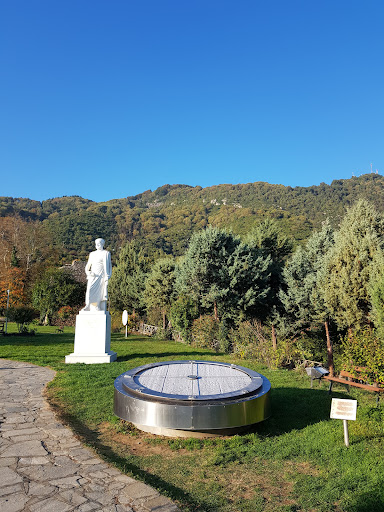
Solar clock. The horizontal solar clock tells the time at its location. The difference from official time is 1:25 in the summer, and 0:25 in the winter. Inside the curved lines, in addition to the time we can also see the current month.
Lens. Each photon (particle of solar energy) on its own has minimal energy, but when many photons are concentrated on a point, the energy increases greatly.
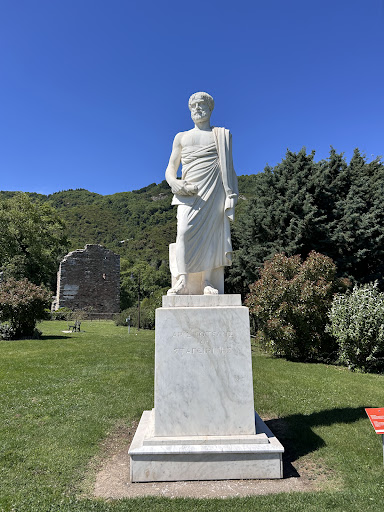
Compass. Philosophy has no location; it is universal and belongs to humanity. Aristotelian philosophy has reached every corner of the world, and it is the starting point of contemporary scientific thought.
Pentaphon. Depending on specific gravity and mass, each material will produce, through percussion, a different sound frequency. The 5 granites correspond to the scale of the ancient pentaphon.
Optic Disks. When images pass with great speed before the human eye, we do not perceive them as separate (e.g., the cinema).
Pendulum. The energy of the system that begins the oscillation is transferred through coupling to the other system, resulting in the width of oscillation decreasing in the first system and increasing in the second.
Hydro-turbine. The energy created by turning the lever creates a vortex in the water, much like the circular motion of the air creates a whirlwind.
Inertia spheres. Transfer of momentum when the spheres collide, where the momentum is preserved and transferred sequentially from one sphere to the next until the last one.
Parabolic mirrors. The sound waves carried by the wind are reflected on the parabolic mirror and their energy is concentrated in the center. The same phenomenon is repeated on reflection.
Telescopes. Using the telescopes, visitors can better enjoy the fantastic view of Ierissos Bay and the Athos Peninsula from the park.
Aristotle’s clock. In 2019, a new exhibit was installed. It is a hydraulic alarm clock that Aristotle invented in order to wake up soon after falling asleep to dedicate more time to his studies, as reported by Diogenes Laertius.
It had the form of a large hourglass, similar to Plato’s alarm clock. When the hourglass became full, small spheres (pebbles) fell on a dish, creating an earsplitting sound.
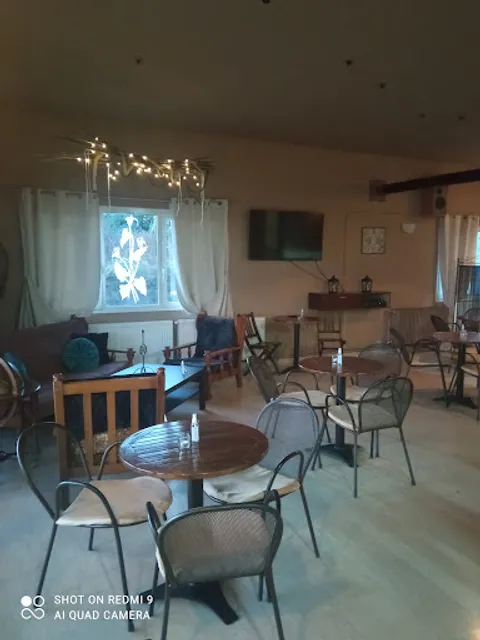
There's also a Café in the making. The parking lot seems bigger than the park. Entrance is 2€ p...
Read more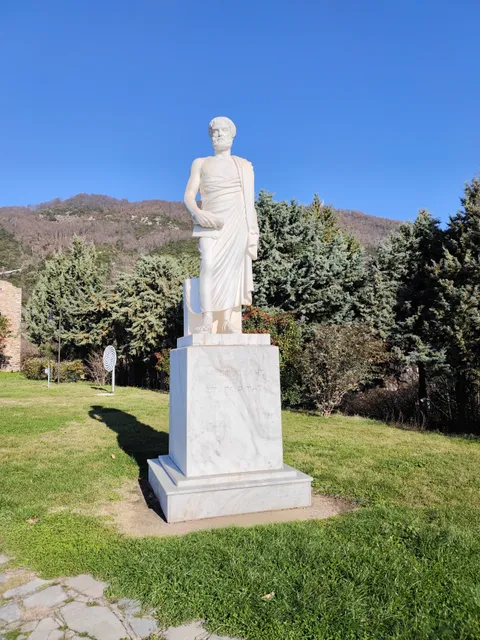
 Learn more insights from Wanderboat AI.