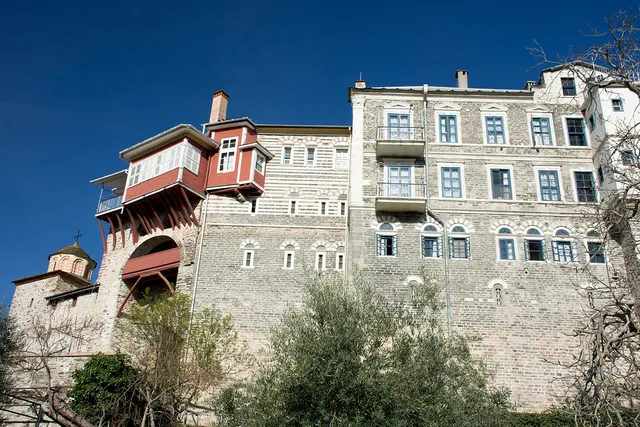
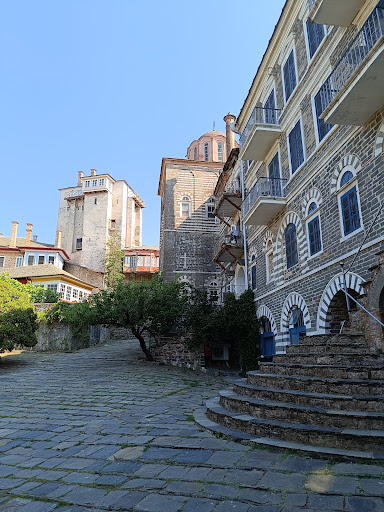
the Vatopedi Monastery is the second most important monastery on the Athos peninsula, as per the official hierarchial ranking of the monasteries released by the Athos authorities. this choice was based on mostly historical reasons, as the Vatopedi monastery was the second monastery to be built following the arrival on Mount Athos of Saint Athanasios the Athonite, who rebuilt Megistis Lavras in the 10th century. this monastery is the second largest and it hosts some extremely advanced hospitality facilities. the arkondariki is huge, clean, it has A/C, it has sufficient bathrooms for all and drinkable tap water and running electricity. food at least in the summer is served punctually at 10 in the morning and at 6.30/7pm. the church hosts a great variety of chapels, little churches, places of worship and it is also notably the place where Saint Sava and his father Saint Simeon, also known as Stephan I Nemanjia of Serbia, had worked to re-establish a monastic community. the main and most important piece of art within the monastery is the katholikon as always. it hosts a variety of different frescoes from at least four discernible and different periods of time. the newest ones date back to the 19th century and their craftmanship is unknown but most probably comes from the monastery itself, probably monks following Dyonisios of Fourna. there are also frescoes from the 18th century present in the outside portico on the right of the main entrance to the narthex and also within the krene/fiale. according to the latest findings within the katholikon, following a tentative effort by art historians to uncover the original layer of frescoes within the naos, there are also two other layers of art dating back to the 14th and 13th century and probably even earlier although it has not been possible to ascertain their age. these frescoes have finally been uncovered and it is possible for the public to see them and they follow the classic iconography of the athonite katholikon with a particular emphasis on the dormition and the assumption of Mary, as this is also the monastery's second name. in general terms the frescoes are very well kept and the frescoes in the portico dating back to the 14th century, which depict an anastasis, a final judgment, the miracles of saint Nicholas and also the ones within the church are of excellent craftmanship and extremely vibrant in colour and composition. for those of orthodox faith the church also hosts a great amount of relics and holy items which are said to contain a great amount of grace within them. in particular the monastery hosts the girdle of Mary, the head of Saint John Chrisostomos, the bones of the founders of the Vatopedi monastery, the bones of St John the Elder, a piece of the True Cross and a series of icons of Mary which are said to have performed...
Read moreA miracle I may recount: on 8th March 2016 I visited Vatopedi and had been asked by somebody to bring back from the Holy Mountain, "a stone or some dust", for some reasons known only to themselves. I wanted to oblige, and did end up taking a stone I think from down near the jetty. When at the monastery itself, I was tempted however by some white stones I saw within the grave of an elder, namely Elder Joseph of Vatopedi (not to be confused with Joseph the Hesychast). As I leant down to take a stone, a voice inside was severely reproaching me and told me emphatically, "No!", I am not to take anything from the elder's grave. I felt an invisible force preventing me from doing so. I walked away and later on, decided just to wander back to the grave again, to make a fresh decision one final time as to whether to take a stone again. I thought, "These are surely such pretty, pristine, white stones. They bring to recall the white stones given to those in the Kingdom of Heaven in Revelation, and wouldn't it be more potent having such a stone rather than an ordinary pebble or some dust from elsewhere on the mountain?". I wandered around, retracing where the grave must have been located. I walked back and forth on the exact spot it should have been located, in the courtyard to the katholikon, and I could not see it anywhere. I then walked around the entire monastery in every courtyard and could not see the grave. I did not see the grave again for the entirety of my stay at the monastery. This surely was a very minor miracle of...
Read moreΗ Ιερά Μονή Βατοπαιδίου είναι η 2η στην ιεραρχία των αγιορείτικων μονών.
-Η Τίμια Ζώνη της Υπεραγίας Θεοτόκου Η Αγία Ζώνη έχει την ιδιαίτερη χάρη να θεραπεύει τη στειρότητα των γυναικών και των καρκινοπαθών με κορδέλα η οποία έχει προηγουμένως ευλογηθεί πάνω στο ιερό κειμήλιο και ακολούθως την φορούν οι στείρες γυναίκες και οι ασθενείς.
-Ιερές εικόνες της Παναγίας
Παναγία Βηματάρισσα : Η εικόνα αυτή κατά την επιδρομή των Αράβων, απεκρύβη από τον Σάββα τον βηματάρη σε ένα πηγάδι, μαζί με το σταυρό του Μεγάλου Κωνσταντίνου και μία λαμπάδα. Δυστυχώς για το Σάββα όμως πιάστηκε και αυτός αιχμάλωτος, με αποτέλεσμα να μην μπορέσει να επιστρέψει πίσω. Όταν ελευθερώθηκε μετά από 70 έτη υπέδειξε το μέρος το οποίο είχε κρύψει τα κειμήλια και όταν ανοίχτηκε το πηγάδι βρήκαν την εικόνα και το σταυρό πάνω από νερό του πηγαδιού και τη λαμπάδα ακόμα αναμμένη.
Παναγία Παραμυθία: Η εικόνα αυτή φέρει το παράδοξο, ότι η Θεοτόκος κρατεί τη χείρα του Ιησού. Η παράδοση αναφέρει πως κάποτε ενώ ο ηγούμενος έδινε τα κλειδιά στο θυρωρό, άκουσε μία φωνή να του λέει “Μην ανοίξετε τις πύλες, αλλά ανεβείτε στα τοίχοι και διώξτε τους πειρατές”. Απορώντας ο ηγούμενος έριξε μία πιο κοντινή ματιά και είδε τη Θεοτόκο μέσω της εικόνας να επαναλαμβάνει το ίδιο μήνυμα. Τότε το “θείο βρέφος” απήντησε “Μη μεριμνάς Μητέρα γι αυτούς τους αμαρτωλούς”, προσπαθώντας να σκεπάσει το στόμα της μητέρας του. Η ίδια όμως κρατώντας το χέρι Του, επανέλαβε το μήνυμα, με αποτέλεσμα οι μοναχοί να υπερασπιστούν τη μονή τους και να διασωθούν.
Παναγία Εσφαγμένη: Το όνομά της το πήρε όταν κάποιος οξύθυμος μοναχός εκκλησιάρχης, αργοπόρησε στην τράπεζα, με αποτέλεσμα ο τραπεζάρης να μη του δώσει φαγητό. Οργισμένος τότε ο μοναχός με ένα μαχαίρι κάρφωσε στο πρόσωπο την εικόνα της Παναγίας, απευθυνόμενος βλάσφημα προς αυτή. Ξαφνικά όμως η εικόνα άρχισε να αναβλύζει αίμα από το σημείο που τρυπήθηκε. Ο ίδιος ο εκκλησιάρχης το υπόλοιπο της ζωής του το πέρασε σε βαθιά μετάνοια. Μάλιστα όταν έγινε η εκταφή του, ενώ όλο το σώμα του είχε λιώσει, το χέρι έμεινε αναλλοίωτο και διατηρείται μέχρι και σήμερα.
Παναγία Αντιφωνήτρια: Πρόκειται για μία ακόμα τοιχογραφία, που βρίσκεται στο “μεσονυκτικό”. Ονομάζεται έτσι διότι όταν επισκέφτηκε τη μονή η κόρη του Μ. Θεοδοσίου, άκουσε φωνή από την εικόνα η οποία της απαγόρευσε να εισέλθει, διότι τόλμησε να παραβιάσει το άβατο του Αγίου Όρους.
Παναγία Ελεούσα: Στον ίδιο χώρο με την εικόνα της Αντιφωνήτριας βρίσκεται και αυτή η εικόνα. Χρονολογείται από τον 15ο αιώνα και προέρχεται από τη σκήτη του Αγίου Ανδρέα. Η εικόνα αυτή σύμφωνα με το Γεράσιμο Σμυρνάκη παλαιότερα ήταν εντοιχισμένη σε τζαμί της Κωνσταντινούπολης, όταν χριστιανοί τεχνίτες της ανακάλυψαν μετά από επισκευές στο οικείο τζαμί, όπου και την πούλησαν το 1893 στον οικονόμο της μονής Σωφρόνιο.
Παναγία Ελαιοβρύτισσα: Είναι και αυτή εικόνα, φορητή, του 14ου αιώνα και βρίσκεται στο “δοχείο” ή “λαδαριό” της μονής. Μετακινείται από εκεί μόνο την παρασκευή της Διακαινισίμου. Η παράδοση αναφέρει πως όταν κάποτε τελείωνε το λάδι στη μονή ξέσπασε διαμάχη μεταξύ του δοχειάρη και του μάγειρα, διότι ο πρώτος δεν έδινε λάδι για να μαγειρέψει. Ο δοχειάρης μετά τη φιλονικία αυτή αποφάσισε να δίνει όσο του ζητήσει ο μάγειρας και ενώ μία μέρα τελείωσε το λάδι, την επομένη βρέθηκαν όλα τα δοχεία γεμάτα, με ένα εξ αυτών να υπερχειλίζει.
Παναγία Πυροβοληθείσα: Η εικόνα αυτή που βρίσκεται στην είσοδο της μονής, ονομάστηκε έτσι διότι το 1882 μία ομάδα Τούρκων οπλιτών εισήλθε στη μονή. Ένας εξ αυτών πυροβόλησε την εικόνα με αποτέλεσμα να την τρυπήσει στο σημείο του χεριού. Μετά το γεγονός αυτός ο οπλίτης παραφρόνησε και βλέποντας το γεγονός αυτό οι υπόλοιποι, φοβήθηκαν και έφυγαν από τη μονή.
Παναγία Παντάνασσα: Η Παναγία η Παντάνασσα είναι μία φορητή εικόνα μεγάλου μεγέθους, που αγιογραφήθηκε τον 17ο αιώνα. Το θαυμαστό γεγονός με αυτή την εικόνα είναι πως κάποτε κάποιος μοναχός πήγε να την προσκυνήσει και ξαφνικά είδε την εικόνα να αστράφτει, με αποτέλεσμα να πέσει στο έδαφος. Ο ίδιος ο μοναχός μετά από λίγο ομολόγησε πως ασχολείτο με τη μαγεία, αν...
Read more