Review: Temple of Aphaia
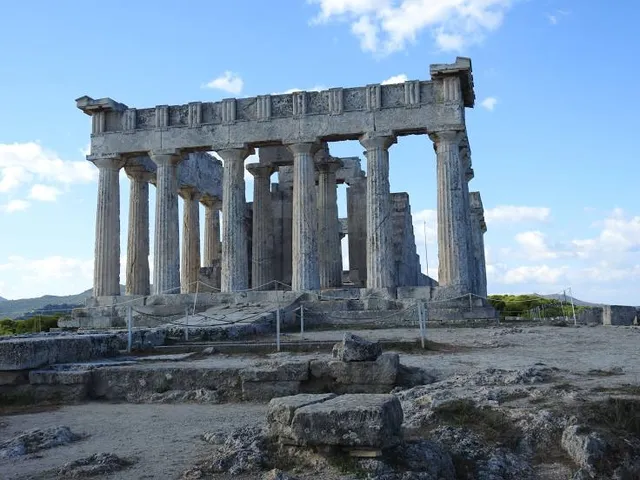
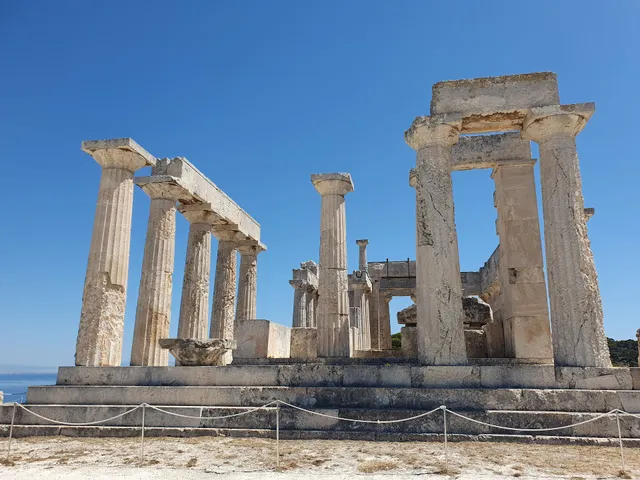
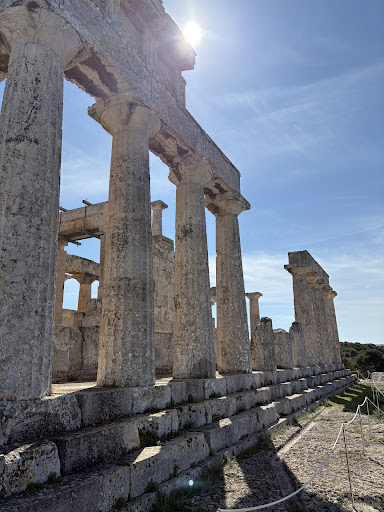
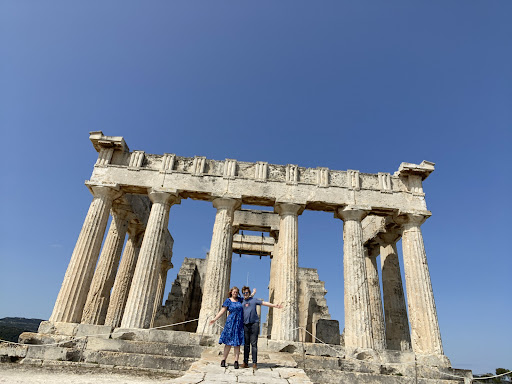
Visiting the Temple of Aphaia on Aegina Island was an unforgettable experience. This ancient temple is renowned for its remarkable preservation and the breathtaking views it offers.
Historical Significance
The Temple of Aphaia, dating to the early 5th century BCE, is indeed one of the most well-preserved ancient Greek temples. Unlike the Acropolis, which has undergone extensive restoration, the Temple of Aphaia retains much of its original structure, providing a more authentic glimpse into ancient architecture.
Stunning Views
Perched atop a pine-covered hill approximately 160 meters above sea level, the temple offers panoramic vistas that are nothing short of spectacular. From this vantage point, you can see across the Saronic Gulf, with clear views extending to the coast of Athens on a clear day.  
Visitor Experience
When we visited in March, the site was tranquil, with few tourists around. This allowed us to fully appreciate the site’s beauty without crowds. The access road is well-maintained, and our 50cc scooter handled the journey uphill without any issues. However, be cautious of limited parking space near the temple.
Facilities and Accessibility
Recent developments, funded by European grants, are enhancing the site’s amenities. A new ticket office is under construction, aiming to improve the visitor experience. Currently, the ticket booth is a small prefabricated structure. There’s a souvenir shop, restrooms, and a small café available for visitors.
Recommendation
If you’re in Aegina, a visit to the Temple of Aphaia is a must. Whether you rent a scooter, take a taxi, or use public transportation, the journey is worthwhile. The combination of historical significance, stunning views, and a peaceful atmosphere makes it a highlight of any trip...
Read moreOne of the main attractions on Aegina is the Temple of Aphaia (or the Temple of Athena Aphaia in Aegina). This temple is dedicated to goddess Athena, and sits on top of a hill. This is considered to be one of the ancient architectural wonders of ancient Greece, built in 480 BC. Legend has it that Aphaia (or Aphaea) escaped the clutches of sailors near the coast of Aegina and was seen going up till she vanished. The name Aphaea means vanish. Aphaea is said to be a mountain and a hunting goddess who protects shipping. Aegina was an important shipping area of the region which accounts for the beautifully built temple.
Aegina is also known for its pistachios. The cultivation of pistachios started on Aegina in around 1860. The pistachios of Aegina are the most famous in Greece. We were told harvest time is from August to the end of September. There is a Pistachio Festival every year - we were about a week early, but this would have been a delightful Greek experience - full of food, wine,...
Read moreAphaia (Greek Ἀφαία) was a Greek goddess who was worshipped exclusively at this sanctuary. The extant temple of c. 500 BC was built over the remains of an earlier temple of c. 570 BC, which was destroyed by fire c. 510 BC. Elements of this older temple were buried in the infill for the larger, flat terrace of the later temple, and are thus well preserved. Abundant traces of paint remain on many of these buried fragments. There may have been another temple in the 7th century BC, also located on the same site, but it is thought to have been much smaller and simpler in terms of both plan and execution. Significant quantities of Late Bronze Age figurines have been discovered at the site, including proportionally large numbers of female figurines (kourotrophoi), indicating – perhaps – that cult activity at the site was continuous from the 14th century BC, suggesting a Minoan connection...
Read more