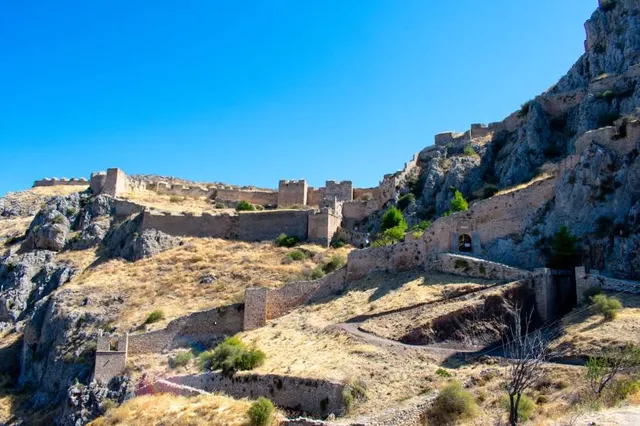
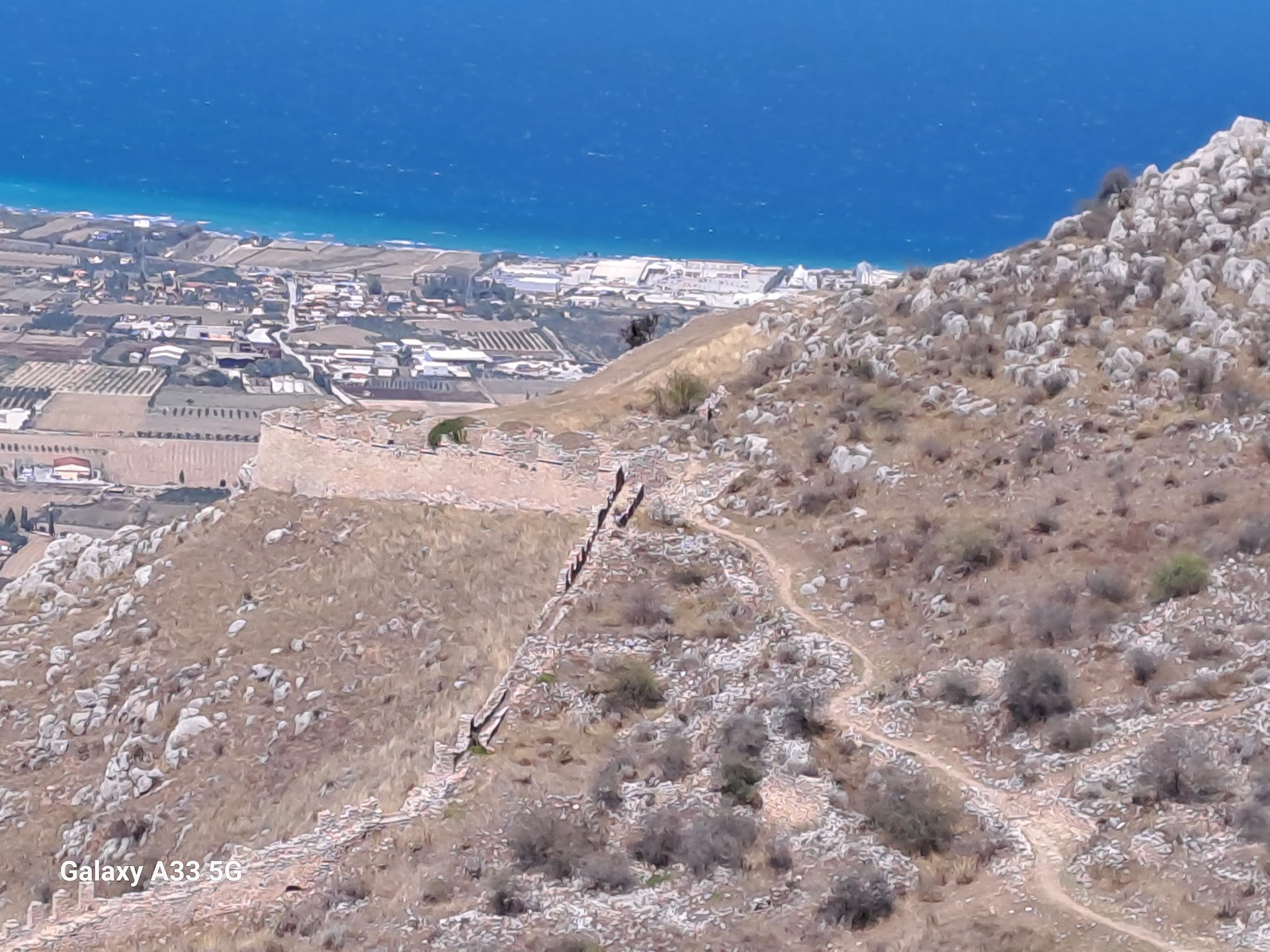
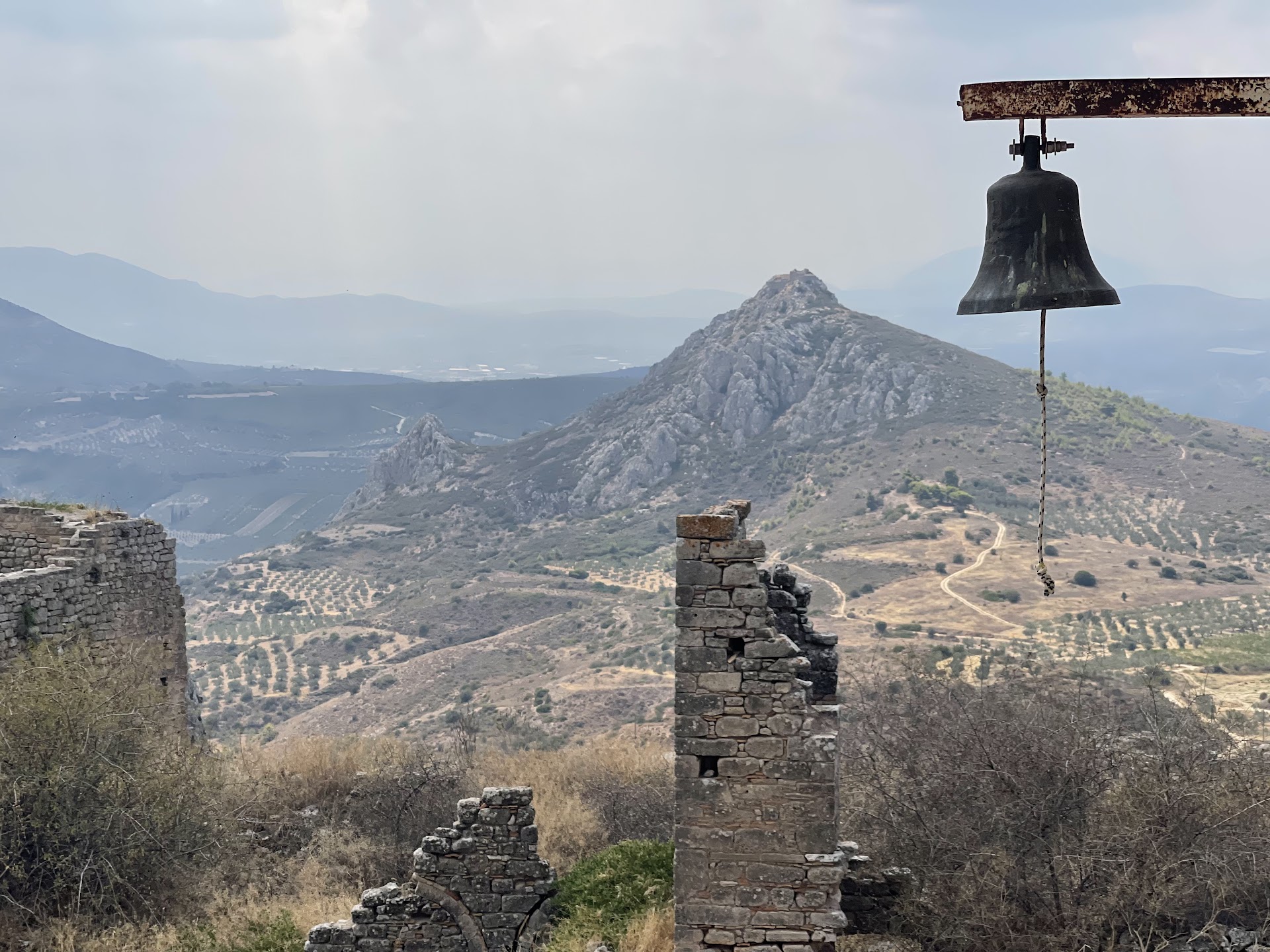
A massive fortification overlooking the wealthiest city of ancient Greece. If you look closely, you will see phases of masonry from many historical periods, from ancient to post medieval times and all in between. Its size renders it almost impossible to see in a single visit. The entirety of the enclosure was built during the Archaic Period by the Kypselids, the tyrant (at that time the word meant ruler and had not yet acquired the negative demeanor it has today) dynasty of Corinth and especially Periandros, son of Kypselos, who was one of the seven wise men of Archaic Greece (among these were also Solon of Athens, one of the fathers of democracy, and Thales of Miletos). The remains of these walls can still be seen all along the base of the walls. The overall enclosure is huge and encompasses all of the area elevated upon the top of the rock, which offers incredible natural defenses on all sides but for a sector in the SW corner. The importance of this fortification cannot be understated. From its commanding position it controlled the entrance to the Peloponnese and the Diolkos, the equivalent of the Suez canal of sea trade in the ancient Mediterranean. Corinth had two major ports, one in the Corinthian Gulf and one in the Saronic Gulf. Ships would dock in one of the two, unload their cargo to be transported to the other dock by land, while the empty vessel would be rolled on the paved road to also end up at the port on the opposite side. This saved seafarers the trip around the Peloponnese, which meant saving time and money, as well as providing much more safety from menacing weather and pirates that constantly endangered ancient seamen. Corinth was greatly enriched by providing this service, as well as by other activities, such as lodging and entertainment for the sailors while the land transport took place. These all lasted all the way through the Archaic, the Classical and the Hellenistic periods, all in all about half a millenia. A major interruption was the time following the Roman punitive sack of Corinth in 146 BC. During the centuries of the Pax Romana the fortress, far from the borders and under Roman protection, was no longer required to be upkept at peak condition. Nevertheless, its sturdy construction upon the naturally fortified rock still stood strong enough to repel the barbarian raids of the 3rd and 4th centuries AD. It seems that the first emperor to really conduct extensive rebuilding on the site was Justinian. The Eastern Roman (Byzantine) empire kept the site in more-or-less excellent condition throughout its lengthy historical journey, and it served as a major army base for most of this time. A Norman raid in 1170 caught the garrison unprepared and thus the site was sacked. In the early 13th century the raiding "crusaders" of the 4th crusade failed to take it by force, and opted to build a castle and additional defensive works in order to compel the garrison to eventually surrender, after about five years of holding out. The Franks made some additions (mainly the keep and the small enclosure surrounding it), and later the Venetians also modified the upper parts of the walls in order to adapt them to the age of gunpowder. So what we see today is a Byzantine rebuild directly upon the Archaic core, topped by Venetian finishes with some...
Read moreThe location offers impressive views, but unfortunately, the overall experience was disappointing. The rocks along the path were extremely slippery during the day, making it difficult to walk safely. The safety ropes, which should provide support, were in poor condition and unusable.
this is what my friend said.
Visiting this castle was a thoroughly disappointing experience, and I would not recommend it to anyone considering a trip. From the start, the layout was confusing, with most pathways either blocked off for construction or so poorly marked that navigating became unnecessarily frustrating. The lack of clear signage not only made it difficult to find our way but also raised genuine safety concerns. A historic site of this size and popularity should prioritize visitor safety, yet this felt like an afterthought throughout the entire visit.
Even more frustrating was the fact that nearly half of the main tourist attractions were closed, and there was no explanation provided as to why. Visitors deserve at least some transparency, whether it’s due to maintenance, restoration, or other issues. Instead, we were left wandering through areas that felt incomplete, empty, and frankly not worth the admission fee. It gave the impression that the castle is poorly managed and not prepared to handle guests in a respectful or professional way.
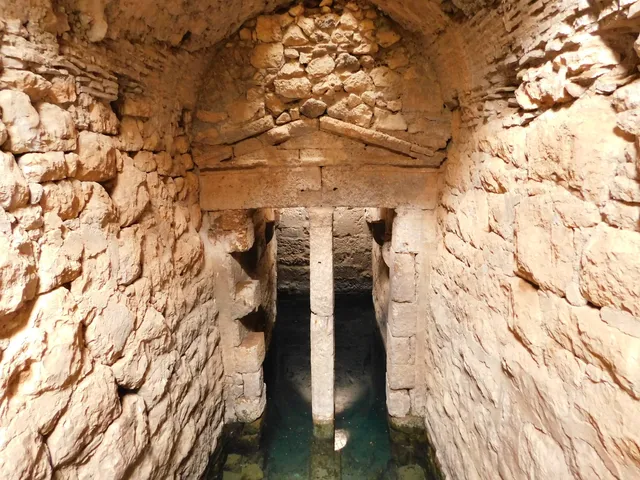
The underground area was particularly disappointing. It was promoted as a point of interest, but in reality, it consisted of nothing more than stagnant water in a dark space. Rather than offering historical insight or a unique experience, it felt unsafe and entirely underwhelming. There was no educational value, no explanation, and nothing worth seeing—just a sense of wasted time.
Overall, the castle has potential as a historical site, but the way it is currently operated makes for an unwelcoming and unsatisfying visit. With confusing routes, inadequate safety measures, closed attractions, and poorly maintained areas, it is not a destination I would recommend. If you’re planning a trip in the area, I suggest spending your time and money elsewhere.
When I explored the underground area, I encountered stagnant water. Out of curiosity, I tested it by tossing a rock, which unexpectedly disturbed a swarm of bees and flies, forcing me to leave immediately. To make matters worse, the site’s highlight—the tower with the best view—was closed to visitors without any clear explanation.
Overall, the lack of maintenance and safety measures made the visit unpleasant. I would not recommend this site until significant...
Read moreOk, the castle, besides HUMONGOUS, is actually an awesome one to visit. Lines after lines of defense make you wonder how did it actually fell. The views of the surrounding area are fantastic. A bit over an hour drive from Athens, access to the area is pretty easy (most of the drive is on highways) but access from the ancient Corinth site to the castle ( about 10 minutes of narrow and curvy mountain road) requires some driving skills. If you don’t have a car, frequent train service from Athens also make it easy if you take a taxi from Corinth. Hire a taxi for the day from Athens is an option too although this one is more expensive. The “restaurant” by the parking lot is really not a restaurant since they only offer coffee and soft drinks etc. but it’s a nice stop after going up to the castle. Getting there from the parking lot is a hike, and the paths are steep and paved with old stone thy can be slippery at times. The steepest parts have guard rails where possible. Wear comfortable clothes and shoes. Wearing flip flops or heels is inadvisable. You won’t find this castle in many tourist books and guides but it’s definitely worth a visit, not only for the castle itself but also for the...
Read more