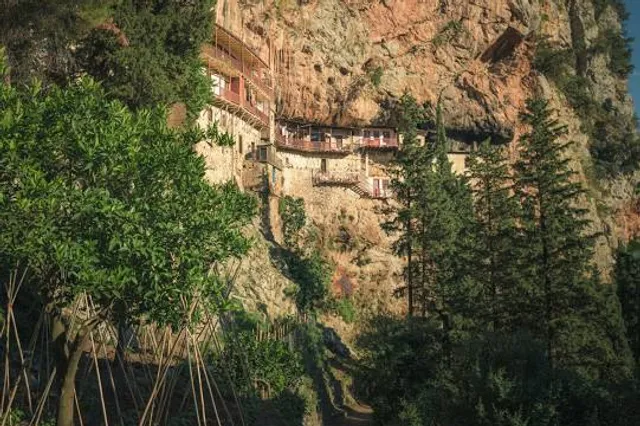
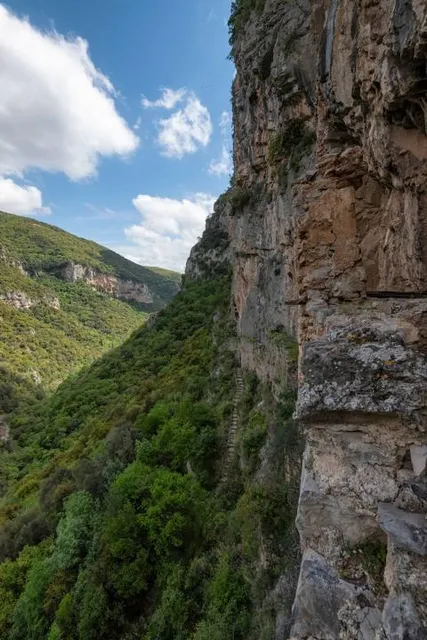
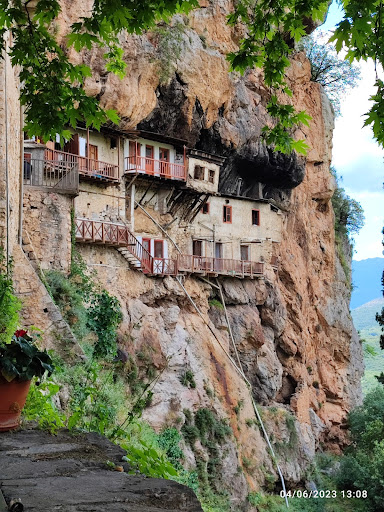
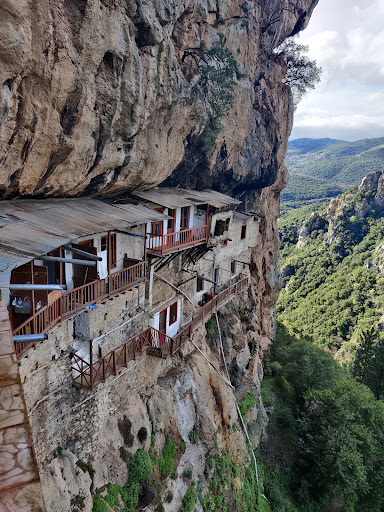
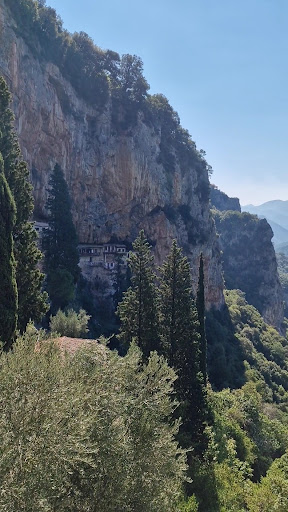
The Timiou Moni Prodromou (Greek: Μονή Τιμίου Προδρόμου) (i.e. for Greek Monastery of the Holy Precursor) is a famous Greek monastery, very picturesquely situated on the eastern bank of the Lousios gorge. It houses today still an important monastic community (± 15 monks?) And is accessible from Stemnitsa , Dimitsana and Ellinikon through a very meandering and not too good way.
According to tradition it was founded in 1167 by Emperor Manuel Comnenus, but reliable sources situate the foundation of the current monastery rather somewhere in the 16th century. It is dedicated to St. John the Baptist, which is called in the Orthodox tradition usually Prodromos, i.e. Precursor (of Christ).
The monastery has two churches. The oldest is very small (only 2.25 x 4.90 m) and lies against the rock face. The peculiar arrangement of the iconostasis (which forms an angle of ± 45 ° with the nave) is explained by the lack of available space. The frescoes late 16th / early 17th century were applied directly to the wall. Around this church were gradually built on the other monastic buildings whose balconies hang high above the Lousios gorge. A second church, architecturally less important, more recent (1911), and is isolated at a distance from the other buildings. She is committed to the orthodox Holy Athanasios of Christianoupolis, who lived around the turn of the 18th century, and was buried in the monastery after his death.
From here you can descend via a walkway to the bed of the Lousios, and hence reach the nearby monastery of the Philosopher.
-From "Wikipedia" the free...
Read moreΗ Μονή Τιμίου Προδρόμου Αρκαδίας ιδρύθηκε, σύμφωνα με την παράδοση, τον 8ο αιώνα. Εκεί, ίσως υπήρξε κατά τα αρχαία χρόνια, βωμός και σπήλαιο του θεού Πάνα, το οποίο είδε ο Παυσανίας στα αριστερά του δρόμου που ένωνε την Αρχαία Τεγέα με την Λακεδαίμονα. Από μεταγενέστερη επιγραφή στην είσοδο του μοναστηριού, η ιστορική του παρουσία ξεκινά το 1126. Σύμφωνα με την παράδοση, όταν χτιζόταν το μοναστήρι, ένας μάστορας γκρεμίστηκε μαζί με ένα πελεκημένο λιθάρι. Όταν οι υπόλοιποι κατέβηκαν για να τον μαζέψουν, τον είδαν να ανεβαίνει το μονοπάτι με το λιθάρι στον ώμο. Κατά την Επανάσταση του 1821, το μοναστήρι, λόγω της απρόσιτης του θέσης, χρησίμευσε ως ορμητήριο εναντίον των Τούρκων, ως στρατιωτικό νοσομοκείο, αλλά και ως καταφύγιο του άμαχου πληθυσμού. Τον Μάϊο του 1821, οι μοναχοί συμμετείχαν ενεργά στις μάχες των Δολιανών και των Βερβένων. Το 1826, ο Ιμπραήμ Πασάς πολιόρκησε 2 φορές την μονή, χωρίς αποτέλεσμα. Η μονή Προδρόμου, ήταν ενοριακή και υπαγόταν στην Μητρόπολη Άργους και Ναυπλίου. Σήμερα η μονή είναι ανδρική και υπάγεται στην Μητρόπολη Μαντινείας και Κυνουρίας. Το καθολικό είναι ένας τρουλαίος ναός, που έχει χτιστεί σε ακανόνιστο σχήμα Γ, έτσι ώστε να προσαρμόζεται στην μορφολογία του σπηλαίου. Στο εσωτερικό του, έχουν διατηρηθεί τμήματα αγιογραφιών, έργα του 18ου αιώνα από τον ναυπλιώτη Ιερομόναχο Ιερεμία. Το ξυλόγλυπτο τέμπλο του ναού, φέρει αξιόλογες εικόνες, φιλοτεχνημένες τον 18ο αιώνα. Δίπλα από το καθολικό, υπάρχει ένας στενόμακρος δρόμος που οδηγεί στο σπήλαιο, χωρίς να είναι γνωστό που καταλήγει. Μερικοί πιστεύουν ότι οδηγεί...
Read moreThe monastery was a 15-minute walk from the parking lot through a beautiful woodland path. No shorts / short skirts are allowed to enter the monastery, however clean, spare fabrics are provided for that purpose. The monastery is built on the cliff wall and we visited the interior - the view was amazing! The monks were very friendly and offered us fresh Greek coffee, water and a dessert called loukoumia - true representatives of Greek hospitality! We bought some handmade soap to support them, such a...
Read more