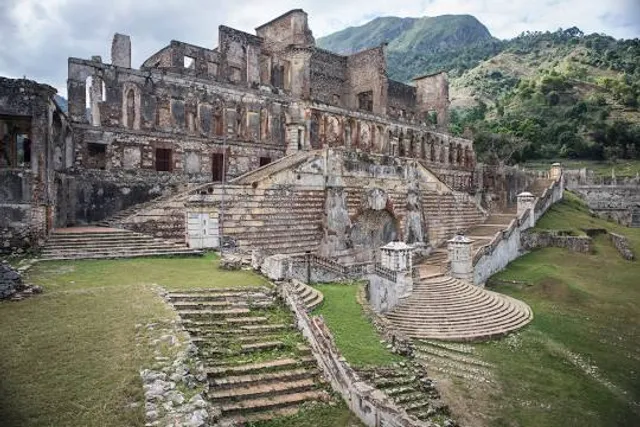
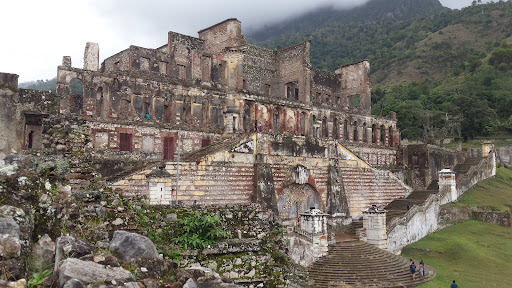
Sans Souci Palace is an awe-inspiring historical landmark in Northern Haiti that has mesmerized tourists and locals alike for decades. The palace was once the royal residence of King Henri Christophe, an ambitious and visionary leader who oversaw the creation of a new kingdom in Haiti during the early 19th century.
The architecture of the palace is a mix of European and Afro-Caribbean styles, featuring ornate columns, arches, and decorative carvings. The palace is surrounded by beautiful gardens and overlooks the nearby town of Milot. Visitors to Sans Soucis Palace can explore the ruins of the palace and take in the breathtaking views of the surrounding landscape.
The palace is a remarkable example of 18th-century architecture and engineering and has been recognized by UNESCO as a World Heritage site. Visitors can explore the palace's ruins, including its grand halls, intricate mosaics, and beautifully landscaped gardens.
In addition to the palace, the nearby Laferrière Citadel is another popular tourist attraction in the area, adding to the region's historical and cultural significance.
Visitors cannot help but be impressed by the sheer size and grandeur of Sans Souci Palace. The palace's intricate details and the vision of its founder, King Henri Christophe, leave visitors in awe.
However, the site's current state of disrepair and the lack of adequate maintenance have led to concerns about its preservation. The Haitian government, along with UNESCO, has taken steps to ensure that Sans Souci Palace is adequately preserved, restored, and maintained for future generations.
Sans Soucis Palace is a fascinating historical site that offers a glimpse into the rich cultural heritage of Haiti. Its architecture and location make it a must-visit for anyone interested in history or...
Read moreIt was my eleven years old son' s initiative to visit the Sans- Souci Palace of Henri Christophe at Milot, in case anyone would care to know. Chiefly, this time around, he wanted to do so on a Sunday, after his mass at his school in Cap - Haïtian; more so, to put to rest the falsely held belief that : in that Palace of Sans -Souci, anywhere that one sees the sign "DANGER" , one should beware not thread lightly, carelessly. For one could be in danger of trespassing, taxed of invasion of privacy or worst: of none other than His Royal Highness, Himself.
On this lovely Sunday, he got to visit every room opened to the public; he got to view and observe the Palace in everyone of its many angles. There is beauty in that, one should know! Mostly, he quickly learned, to his great satisfaction , by a very able, historically minded, at times, tourist guide, that it was Ispan, the entity tasked of protecting sights of importance that put such sign .
It was ISPAN that took care to remind one and all, said the guide, that the effects and dangers of the earthquake that disfigured that handsome piece of "architecture"are still real and present.
On that Sunday visit to the Sans- Souci Palace , truth be told, one cannot properly say of it "the Sans -Souci Palace revisited".
For visited with the mind and eyes of an eleven years old boy, one should have a care in choosing one s word
I m waiting to hear the news from his school...
Read moreThe Sans-Souci Palace is a palace in Haiti in the town of Milot, Nord, located approximately 5 kilometres (3.1 mi) northeast of the Citadelle Laferrière, and 13 kilometres (8.1 mi) southwest of the Three Bays Protected Area. It was the royal residence of King Henri I (better known as Henri Christophe) of Haiti, Queen Marie-Louise and their two daughters. It was the most important of nine palaces built by the king, as well as fifteen châteaux, numerous forts, and sprawling summer homes on his twenty plantations.[1]Construction of the palace started in 1810 and was completed in 1813. Its name translated from French means "carefree". The nearest airport and large city...
Read more