The ancient name of Amravati is "Audumbaravati", in Prakrit, "Umbravati". The variant "Amravati" is the presently accepted name. It is said that Amravati is named for its ancient Ambadevi temple. A mention of Amravati can be found on a stone inscription on the base of the marble statue of God Adinath (Jain God) Rhishabhnath. The statues date back to the year 1097. Govind Maha Prabhu visited Amravati in the 13th century, when Wardha was under the rule of Deogiri's Hindu King (Yadava dynasty). In the 14th century, there was drought and famine in Amravati, so people abandoned Amravati and left for Gujrat and Malwa. Though some locals returned after several years, this resulted in a scanty population. In the 17th century, Magar Aurangpura (today, 'Sabanpura') was allotted for a Jama Masjid by MughalAurangzeb. This indicates the existence of a Muslim population. In 1722, Chhattrapati Shahu presented Amravati and Badnera to Ranoji Bhosle; eventually Amravati was known as Bhosle ki Amravati. The city was reconstructed and developed by Ranoji Bhosle after the treaty of Devgaon and AnjangaonSurji and victory over Gavilgad (Fort of Chikhaldara). The British general and author Wellesly camped in Amravati, the place is still known as the 'camp', by Amravati people. Amravati city was founded towards the end of the 18th century. The Union state of Nizam and Bhosle ruled Amravati. They appointed a revenue officer but neglected defence. The Gavilgad fort was conquered by the British on 15 December 1803. Under to the Deogaon treaty, Warhad was presented as a token of the friendship to the Nizam.
Warhad was ruled by the Nizams thereafter. Around 1805, the Pendharies attacked Amravati city.
The Sahukars (bankers and merchants) of Amravati saved Amravati by presenting seven lakh rupees to Chittu Pendhari. The Nizam ruled for a more than half century. From 1859 to 1871, many government buildings were constructed by the British. The Railway Station was constructed in 1859; the Commissioner Bungalow in 1860, the Small Causes Court in 1886, (today, the S.D.O. OFFICE), the Tahsil Office & the Main Post Office were built in 1871. The Central Jail, Collector's Office, the Rest House and Cotton Market were also built. During 1896, Dadasaheb Khaparde, Raghunath Narasinha Mudholkar, Sir Moropant Joshi, Pralhad Pant Jog were prominent men in Amravati. The 13th Congress Conference was held at Amravati on 27–29 Dec' 1897 due to their efforts.[1] The Municipal AV High School was inaugurated at the hands of Subhas Chandra Bose. Amravati housed the head office of 'Savinay Awagya Andolan '(The Civil Disobedience Movement). On 26 April 1930, water was taken from 'Dahihanda' for the famous 'Namak Satyagrah', Dr Soman brought sea water from Mumbai for the occasion. About ten thousand people prepared salt under the leadership of Vamanrao Joshi.
Udumbaravati is the ancient name of Amravati. It was due to the presence of a large number of Audumber trees in the region. Umbravati, Umravati& Amravati are derivatives of Udumbaravati. The city grew rapidly at the end of the 18th century due to growth in businesses.
In 1853, the present day territory of Amravati district, as a part of the Berar Province was assigned to the British East India Company, following a treaty with the Nizam of Hyderabad. After the Company took over the administration of the province, it was divided into two districts. The present day territory of the district became part of North Berar district, with headquarters at Buldana. Later, the province was reconstituted and the territory of the present district became part of East Berar district, with headquarters at Amraoti. In 1864, Yavatmal District (initially known as Southeast Berar district and later Wun district) was separated. In 1867, Ellichpur District was separated but in August 1905, when the whole province was reorganised into six districts, it was again merged into the district. It became part of the newly constituted province of Central Provinces and Berar in 1903. In 1956, Amravati district became part of Bombay State...
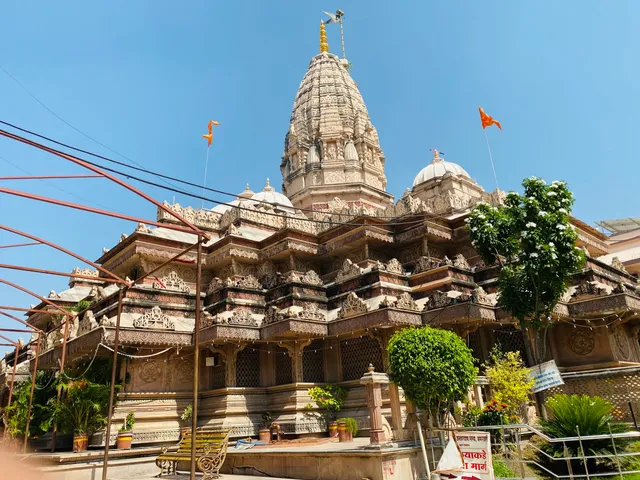
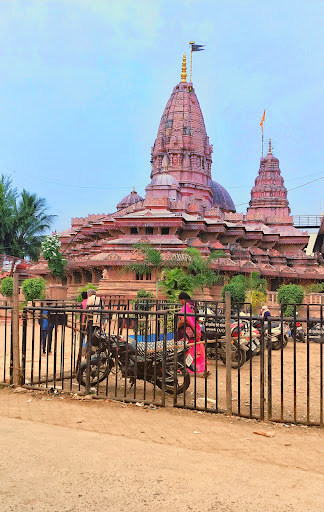
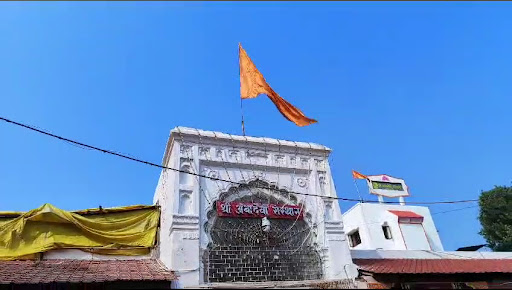
Read moreAmba Devi Temple in Amravati is a highly revered Hindu temple dedicated to Goddess Ambadevi, an incarnation of Goddess Durga. It holds significant historical and mythological importance, with legends tracing its origins back over a thousand years, even to the time of Lord Krishna.
Here's some more information about the temple:
Historical and Mythological Significance:
The temple is believed to be where Lord Krishna eloped with Rukmini before her forced marriage to Shishupala. This connection makes it a significant site for devotees.
Amravati district is also believed to have derived its name from the deity, translating to "The City of the Immortals" or "The Eternal City."
Historical records dating back to 1097 offer glimpses into the temple's ancient origins.
Architecture and Layout:
The temple complex is surrounded by high walls with main entry gates resembling towering palace or fort doorways.
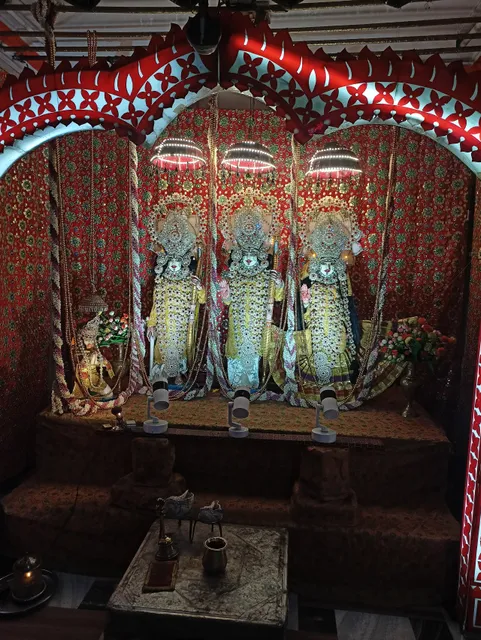
Inside, there's a spacious hall, and the main "Garbagriha" (sanctum sanctorum) is divided into three arch-shaped rooms.
The central chamber houses idols of Goddess Ambadevi, Goddess Lakshmi, and Narayan. Other idols include Lord Vishnu, Lord Mahadev, Goddess Parvati, and Lord Ganpati.
The architecture showcases a blend of Dravidian and later Islamic influences, evident in its dome.
Two silver lamps are kept burning 24/7 in front of the deities.
Daily Programs and Timings:
The temple opens at 5:00 AM daily.
Morning Puja is performed at 6:00 AM, after which the temple opens for devotees for Darshan.
Afternoon Puja is at 12:00 PM.
Evening Pujas are at 6:00 PM and 7:30 PM.
The temple closes at 10:30 PM.
During festive seasons, the temple may open as early as 4:00 AM.
Festivals:
The Navratri festival is celebrated with great enthusiasm and grandeur, attracting thousands of devotees. During this time, the temple is beautifully decorated, and various cultural and religious programs are organized. A large "Mela" (fair) is also held near the temple.
It is customary for locals to perform a mandatory puja of Goddess Amba before marriages or other auspicious ceremonies.
Location and Accessibility:
The Amba Devi Temple is centrally located at Gandhi Square in Amravati.
It is approximately 1 km west of Amravati Railway Station and 1.5 km from Amravati Bus Stand.
Local buses, taxis, and auto-rickshaws are readily available to reach the temple.
Nearby Attractions:
The Ekvira Devi Temple is located near the Ambadevi Temple, and a bridge connects the two, making it easy for devotees to visit both.
The Amba Devi Temple is not just a place of worship but also a significant cultural and historical landmark in Amravati, offering a peaceful and enriching experience for pilgrims and...
Read moreVisiting Ambadevi Temple in Amravati was a spiritually enriching experience. The temple, dedicated to Goddess Ambadevi, is an important religious site with a history that spans several centuries. As I approached the temple, the intricate carvings on its façade immediately caught my eye, reflecting the rich cultural heritage of the region.
Inside, the atmosphere was serene and filled with the scent of incense. Devotees were engaged in prayer, and the rhythmic chanting created a deeply spiritual ambiance. The temple’s sanctum sanctorum, where the idol of Ambadevi is enshrined, was beautifully adorned with flowers and offerings. The sense of devotion and reverence was palpable.
The temple complex also houses several smaller shrines dedicated to various deities, each with its unique significance. I spent some time exploring these shrines and learning about the different rituals and traditions associated with them.
One of the highlights of my visit was participating in the evening aarti. The sight of the temple illuminated with oil lamps and the sound of bells ringing in unison was truly mesmerizing. It was a moment of collective devotion that left a lasting impression on me.
The temple’s surroundings are well-maintained, with lush greenery and benches for visitors to sit and meditate. I took some time to reflect on the peaceful ambiance before concluding my visit. Overall, my experience at Ambadevi Temple was a blend of cultural discovery and spiritual fulfillment, making it a...
Read more