The Gooty Fort, also known as Ravadurg, is a ruined fort located on a hill in the Gooty town of Andhra Pradesh, India. The word Gooty (locally pronounced "Gutti") is derived from the town's original name, Gowthampuri. It is one of the centrally protected monuments of national importance. Eight inscriptions have been found on the rocks close to the Narasimha temple located within the fort premises. These inscriptions are seriously damaged, but appear to be from the reign of the Western Chalukya king Vikramaditya VI (r. c. 1076-1126 CE). The earliest of the existing fortifications and other structures can be dated to the late Chalukya period.[2]
The fort later came under the control of the Vijayanagara Empire. During the reign of Venkata II (r. c. 1584-1614), the Vijayanagara lost the fort to the Qutb Shahi dynasty. The Mughals appear to have controlled the fort after their conquest of the Qutb Shahi capital Golconda. Around 1746 CE, the Marathageneral Murari Rao captured the fort, and made it his permanent residence eight years later. He repaired the fort, and commissioned the stucco ornamentation of the small gateways.[2]
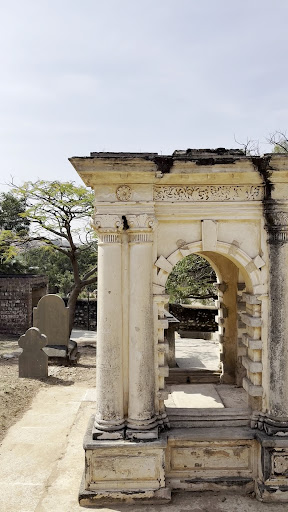
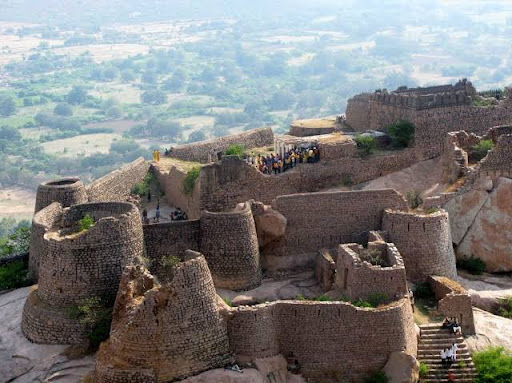
In 1775 CE, the Mysore ruler Hyder Aliattacked and besieged the fort. After two months, Murari Rao was forced to surrender, as he ran out of water supplies. The fort later came under the control of the East India Company. Its administrator Thomas Munrowas buried at the cemetery located at the foothill. The fort is located on a group of hills that rise up to 680 m above the sea level. The hills are connected by lower spurs. The citadel of the fort is located on the westernmost hill. The summit of the citadel has two buildings, apparently a granary and a gunpowder magazine. The ruined Narasimha temple is located near the summit. On a 300 m high cliff, there is a small pavilion called "Murari Rao's seat", which provides a panoramic view of the town below. It is said that the Marathageneral Murari Rao used to play chess and swing here.[2]
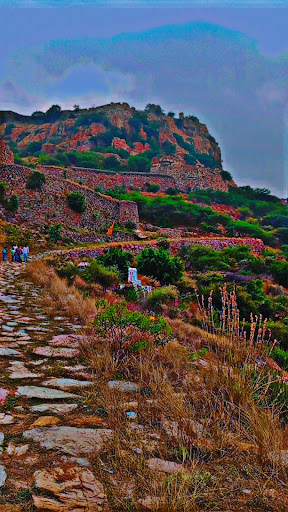
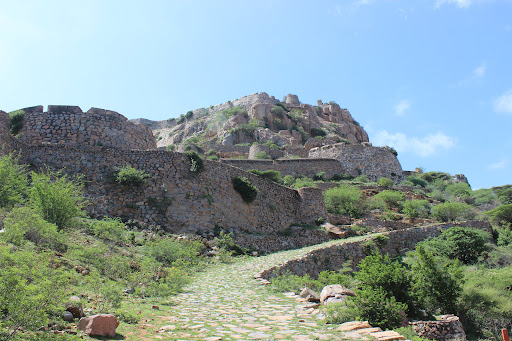
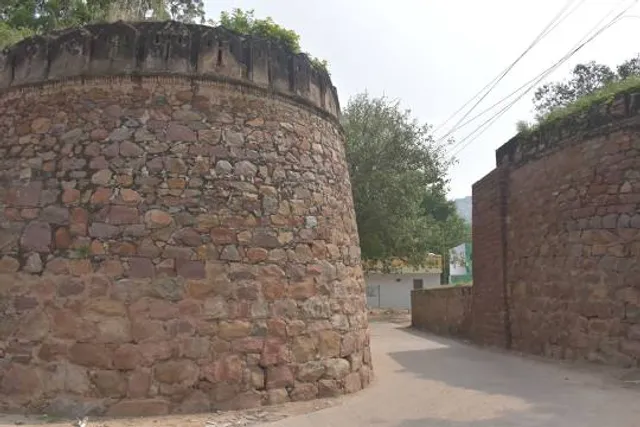
The lower fortifications comprise a series of ramparts, which are connected by gateways and flanked by bastions. Numerous reservoirs excavated on the rock clefts were used to trap the seasonal rainwater.[2] 108 wells were also dug within the fort walls.[3]
There are several ruined buildings within the fort, including granaries, storerooms,...
Read moreA great place for exploration. A total absence of preservation or tourism officials in the vicinity.No entrance tickets or fixed timings or guards .so if you go in a group it is safer and more enjoyable . The fort has strategically constructed ramparts with the outermost walls protecting the old village inside the fort. As we cross each gate we enter the inner and higher chambers of the Kings .the walls are dotted with towers every 100 metres and are constructed in such a way so as to make the entrance of an enemy a hell of a task . (Take some food and water with you as you won't find any at the top . The hike to the top is challenging so be prepared .) The fort has water ponds at different places which are dug to survive the long seiges that they are susceptible to in medieval ages . The largest one is in the village on the plains. Smaller ponds are to be seen at the middle level as well as at the highest point of the fort. (The water obviously is not drinkable anymore ) There is a small plateau on the shoulder of the hill which houses medieval ruins of probably government buildings and granaries . The trek from here is more uphill . At the top most part the kings and Queens chambers are now in ruins but show hints of art and sculpture on the walls and towers. There is an inscription in medieval telugu on the rocks which is difficult to notice if you don't observe keenly. It is on the floor near the kings chambers . There is a tower here which reaches the highest elevation and climbing atop it offers us breath taking view of the kurnool and anantapuram districts. (Best for panoramic photography as you have an unhindered view ). Overall a great place for history and fort enthusiasts. Be prepared and visit in groups during day time. If you visit please don't vandalise the place by writing your names or throwing litter. I was pained to see that. There was no facility for tourist guides so read about the history in wikipedia or andhra history books to know about the forts significance from chalukyan period to east india company rule. You can pay your respects to Thomas Munroe the British civil servant who pioneered the ryotwari system...
Read moreDate of Visit: December 2023,
Gooty fort is one of the oldest and most prominent forts in Rayalaseema region. The summit is 1700ft high above surrounding ground level.
Tips for visit:
There is no ticket for visit. One person per group has to fill his contact details along with Aadhar card details. The trek is easy-medium scale and takes 3 hours total (to and fro). There are absolutely no facilities for toilets or drinking water. There are no information boards or any way boards along trek aparr from just one 'ASI protection zone' board at the base. There is zero maintenance. Since the place is hot and dry, it is better to start the trek early. The access to the base is through very narrow streets of the town. The parking is provided in one barren land next to the base office and is not proper. But the views and the historic experience is worth.
Must see place if you are a trekking or history enthusiast.
History:
The fort dates back to Western Chalukyan era (10th Century C.E.) and was expanded to it's best under the Vijayanagara rulers. It later fell to Qutub Shahis and Mughals. It was captured by Murari Rao Ghorpade, A Maratha general in 1746 CE. The fort was besieged by Hyder Ali in 1775 and later was under control of East India Company.
Architecture:
The fort is situated on high rough cluster of steep and bare Rocky hills connected by lower spurs. The hills are connected by ramapart walls, built of irregular red granite blocks pointed with lime mortar. There are more than 100 bastions and 14 gateways. There are several ruined structures like Rangamahal, Horse stable, kitchen, jail, etc. One can see the transition of architecture of various eras, the coexistence of Islamic motifs of later date along with vijayanagara...
Read more