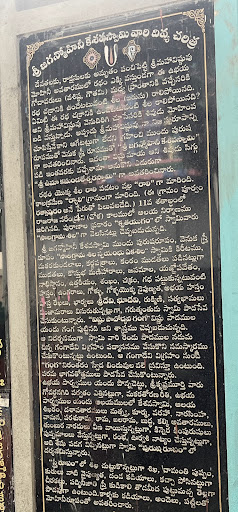
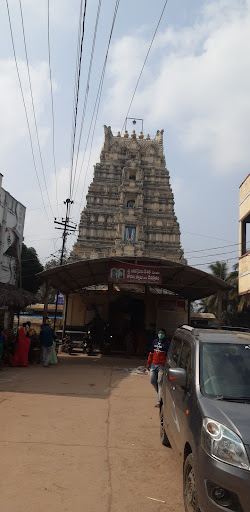
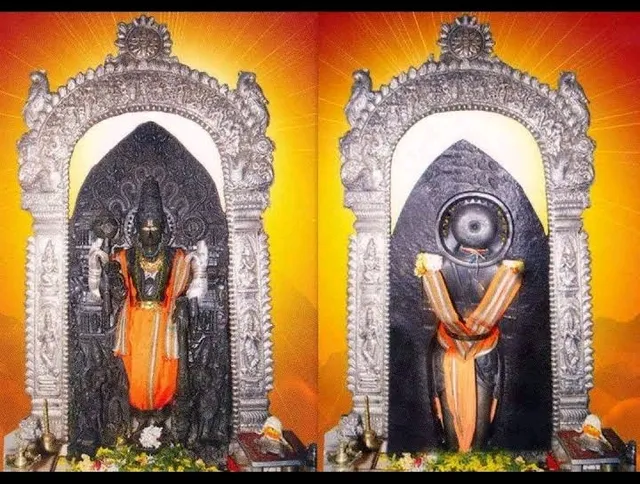
Ryali is located 40 Km from Rajahmundry, 74 Km from Kakinada and 34 Km from Amalapuram and it is situated between the rivers Vashista and Gautami, Tributaries of river Godavari, this is the site of the renowned Jagan Mohini Kesava Swamy temple. The exquisite idol, made of black stone depicting Maha Vishnu and Mohini on its front and rear sides, is a real marvel of sculptural dexterity.
Jaganmohini Keshava (left – front male form & right – back female form) main swayambhu idol at RYALI
Sthala Puranam
According to the legend “Bhagavatam” while Devatas and Rakshas were quarrelling over sharing of holy Devine nectar “Sree Maha Vishnu” came to the rescue of Devatas in the guise of Mohini and convinced both the rivalry groups promising to distribute holy Devine nectar in equal share to Devatas and Rakshas. But in the interest of universal peace and welfare of sages, holy and Devine nectar was distributed among Devatas alone and the Mohini disappeared.
Lord Siva having seen the most fascinating beauty of Mohini allured her. He chased her for getting for a while the presence of his consort Parvathi Devi it is the general belief that the holy incident was the result of birth of “AYYAPPA SWAMY”. One flower from the plait of Mohini fell down and it was smelt by Lord Siva. Then he surprisingly found “Sree Maha Vishnu” in the form of Mohini and felt shy for his behavior. The place where the flower from the plait of Mohini fell is named as RYALI the Telugu meaning of “Fall”.
This place known as Ryali for the above reason became above of Lord Siva and Sree Mahavishnu with the form of Mohini on back side Lord Brahma consecrated the Siva Lingam with his Kamandalam and hence Lord Siva at Ryali is worshipped as Sri Uma Kamandalesara Swamy Varu, Sri Mahavishnu with the form of Mohini on backside is worshipped as Sri Jaganmohini Kesava Swamy varu both Siva and Vishnu Temples are located facing each other. This is very rare feature at Ryali where Vishnu and Lord Siva Temples faces each other in East, West direction.
During 11th Century, this village was a part of wild Forest and these parts were under the rule of Chola Rajas. Sri Raja Vikrama Deva who ruling these parts during those days came to this place for hunting. Having been tired after hunting wild animals, he took rest under the shade of a big ponna tree, and fell in deep sleep and got a dream. Lord Sri Maha Vishnu appeared in his dream and informed that his shrine was located in the under ground of this area and directed the “Raja to get the wooden made chariot pull in the area and where the nail of chariot fell, the shrine can be found in the under ground of that place. Raja has done accordingly and the land where the nail of chariot fell was excaved and found the idol making the dream of Raja true. He constructed a small temple during 11th Century and arranged worship during his regime. Gradually prakarams were developed in the year 1936 (Data nama Samvatsara) it was renovated.The Shrine of Sri jaganmohini kesava Swamy varu is Salagrama Ekasila with 5 feet height and 3 feet width.
Salgramasila is itself the form of Sri Maha Vishnu. The idol of Sree Kesava Swamy varu of “Sri Mahavishnu” in front side and Jagan Mohini on back side. The tem incarnations Lord Sree Maha Vishnu with consorts, Sri Devi, BhooDevi, Sage Narada, Thumbura, Rambha, Urvasi, Kinnera, Kimpurusha, Lord Krishna with Govardhanagiri, Adiseshu, Garuda and Ganga are beautifully, scluptured around the shrine. The most miracle and rare feature is that, Ganga always flows from the feet of Sri Maha Vishnu is the origin of Akasa Ganga and this truth can be witnessed here. The most wonderful architectural beauty of Shrine, and flow of Ganga from the feet of Swamy varu are really unique features and shrine became very sacred. The architectural beauty of idol can not be described in words. Further it gives impression as it is new idol though its origin is of 11th Century.This shrine is “SWAYAMBHU” people visiting the temple form several parts of the Country believe that the shrine is not of man made but...
Read moreSri Jaganmohini Kesava Swamy Temple, Ryali —
It is one of the most unique and divine temples I have ever visited 🙏. The vibrations here are deeply positive and peaceful—you immediately feel why this sacred place was chosen for the temple.
The idol is what makes it truly extraordinary. By taking a ticket, devotees are allowed into the sanctum sanctorum, where priests carefully explain both sides of the deity. On the front, Lord Kesava Swamy appears in His majestic male form, with Sridevi, Bhudevi, and the Dasavataras. On the back, He reveals His enchanting feminine form as Jaganmohini.
This is not a temple where you just offer prayers and leave—you must see the sanctum to experience the wonder of this unique idol. It is so lifelike and smooth that it looks almost human, with details down to the nails and fingers. The priests and villagers explain that this is not a sculpture but a Swayambhu (self-manifested) form of the Lord.
Annadhana (free meals) is served daily from 11 am to 1 pm, so devotees can partake in Swami’s prasadam.
The Story of the incarnation of Sri Jaganmohini Kesava swamy —
The story of this temple goes back to the time of the churning of the ocean for nectar. After distributing nectar in the form of Mohini, Lord Vishnu set out in His chariot. When He reached the land between the two Godavaris, a stone fell from the chariot wheel. From then, the chariot was called Rali, and the place eventually became known as Ryali (earlier Ratnapuram).
At that time, Lord Shiva followed Vishnu, captivated by Mohini’s beauty. To reveal His true nature, Vishnu manifested as Sri Jaganmohini Kesava Swamy, showing the male form in front and female form at the back. Shiva realized it was all Vishnu Maya and in reverence, took form nearby as “Sri Uma Kamandaleswara Swamy”, who is still worshiped in a temple opposite to this temple in Ryali.
The present temple was built in the 11th century CE during the reign of Chola king Rajaraja Narendra, though the legend says the Lord appeared here in the Krita Yuga as a self-manifested Salagrama Shila.
The Idol and Temple —
The idol of Sri Jaganmohini Kesava Swamy is one of a kind. On the front, He appears in His male form as Vishnu: • Crowned and adorned with jewels, earrings, and the Kaustubha gem. • Wearing the sacred thread and rosary, holding the conch, discus, and mace. • With the blessing hand (abhaya hasta) and fine ornaments decorating His body. • His consorts, Sri Devi and Bhu Devi, are shown as Rukmini and Satyabhama, offering Him garlands. • Garuda, His eternal servant, is at His feet in service.
At His lotus feet rests a tiny idol of Goddess Ganga, placed there because the scriptures declare that the holy river originates from Vishnu’s feet. Even today, water resembling drops of sweat can be seen flowing from this idol, believed to be the continuous flow of Ganga herself.
The Mohini Form
What makes the idol most extraordinary is that the back side shows the Mohini form. • Her hair is tied beautifully with flowers. • She wears bangles, anklets, and a graceful sari. • Her form is delicate and radiant, marked by a long white mole on her right thigh, a symbol of divine beauty.
Thus, in one sacred image, Vishnu reveals both His protector form as Kesava and His enchanting form as Mohini.
The Significance —
The story of Sri Jaganmohini Kesava Swamy is not just about a temple—it is about the mystery of the Divine, who can appear in many forms, sometimes as the mighty preserver, sometimes as the most enchanting beauty.
Ryali reminds us of this eternal play of the Lord, and anyone visiting Andhra Pradesh should not miss the blessings and the unique darshan of Sri Jaganmohini...
Read moreRyali is situated in East Godavari district (Atreyapuram Mandal) of Andhra Pradesh - India. This area is also called KonaSeema, a purely well irrigated area of Andhra Pradesh due to many tributaries of river Godavari. The famous Sri Jagan Mohini (Sri Maha Vishnu) temple is situated here. The shrine of Sri Jagan Mohini Keshava Swamy is made up of single stone (Salagrama Ekashila - 5 feet height and 3ft width). The idol looks like Sri Vishnu (male) from front side and as Mohini (female) from rear side. The architectural beauty of the idol and temple is excellent. The flow of Akasha Ganga at the feet of Sri Maha Vishnu can be seen here. This place was purely a wild forest during 11th century and was ruled by Cholas. Raja Vikrama Deva originally constructed a small temple during 11th century and later renovated.
How to reach Ryali
Ryali is located in East Godavari district of Andhra Pradesh - India. Tourists travelling from Northern part of India have to come to Visakhapatnam via National Highway 5 (Highway between Kolkata and Chennai) and proceed towards Tuni, Annavaram and Rajahmundry. From Rajahmundry, travel towards Dowlaiswaram Barrage and take left turn at Bobbarlenka (immediately after the barrage on river Godavari). From Bobbarlanka proceed towards Lolla and take right diversion at Marlapalem to reach Ryali. The distance between Rajahmundry and Ryali (Rali) is 25 Kms. People travelling from South and other parts of India have to reach a place called Ravulapalem on National Highway 5 (before Rajahmundry). At Ravulapalem take right turn to proceed towards Marlapalem and take left turn here to reach Ryali.
Importance of Ryali In local language (Telugu) Ryali means FALL. As per Bhagavatam, Lord Vishnu takes the guise of Mohini to rescue Devatas against Rakshasas during Samudra Mathana for getting Amrutam (holy divine nectar). During equally distributing the Amrutham among Devatas and Rakshasas, Mohini works in favour of Devatas and avoids the nectar by giving to Rakshasas. Lord Eshwara (Shiva) sees Mohini and falls in love with her. Lord Shiva comes to know that Mohini is the guise of Lord Vishnu when a flower falls from the plait of Mohini. This place where the flower has fallen is named RYALI meaning FALL in Telugu. In Ryali Lord Shiva is worshipped as Uma Kamandaleswara because on the back side Lord Brahma Consecrated the Siva Lingam with his Kamandalam. The Mahavishnu is consecrated as Mohini at the back side and hence worshipped as Sri Jaganmohini Keshava Swamy. The temples of Lord Shiva and Lord Vishnu face each other in East and West direction, a rare feature to see at Ryali. The shrine of Sri Jaganmohini is a joy to see. The ten incarnations of Lord Sri Vishnu and consorts are beautifully sculptured around the shrine.
The temple timings are from 6.00am to 12.00noon and from 3.00pm to 8.00pm. No photography allowed inside the temple. Better plan to have food and stay at Ravulapalem as Ryali is a small village. People can include other places like Vadapalli (Lord Venkateswara temple), Pancharama temples (4 in this area, Samalkot, Draksharama, Palakollu, Bheemavaram) in their trip plan for visiting as these are all nearby. There is no standard package to visit Ryali from any of the travel agents. The nearest Railway station is Rajahmundry and nearest airport is Visakhapatnam. Plan for hiring a private vehicle to visit places...
Read more