HTML SitemapExplore

Digboi Centenary Museum — Attraction in Assam

Name
Digboi Centenary Museum
Description
Nearby attractions
Digboi Park
9JRF+GR, Digboi, Assam 786171, India
Digboi Centenary Park
Digboi Centenary Park, opp. IOCL Refinery, Digboi, Assam 786171, India
Nearby restaurants
Nearby local services
Nearby hotels
Related posts
Keywords
Digboi Centenary Museum tourism.Digboi Centenary Museum hotels.Digboi Centenary Museum bed and breakfast. flights to Digboi Centenary Museum.Digboi Centenary Museum attractions.Digboi Centenary Museum restaurants.Digboi Centenary Museum local services.Digboi Centenary Museum travel.Digboi Centenary Museum travel guide.Digboi Centenary Museum travel blog.Digboi Centenary Museum pictures.Digboi Centenary Museum photos.Digboi Centenary Museum travel tips.Digboi Centenary Museum maps.Digboi Centenary Museum things to do.
Digboi Centenary Museum things to do, attractions, restaurants, events info and trip planning
Digboi Centenary Museum
IndiaAssamDigboi Centenary Museum

Basic Info

Digboi Centenary Museum

Centenary Museum, Digboi, Assam 786171, India
4.4(499)
Open until 4:15 PM
Save
spot

Ratings & Description

Info

Cultural
Family friendly
Accessibility
attractions: Digboi Park, Digboi Centenary Park, restaurants: , local businesses:
logoLearn more insights from Wanderboat AI.
Phone
+91 374 233 1572
Open hoursSee all hours
Tue9 AM - 4:15 PMOpen

Plan your stay

hotel
Pet-friendly Hotels in Assam
Find a cozy hotel nearby and make it a full experience.
hotel
Affordable Hotels in Assam
Find a cozy hotel nearby and make it a full experience.
hotel
The Coolest Hotels You Haven't Heard Of (Yet)
Find a cozy hotel nearby and make it a full experience.
hotel
Trending Stays Worth the Hype in Assam
Find a cozy hotel nearby and make it a full experience.

Reviews

Nearby attractions of Digboi Centenary Museum

Digboi Park

Digboi Centenary Park

Digboi Park

Digboi Park

4.1

(435)

Open until 5:00 PM
Click for details
Digboi Centenary Park

Digboi Centenary Park

4.2

(363)

Open until 7:00 PM
Click for details
Get the Appoverlay
Get the AppOne tap to find yournext favorite spots!
Wanderboat LogoWanderboat

Your everyday Al companion for getaway ideas

CompanyAbout Us
InformationAI Trip PlannerSitemap
SocialXInstagramTiktokLinkedin
LegalTerms of ServicePrivacy Policy

Get the app

Š 2025 Wanderboat. All rights reserved.

Reviews of Digboi Centenary Museum

4.4
(499)
avatar
4.0
5y

Aa FEATURES There’s a lot more to Digboi than just oil For its small size, this Assamese town packs a lot—oil wells and museum, tea gardens, Buddha vihar, war cemetery

Many had a question in school geography and/or a quiz on general knowledge — “Which place in India has the oldest oil well?” or “Where in India is the oldest oil refinery?” And, most knew the answer by heart: Digboi. Unfortunately, that’s the only piece of information most had about this tiny place in northeastern India. It is barely 30 km away from Tinsukia, a big town in eastern Assam. From Tinsukia, head towards east and right outside the city limits, one is greeted by lush green tea gardens on both sides. A tiny village every now and then that has houses with sloping tin roofs and a neatly maintained courtyard breaks the monotony of the many shades of greens of paddy fields and tea gardens. After a while, one sees the boards announcing the place with the historical oil well.

Digboi’s main road is no different than that of any other typical Indian town with familiar shops lining the arterial road — mobile repair and recharge shops, pharmacy, toy shops, grocery stores, a school here and a roadside restaurant there. One can’t miss the ‘Indian Oil Corporation Assam Oil Division’ boards plastered all over in all shapes and sizes.

Oil museum

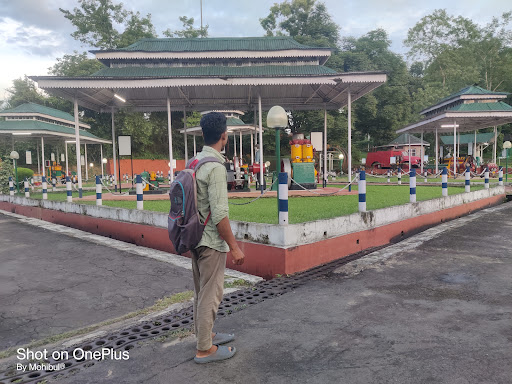
And just then, one comes across a simple flex board: Digboi Centenary Museum — An unforgettable walk through 100 years of oil. This exceptional museum has two parts: one is an open-air installation portion and the second is an elegant enclosure of all things associated with the oil industry since the last century.

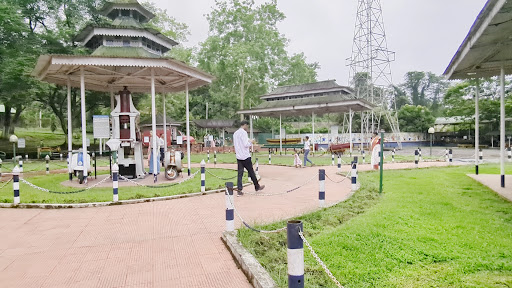
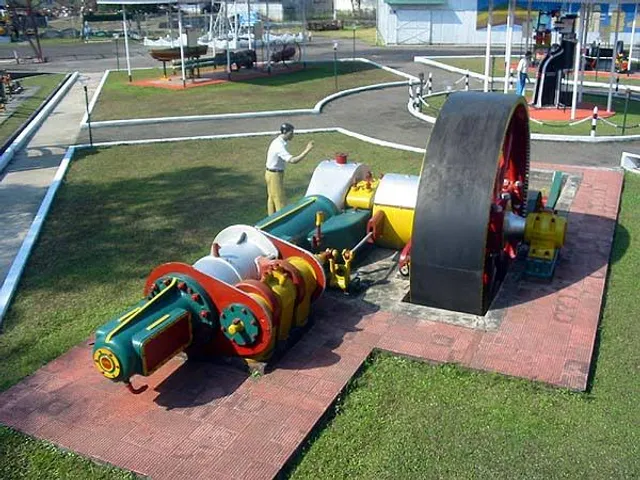
Most important in the open air is the first oil well — Discovery Well No. 1. It is out of use for many decades now (flow ceased in 1927, final abandonment in 1932). Along with the oil wells, coke chutes and a steam engine (it retired in 1986, the board beside it tells us) used to move compressors and vacuum pumps at kerosene treating unit are showcased. And, there is also a replica of an erstwhile Assam Oil Company-run petrol pump, complete with mannequins of a neatly dressed English couple and a petrol pump attendant.

The inside halls have a vast collection of things, photos and posters documenting the Digboi oil centenary. Apart from all things related to the oil industry, there are these odd things on display too — for instance, cricket related stuff used by the English and, of all the things, an iron chain used in a toilet of one of the old bungalows.

Town’s history

Digboi is home to the first oil well, not just in India but also across Asia, from way back in 1867. Just seven years after Elvin L Drake dug the world’s first oil well at Pennsylvania (USA) in 1859. In 1867, work had started for a railway line in the area. Wooden sleepers were needed for the rail track, so timber was lugged by elephants from the surrounding forests. One day, one of the elephants had his legs dripping with oil. The mahouts re-traced the steps to find the oil bubbling out and spreading on the floor of the jungle. It was a day that etched Digboi’s place on the oil map permanently. It was in 1891 that they started systematic oil drilling, and in 1901 came the...

   Read more

avatar
5.0
3y

As part of the centenary celebrations of the first production oil well in India, the Assam Oil Company (part of Indian Oil) established a museum of the history of the Assam oil industry, behind the refinery at Digboi, which opened in early 2002. There is a fair amount of preserved machinery present, much of it stationary steam. Not illustrated are a number of small simplex and duplex pumps, mostly anonymous but including a couple of examples by Weir. Note that the museum is closed on Monday and nearby is the Digboi War Cemetry, poorly sign posted but as ever a poignant reminder of the futility of war as a means of solving problems. Not far away are some rather less well conserved North Eastern Coalfields Relics.

Pride of place is given to this large Borsig stationary engine - unfortunately not all exhibits have explanatory notices (as this one) and the curator is not a technical man...

Next to it is a large duplex pump, marked only as Dow 41245. From the workshops is a steam hammer from B & S Massey (Manchester, England), dating from about 1930, a nice 'spot' following our afternoon with working examples in Howrah.: This is a Clarke, Chapman (Gateshead, England) steam winch, 8" x 12" as marked on the cylinders: There are three very similar large duplex pumps, this one has been painted and appears to be from Brasov (Romania, I believe): Unrestored are two almost identical engines to this, one is marked with 'Weston' and the other is Romanian with a plate  from Uzinele "Strungul" Orasul Stalin, dating it from 1959.

I was quite unclear what this monster did, but have been informed by Tom Sherrif that it is a diesel driven gas compressor, most likely produced in the USA in the 1950s.:

Exhibited in the main hall is a vertical Ashworth and Parker (Bury, England) engine, its plate carries 1856/1949, although the explanatory notice dates it to 1930!

Metre gauge Ruston and Hornsby 4wDM (Size 88, Class DSC No. 394011) is displayed, presumably it worked here, there are also two pictures of steam locomotives at work in Digboi exhibited. More bizarrely present is one of the small Bagnalls from Coal India with two home made coaches: The following account of the museum has kindly been supplied by Sabeena Chowdhary, Deputy Manager (Corporate Communications), Indian Oil Corporation Limited (Assam Oil...

   Read more
avatar
5.0
6y

A place worth of travelling and knowing the history of India. A historic Place where economy of Independent India started. The first refinery in India and Asia started here in Digboi in the year 1901. This Oil well produced around 1000 liters of oil per day for 40 years. Inside museum, Oil history of India is shown. It is said that the town gets its name from the phrase "dig-boy-dig," which is what the English told the labourers as they dug for crude oil. The oil history begins in 1867 when a small group of men from the Assam Railway and Trading Co. found their elephants' legs soaked in black mud, that smelt somewhat like oil. The men began exploring more, and in 1889, the English started a small oil installation.

Assam Oil Company was formed in 1899 to look after the running of the oil business in this area. The Digboi oil field produced close to 7,000 barrels per day of crude oil at its peak, which was during World War II.

The field was pushed to produce the maximum amount of oil with little regard to reservoir management; as a result, production started to drop almost immediately after the war. The current production from the Digboi fields is about 240 barrels per day. Over 1,000 wells have been drilled at Digboi – the first well in 1889 had stuck oil at 178 feet (54 m). In 1989, the Department of Posts, India came out with a stamp commemorating 100 years of the...

   Read more
Page 1 of 7
Previous
Next

Posts

Palash Priyanshu DuttaPalash Priyanshu Dutta
It is a piece of history that truly captivates the imagination. I love Digboi for its unique charm; it’s a very quiet town, and the lush greenery surrounding it makes me incredibly happy. The atmosphere is serene, allowing visitors to appreciate nature while exploring its rich heritage. One of the highlights of Digboi is the museum dedicated to the oil industry, which showcases the first oil well in Asia. This museum is a treasure trove of information and artifacts, making it a must-visit for anyone interested in history. Inside the museum, where photography is banned to preserve the exhibits, you can learn about the fascinating story of how crude oil was discovered in this region. The displays include photographs, documents, and memorabilia from the British era, reflecting the town's significant role in the oil industry. It’s intriguing to see how this small town contributed to the energy sector not just in India, but across Asia. I highly recommend you pay a visit to Digboi and its museum. It’s not just an educational experience; it’s a journey back in time, offering insight into the past and the development of the oil industry.
Soumen PalitSoumen Palit
The Digboi Oil Centenary Museum in Assam is a must-visit for every Indian. This museum showcases how oil was first discovered and extracted in India, a history that is nothing short of astonishing. The museum is divided into two sections – an indoor exhibit and an outdoor display. Inside, beautifully crafted models illustrate the process of the first oil extraction, alongside several vintage tools and equipment. The outdoor section features original machinery and structures used during those early days, giving visitors an unparalleled experience. What makes it even more remarkable is that the area is still so rich in oil reserves that you can see oil naturally seeping from the ground in spots around the museum premises. Truly, this extraordinary experience is something I will cherish for a lifetime.
Bhaswanjyoti BuragohainBhaswanjyoti Buragohain
Very nice place. Houses a lot of amazing history about the pioneering oil exploration in Assam. It houses an exclusive gallery of photos of historical importance of the oil industry in Assam. There is also housed the first commercial oil well set up in India back in September 1889. Houses a lot of early oil drilling, exploring and refinery machinery, most of them imported from abroad by the Burmah Oil company set up by the British, now operated by Oil India. Also houses old equipments used during the British rule in the refinery offices, hospitals and also in the field. Piece of advice, cameras, phones and other electronic gadgets are not allowed inside the exhibit house. Although one can take photos in the campus outside. One can also visit the Coal Museum in Margherita, not far from here
See more posts
See more posts
hotel
Find your stay

Pet-friendly Hotels in Assam

Find a cozy hotel nearby and make it a full experience.

It is a piece of history that truly captivates the imagination. I love Digboi for its unique charm; it’s a very quiet town, and the lush greenery surrounding it makes me incredibly happy. The atmosphere is serene, allowing visitors to appreciate nature while exploring its rich heritage. One of the highlights of Digboi is the museum dedicated to the oil industry, which showcases the first oil well in Asia. This museum is a treasure trove of information and artifacts, making it a must-visit for anyone interested in history. Inside the museum, where photography is banned to preserve the exhibits, you can learn about the fascinating story of how crude oil was discovered in this region. The displays include photographs, documents, and memorabilia from the British era, reflecting the town's significant role in the oil industry. It’s intriguing to see how this small town contributed to the energy sector not just in India, but across Asia. I highly recommend you pay a visit to Digboi and its museum. It’s not just an educational experience; it’s a journey back in time, offering insight into the past and the development of the oil industry.
Palash Priyanshu Dutta

Palash Priyanshu Dutta

hotel
Find your stay

Affordable Hotels in Assam

Find a cozy hotel nearby and make it a full experience.

Get the Appoverlay
Get the AppOne tap to find yournext favorite spots!
The Digboi Oil Centenary Museum in Assam is a must-visit for every Indian. This museum showcases how oil was first discovered and extracted in India, a history that is nothing short of astonishing. The museum is divided into two sections – an indoor exhibit and an outdoor display. Inside, beautifully crafted models illustrate the process of the first oil extraction, alongside several vintage tools and equipment. The outdoor section features original machinery and structures used during those early days, giving visitors an unparalleled experience. What makes it even more remarkable is that the area is still so rich in oil reserves that you can see oil naturally seeping from the ground in spots around the museum premises. Truly, this extraordinary experience is something I will cherish for a lifetime.
Soumen Palit

Soumen Palit

hotel
Find your stay

The Coolest Hotels You Haven't Heard Of (Yet)

Find a cozy hotel nearby and make it a full experience.

hotel
Find your stay

Trending Stays Worth the Hype in Assam

Find a cozy hotel nearby and make it a full experience.

Very nice place. Houses a lot of amazing history about the pioneering oil exploration in Assam. It houses an exclusive gallery of photos of historical importance of the oil industry in Assam. There is also housed the first commercial oil well set up in India back in September 1889. Houses a lot of early oil drilling, exploring and refinery machinery, most of them imported from abroad by the Burmah Oil company set up by the British, now operated by Oil India. Also houses old equipments used during the British rule in the refinery offices, hospitals and also in the field. Piece of advice, cameras, phones and other electronic gadgets are not allowed inside the exhibit house. Although one can take photos in the campus outside. One can also visit the Coal Museum in Margherita, not far from here
Bhaswanjyoti Buragohain

Bhaswanjyoti Buragohain

See more posts
See more posts