Gibbon Wildlife Sanctuary: Preserving Assam's Natural Treasures
History: The Gibbon Wildlife Sanctuary, nestled in the verdant landscape of Assam, emerged from a rich history of conservation efforts dating back to the early 20th century. Established in 1997, its primary aim was to safeguard the hoolock gibbons, India's sole ape species, from extinction. Over time, the sanctuary expanded to its current size of 20.98 square kilometers, evolving into a vital habitat for a diverse range of flora and fauna.
Current Condition: Despite challenges such as encroachment, deforestation, and poaching, the Gibbon Wildlife Sanctuary remains a beacon of hope for wildlife conservation. Its remarkable biodiversity, including hoolock gibbons, various primates, birds, reptiles, and mammals, underscores its significance as a sanctuary for endangered species. The dense vegetation not only sustains wildlife populations but also serves as a crucial ecological corridor, facilitating genetic diversity and population viability.
However, threats persist, necessitating proactive conservation efforts. The Assam Forest Department, with its dedicated team of officers and frontline staff, plays a pivotal role in safeguarding the sanctuary's integrity. Through community engagement, research, and enforcement initiatives, the department strives to ensure the sanctuary's long-term sustainability.
The Assam Forest Department: The Assam Forest Department adopts a multifaceted approach to wildlife conservation, emphasizing community participation, research, and enforcement. By involving local communities in decision-making processes, the department fosters a sense of ownership and promotes sustainable resource management practices.
Research and monitoring initiatives provide valuable insights into wildlife populations and habitat dynamics, informing conservation strategies. Outreach programs raise awareness about the importance of wildlife conservation, garnering support from stakeholders and fostering a culture of environmental stewardship.
Enhanced enforcement efforts, including patrols and collaboration with law enforcement agencies, have yielded significant successes in combating wildlife crime and illegal activities within the sanctuary. By addressing threats such as poaching and habitat degradation, the department works tirelessly to safeguard Assam's natural heritage.
In conclusion, the Gibbon Wildlife Sanctuary stands as a testament to Assam's commitment to biodiversity conservation. With its rich history, diverse ecosystems, and proactive conservation efforts by the Assam Forest Department, the sanctuary remains a vital refuge for endangered species. However, ongoing challenges underscore the need for continued vigilance and concerted conservation efforts to ensure the sanctuary's long-term sustainability...
Read moreThe Hollongapar Gibbon Sanctuary, formerly known as the Gibbon Wildlife Sanctuary or Hollongapar Reserved Forest (Assamese: হোলোঙাপাৰ গিবন অভয়াৰণ্য), is an isolated protected area of evergreen forest located in Assam, India. The sanctuary was officially constituted and renamed in 1997. Set aside initially in 1881, its forests used to extend to the foothills of the Patkai mountain range.
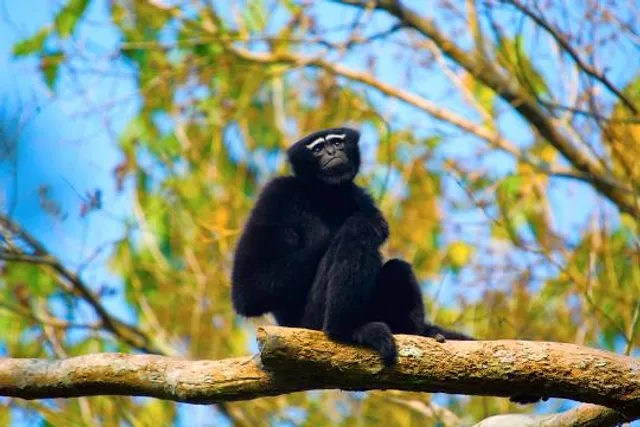
Since then, the forest has been fragmented and surrounded by tea gardens and small villages. In the early 1900s, artificial regeneration was used to a develop well-stocked forest, resulting in the site's rich biodiversity. The Hollongapar Gibbon Sanctuary contains India's only gibbons – the hoolock gibbons, and Northeastern India's only nocturnal primate – the Bengal slow loris. The upper canopy of the forest is dominated by the Hollong tree (Dipterocarpus macrocarpus), while the Nahar (Mesua ferrea) dominates the middle canopy. The lower canopy consists of evergreen shrubs and herbs. The habitat is threatened by illegal logging, encroachment of human settlements, and habitat fragmentation.
The elephants' range of this small sanctuary extends to the Dissoi Valley Reserve Forest, Dissoi Reserve Forest, and Tiru Hill Reserve Forest, which are used as dispersal areas through tea gardens (Elephas maximus). Three extensive tea gardens that belong to the estates of Dissoi, Kothalguri, and Hollonguri span the distance between the Hollongapar Gibbon Sanctuary and the nearest forests in Assam-Nagaland border, the Dissoi Valley Reserve Forest.
The tea gardens include Katonibari, Murmurai, Chenijan, Koliapani, Meleng, Kakojan, Dihavelleoguri, Dihingapar, Kothalguri, Dissoi and Hoolonguri. Neighboring villages include Madhupur, Lakhipur, Rampur, Fesual A (the western part), Fesual B (the eastern part), Katonibari, Pukhurai, Velleoguri, Afolamukh, and Kaliagaon
The Hollongapar Gibbon Sanctuary is classified as "Assam plains alluvial semi-evergreen forests" with some wet evergreen forest patches.It receives 249 cm (98 in) of rainfall on average per year. Situated at an altitude between 100 and 120 m (330 and 390 ft), the topography gently slopes downward from southeast to northwest. The Bhogdoi River creates a waterlogged region dominated by semi-hydrophytic plants along the border of the sanctuary, helping to create three distinct habitat zones or micro-ecosystems in the park: the up-slope zone, the down-slope zone, and the...
Read moreGibbon Wildlife Sanctuary Jorhat
The Hoollongapar Gibbon Sanctuary is a protected area located in the state of Assam. This sanctuary was previously known as the Gibbon Wildlife Sanctuary. On 30th July 1997, this reserve was declared as a sanctuary by the government of Assam. It is a special tourist attraction of the Jorhat district and is just about a distance of 19 kms from the district. This wildlife sanctuary plays a vital role in the conservation of the primate species of the animal kingdom. It is the only sanctuary in our country where you can spot the hoolock gibbons and the Bengal slow loris. Travelers from far away places visit the sanctuary to take a view of these rare species that being preserved here for many long years. The other wildlife creatures found here comprise of the stump-tailed macaque, eastern Assamese macaque, capped langur, tigers, jungle cats, wild boar, different types of squirrel and civet, Indian elephants and several other mammals.
The sanctuary has many evergreen trees and also there are several other herbs and shrubs found here. Several avian species are also seen here some of which are Kalij Pheasant, Red Jungle fowl, Red Breasted Parakeet, Spotted dove and the Drongo Cuckoo. Many camps and conservation programs are also organized by the authorities in charge of the sanctuary to make the local villagers aware of the fact that we must work towards saving our environment and wildlife.
POPULAR THINGS TO DO & SEE IN AND AROUND
The sanctuary witnesses many tourists visiting the place almost all round the year and a number of bungalows have been constructed so that the tourists can reside here comfortably. You will get to see many tea gardens surrounding the sanctuary which act as a geographic barrier for the animals. There also many ferns, orchids, bamboo and canes that enrich the reserve. The Hoollongapar Gibbon Wildlife Sanctuary is an absolute treat for the nature lovers out there.
GETTING THERE
The nearest airport to the sanctuary is the Jorhat airport and the closest railway junction is the Mariani railway station.
Tourists will get ample number of taxis and buses from both the airport as well as railway station which assist them in reaching the sanctuary.
BEST TIME TO VISIT
The Gibbon Wildlife Sanctuary is visited all throughout the year by the tourists; however, the best time considered to visit the sanctuary is between the months of June and July and...
Read more