The town of Sasaram in Bihar is best known to the country for the magnificent mausoleum of Sher Shah Suri, the enterprising Pashtun who forced emperor Humayun out of India, took charge of his empire, and established a dynasty that kept the Mughals at bay for 15 long years. Hailed as one of the most magnificent tombs of the ‘octagonal style’ in India, the monument continues to draw a steady stream of visitors throughout the year. It is currently protected and maintained by the Archeological Survey of India. Lying a few hundred meters away, and also protected by the ASI, is the tomb of Hasan Shah Suri, Sher Shah’s father. Though less celebrated, this tomb is also quite well known and frequently visited.
Hidden from the world, and little known even to the local residents of Sasaram, lies another tomb – a tomb that could well have surpassed the glory of its celebrated predecessor, but now lies incomplete and in ruins, a cruel victim of fate and circumstance – the tomb of Salim Shah Suri (Islam Shah), the son and successor of Sher Shah. Very few people know of it, and almost none visit it. It lies about a kilometer to the North-West of Sher Shah’s tomb, and, like the latter, occupies the center of a large artificial lake. The tomb is very difficult to locate on the ground, owing mainly to the fact that the lake has been completely surrounded by clusters of haphazard constructions. Asking around only leads to confused stares, or confident directions to the tomb of Sher Shah. Though it has been documented in the past, its memory seems to have gradually faded over the years into oblivion. But why did the tomb of an emperor who succeeded the great Sher Shah come face to face with such cruel fate? Well, for that, we’ll have to go a little into history, and take a look at the political scenario of the empire at the time of its construction. Before that, let’s take a look at the tomb itself.
The tomb of Salim Shah was modeled upon that of his father, but was intended to be larger and by far more flamboyant than its predecessor. It was never completed. The tomb complex can presently be accessed through a network of narrow lanes, which pass through the shanties around the lake. The square island on which the tomb sits measures about 106m each way, while the lake itself measures about 381m square.[1] The main structure can hardly be seen from the periphery of the lake, owing to the thick foliage that seems to shield the entire island. The island itself is accessed through a 10 m broad bridge, constructed by placing horizontal stone slabs between piers, thus creating channels for water to pass through The bridge, like much of the entire complex, is presently in a very shabby and downright dirty condition. The lake is used by the surrounding residents for washing clothes and utensils, and much of their daily refuse is dumped on to the bridge.
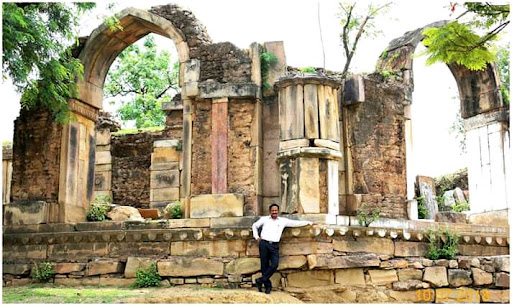
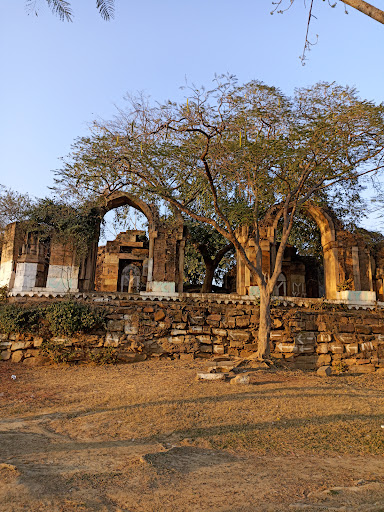
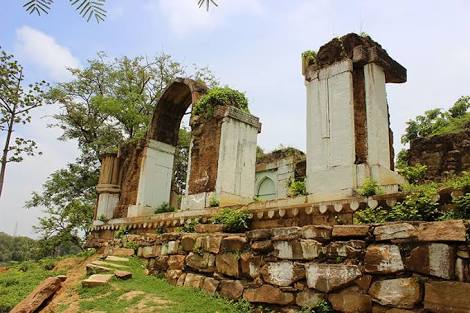
The magnificent entrance archways which adorn each face of the octagon. After having negotiated their way through the bridge, the visitor arrives on the island, and, for the first time, gets a glimpse of the glory that the building had once aspired to achieve. Magnificent arches, supposed to have been entrances to the tomb, now stand alone, as if each telling their own story. Following the general grammar of octagonal tombs in the subcontinent, this structure comprises of a large central octagonal chamber, around 23 m across, surrounded by an arcaded verandah designed to have been pierced by three arches on each of its eight faces. The grave of Salim Shah occupies the geometric centre of the entire building, surrounded by a number of other later graves. The structure rises barely to about 3-4 metres.
This tomb possesses another feature, which makes it architecture.
Have a better...
Read more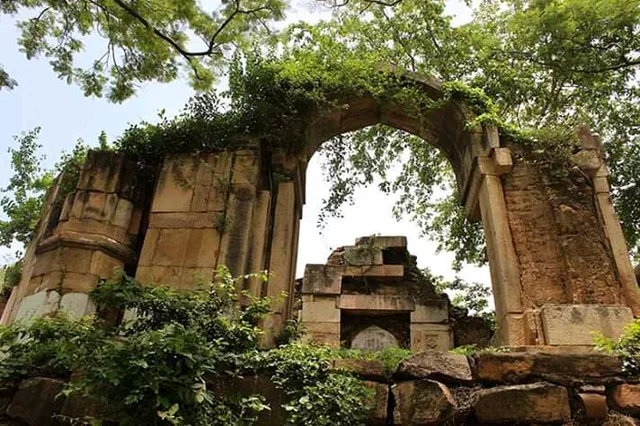
 Learn more insights from Wanderboat AI.